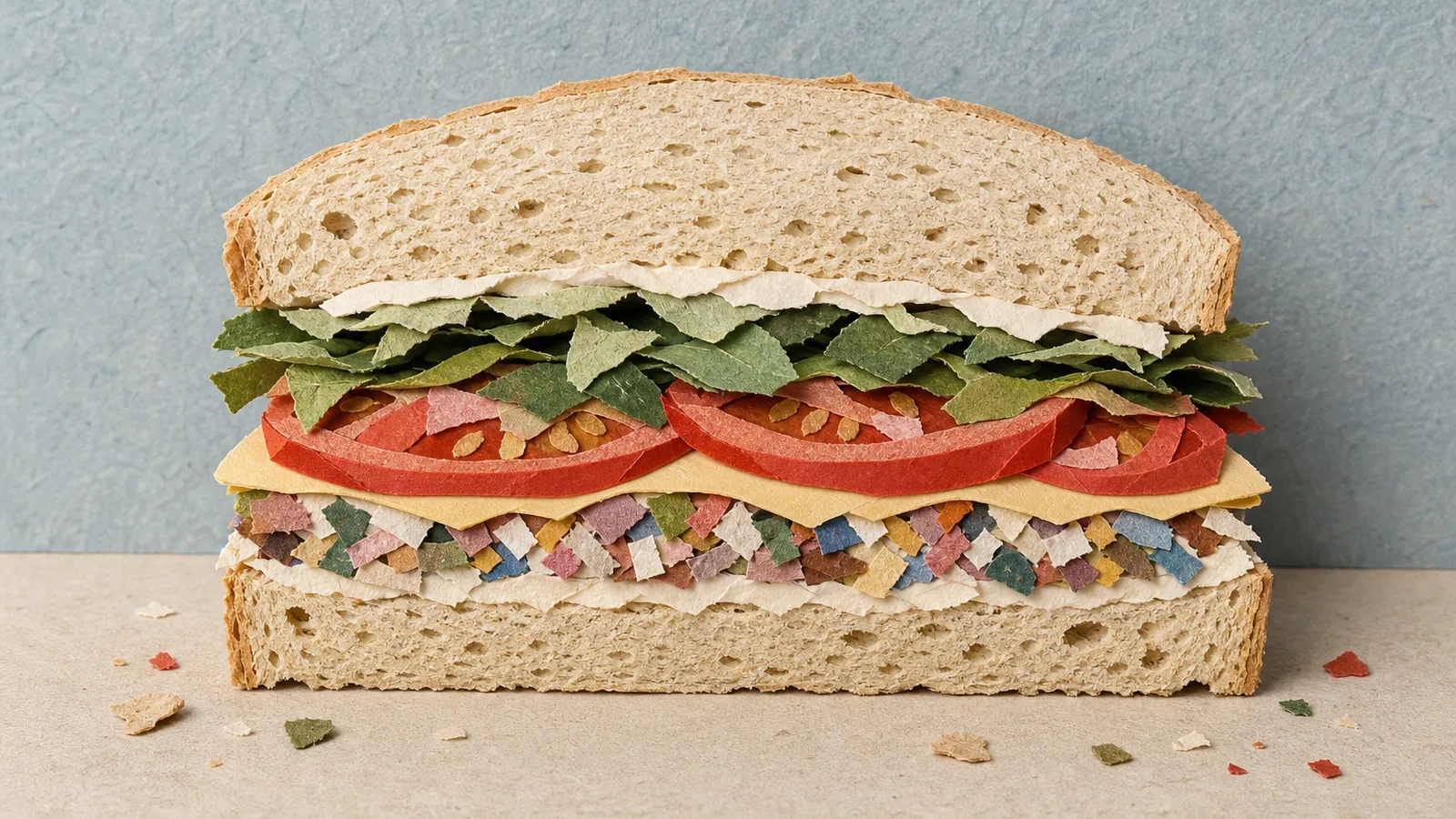
I keep going back to one number from a New England Journal of Medicine review this May, because it rewrites what nutrition science is even supposed to be doing. Your food contains more than 139,000 distinct molecules. The federal databases that train nutritionists and underwrite dietary guidance track about 150 of them. That is roughly one tenth of one percent. Every sandwich, every bowl of soup, every supplement gummy you have ever swallowed was a chemistry event a thousand times more complicated than the label admits, and we have been writing public dietary advice off the wrong end of that ratio.
The review, Chemical Complexity of Food and Implications for Therapeutics, is by Giulia Menichetti, Albert-László Barabási, and Joseph Loscalzo. They built a curated library of more than 139,000 unique compounds across roughly 3,000 foods and mapped those compounds against the human proteome. Their finding, the one that should be on the front of every nutrition-textbook revision, is that dietary molecules interact with nearly half of all human proteins, and roughly two thousand of those food compounds share structural backbones with already-approved drugs. You are not just eating macronutrients. You are dosing yourself with a sprawling, evolutionarily tuned pharmacy that nobody mapped before because nobody had the tools, or the budget, to bother.
Barabási, the Northeastern University network scientist, has been calling this gap “nutritional dark matter” for years, and the analogy is sharp, as nutrition professor David Benton laid out in The Conversation last August. Astronomers infer cosmological dark matter from its gravitational tug on things they can see. Nutritional dark matter works the same way: standard nutrition databases and food labels do not track most food compounds, but the effects of those compounds on disease risk, longevity, and drug response keep showing up in the data once anyone bothers to look. The 2019 Nature Food perspective where Barabási’s group first staked out this argument used a phrase I have not been able to shake since: “the unmapped chemical complexity of our diet.” Six years later, NEJM is publishing the same critique with more receipts.
The reason this matters at the kitchen-table level is that mechanism is where nutrition science has been quietly snapping in half. Take TMAO, trimethylamine N-oxide. It is a metabolite produced not by you but by gut bacteria when they encounter compounds in red meat and eggs, and elevated levels track with cardiovascular disease risk. A 2022 paper in npj Biofilms and Microbiomes found that allicin from raw garlic reduces TMAO production by shifting the gut community responsible. That is not a story about red meat or about garlic on their own. It is a story about the microbe sitting between them rewriting your dinner before your bloodstream sees a thing. Or take ellagic acid, the compound in pomegranates and walnuts that you do not directly use. Your gut bacteria convert it into urolithin A, which a 2019 Nature Metabolism trial showed is safe in humans and induces a molecular signature of improved mitochondrial health. The thing on the food label is the precursor. The thing doing the work is a metabolite the bug made. None of that fits on a Nutrition Facts panel, and none of it survives a trial design that asks “does antioxidant X in a pill prevent cancer.”
Now zoom out. If 139,000 food molecules act on roughly half the proteome and only about 150 are on the books, the math is brutal: nutrition science has been arguing about something like one tenth of one percent of the chemistry. That is my arithmetic on the NEJM numbers, not a quote from the paper, but it explains the great nutrition reversals far better than “science evolves.” The decades-long crusade against dietary fat collapsed when the trials kept failing to show a clean cardiovascular benefit, because the operative chemistry was apparently elsewhere in the diet. The antioxidant-supplement boom of the 2000s ended after large randomized trials of isolated vitamin pills found no benefit and, in some cases, real harm, because antioxidants in a capsule are not the same chemical event as antioxidants in a pomegranate metabolized by your microbes. Mediterranean-style eating, by contrast, has held up in trial after trial, and my read of the foodome work is that it holds up precisely because it delivers molecules in networks the gut can do its part of the chemistry on. Pull the molecule out, package it in a tablet, and the signal evaporates.
The implications hit hardest where the regulators have been napping. The FDA reviews additives one compound at a time and polices labels; it does not require, and does not run, foodome-scale chemistry on the actual products sold. The USDA’s reference databases, the ones that underwrite every dietary guideline and train every clinical nutritionist, still track on the order of 150 nutrients per food. Meanwhile, ultraprocessed foods deliver around 55 percent of American calories in the most recent CDC NCHS data brief, with kids running higher still, and the formulations are explicitly engineered for shelf life, palatability, and satiety hijacking, with additive loads and processing-derived compounds that no federal database resolves at foodome scale. The current public-health stack cannot see, let alone evaluate, most of what is in the dominant American diet. The MAHA-camp gripe that federal nutrition science has failed the country on ultraprocessed foods is not a fringe complaint. It is, by my reading, the same gap the NEJM review describes from a different angle, with different vocabulary, and a longer reference list.
And here is the part that ought to embarrass the funders: the people trying to close this gap are out begging. Barabási’s group has gone to the Federation of American Scientists with a pitch for a Focused Research Organization to build the Foodome, an open-access compendium of food compounds at scale. The proposal’s own justification is bracing: “normal funding channels are generally unable to offer sustained support for a project of this size,” academic institutions reward short-term publications, and venture capital sees the timeline as “too far from the market.” Translation: building a public chemical map of food does not pay quarterly, so neither the agencies nor the markets fund it. As for the companies selling the processed food, ask what their incentive looks like. A public, open-access foodome would let outsiders audit those formulations down to the metabolite for the first time. There is no version of that audit that goes well for an industry whose product strategy lives in the unmapped tail of the chemistry.
What I take from this, plainly: I am going to keep paying close attention to whole-food, mechanism-rich research and a lot less to the “one new study finds nutrient X causes or cures Y” press cycle, because the press cycle is operating on a fragment of the actual chemistry and the headlines age accordingly. I am going to read ultraprocessed-foods skepticism as the conservative position, not the radical one, because the radical position is the assumption that 150 numbers describe what 139,000 molecules are doing inside us. And I am going to watch the Foodome project, because the day a real public chemical map of food exists is the day labels, dietary guidelines, and industry health claims become auditable in a way they simply are not now. A lot of comfortable nutritional advice and a lot of comfortable food-industry talking points stop being defensible on that day. It cannot come soon enough.
Sources
- NEJM – Menichetti, Barabási, Loscalzo, “Chemical Complexity of Food and Implications for Therapeutics” (May 2025)
- Nature Food – Barabási, Menichetti, Loscalzo, “The unmapped chemical complexity of our diet” (2019)
- The Conversation – David Benton, “What exactly are you eating? The nutritional ‘dark matter’ in your food” (August 29, 2025)
- npj Biofilms and Microbiomes – “Atherosclerosis amelioration by allicin in raw garlic through gut microbiota and trimethylamine-N-oxide modulation” (2022)
- Nature Metabolism – “The mitophagy activator urolithin A is safe and induces a molecular signature of improved mitochondrial and cellular health in humans” (2019)
- CDC NCHS Data Brief No. 536 – Ultraprocessed food consumption, United States, August 2021–August 2023
- Federation of American Scientists – Foodome Project FRO proposal