For years I filed “eat more whole grains” under advice you nod along to and then quietly ignore, somewhere between “drink more water” and “get more sleep.” It is the beige end of nutrition, the fiber sermon on the side of the cereal box, the thing your grandmother trusted. Then 87 randomized trials put an actual number on that bowl of oats, and what stopped me was not that whole grains help. It was how many things they moved at once, and how ordinary the dose turned out to be.
On September 15, the European Heart Journal published what its authors call the largest and most comprehensive meta-analysis of randomized trials on wholegrain intake and cardiovascular risk factors to date. The team, led by Dr. Helda Tutunchi at Tabriz University of Medical Sciences in Iran, pooled 87 controlled trials covering 6,529 participants across Asia, Europe, North America, Australia and Brazil. And they chased the question most nutrition coverage skips: not just whether whole grains help, but how much you actually need.
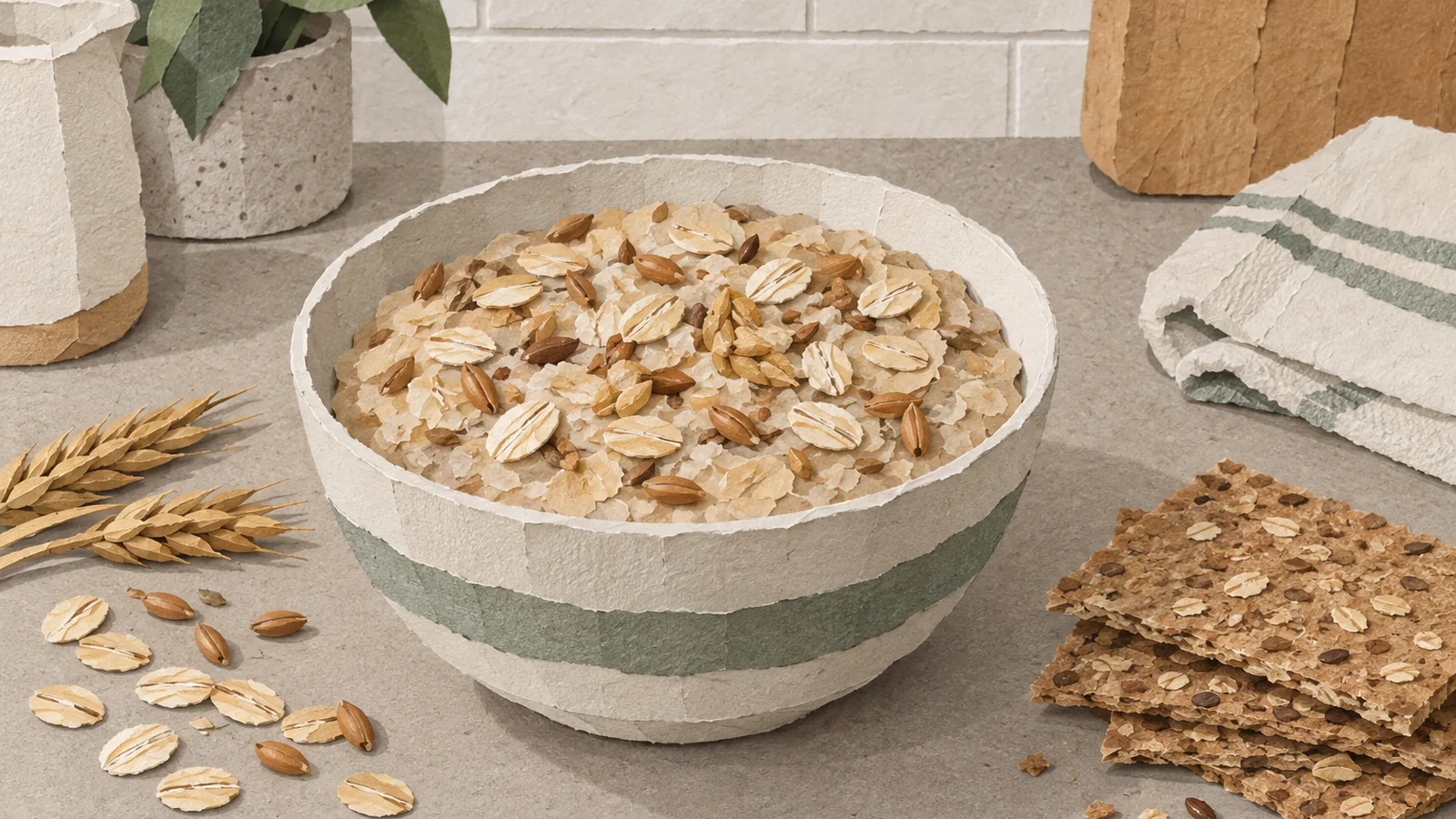
The answer is a range, not a slogan. Benefits started showing up around 30 to 40 grams a day (dry weight), but the strongest, most consistent effects clustered at 60 to 100 grams, roughly four to six servings. The researchers put that in food you already recognize: a bowl of oatmeal, a sandwich on wholegrain bread, a serving of brown rice across a day. Nothing exotic. Nothing you order online.
And it did not win by doing one dramatic thing. It nudged five different things at the same time, which is a stranger and more interesting way to help a heart. The meta-analysis reports high-certainty evidence for drops in body weight, waist circumference, total cholesterol and interleukin-6, a marker of inflammation, plus moderate-certainty improvements in LDL cholesterol, triglycerides, systolic blood pressure, fasting blood glucose, and insulin resistance. Weight, pressure, lipids, sugar, inflammation, all of them, gently, together.
Sit with that cluster, because it is the same one medicine usually treats one prescription at a time. A statin for the cholesterol. A blood-pressure pill for the pressure. Metformin for the glucose. A GLP-1 injection for the weight. Four drugs, four copays, four side-effect profiles, each number its own patented problem. And here is an unpatentable food, the cheapest thing in the aisle, moving the whole panel at once.
So why would one food reach into the gut, the liver, the bloodstream and the waistline all at the same time? Because whole grain is not one thing. It is the intact package, the bran and the germ and the starchy endosperm still in their original proportions, which is exactly what refining strips out. That structure is the mechanism.
Start in the gut. The fiber slows how fast glucose pours out of a meal and into your blood, so the sugar and insulin numbers ease. The viscous fiber in oats and barley sits in the gut and grabs bile acids, which forces the liver to pull cholesterol out of circulation to make more, so the LDL falls. And the fiber that survives all the way to the colon gets fermented by your gut microbes into short-chain fatty acids, the compounds tied to calmer, lower-grade inflammation, the likeliest reason that IL-6 number came down. Wait, why does the same handful of fiber quiet the liver, the blood sugar and the gut at once? Because it was never working on a single organ. It was changing the terrain the whole system runs on. Tutunchi said it plainly: whole grains help through several modest improvements acting together, rather than one large effect on a single risk factor.
The other thing I kept poking at is the ceiling. Benefits climbed to that 60-to-100-gram band and then flattened, and almost no trial tested above 140 grams a day, so more is not endlessly better. And that curve is not a quirk of one paper. A separate 2022 meta-analysis of eleven long-term cohort studies, nearly half a million people, tied higher whole-grain intake to about a 21 percent lower risk of type 2 diabetes, with the benefit steepening for each extra 50 grams a day and an optimal intake landing right around 60 grams before the returns shrank. Different design, a decade apart, a different endpoint, and still nearly the same sweet spot. That convergence is what makes me take the number seriously.
Now the honest part, because enthusiasm is not evidence. These 87 trials measured risk factors, the dials on the dashboard, not the crash. Nobody counted heart attacks or deaths, and the trials were short: most ran about eight weeks. Eight weeks can show whole grains move your cholesterol. It cannot show they keep you off the cardiac ward in twenty years. A statin, whatever you make of the industry that sells it, at least has hard-outcome trials behind it. Whole grain has strong surrogate signals and a stopwatch that stops too soon.
But notice why that gap exists. We have decades of long-run, hard-endpoint data on drugs and eight-week snapshots on barley because there is a fortune in patenting a molecule and nothing in patenting a grain that has fed people for ten thousand years. The announcement does not say who funded this analysis or what the authors’ financial ties are, and food research almost never gets the megatrials a drug launch commands. That asymmetry proves nothing on its own. It is just worth seeing clearly the next time someone tells you the serious evidence always sits on the side of the prescription pad.
I am not going to swap a medication anyone actually needs for a cereal bowl, and neither should you. But 60 to 100 grams is not a supplement I have to buy or a protocol I have to decode. It is oatmeal, brown rice, a wholegrain sandwich, food already in the cupboard. So I have started measuring it instead of vaguely intending to, and I am hitting the four-to-six-serving mark on purpose now, because the downside is a rounding error and the upside just moved five numbers I care about at once.
Sources
- European Heart Journal – “Whole-grain consumption and cardiometabolic risk: a meta-analysis of randomized trials” (2026)
- EurekAlert / European Society of Cardiology – “Four to six servings of wholegrain per day lowers risk factors for heart disease” (2026)
- ScienceDaily – “Scientists find the whole grain ‘sweet spot’ for better heart health” (2026)
- News-Medical – “Eating four to six wholegrain servings daily protects heart health” (2026)
- Food Science & Nutrition – whole grain intake and type 2 diabetes risk, dose-response meta-analysis of cohort studies (2022)