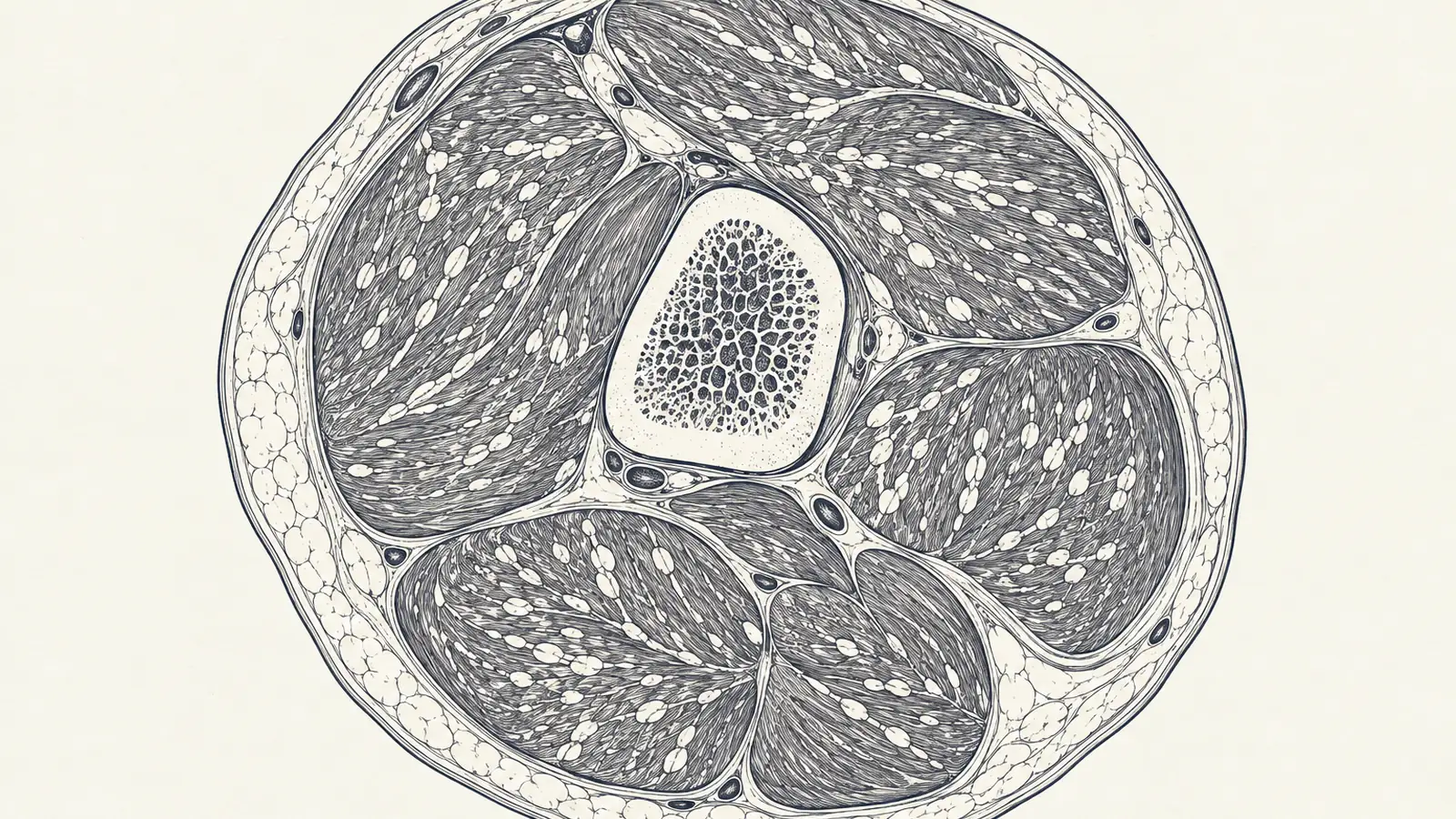
For years I believed something I never once bothered to check: that a calorie is a calorie, and if the number on the label matched, whatever the food did inside you would match too. It is the tidiest idea in nutrition. It is also, judging by a set of MRI scans out of the University of California, San Francisco, blind to something the scanner can see plainly. The more ultra-processed food a person eats, the more fat turns up marbled inside their thigh muscle, and counting the calories does not make that fat disappear.
Researchers led by Zehra Akkaya, a radiologist at UCSF, scanned the legs of 615 adults and did what most diet studies never bother with: they looked inside the muscle. Not the fat you can pinch, not the fat draped over the belly, but the fat that seeps into muscle tissue itself, threading between the fibers like the marbling in a cut of steak. What they found, published in April in the RSNA journal Radiology, is that the more ultra-processed food someone ate, the more of that hidden fat they carried in their thighs. And it held after the team adjusted for calorie intake, fat intake, physical activity, and the usual demographic suspects.
So the calories were accounted for, and the muscle fat showed up anyway. That is the line I keep going back to.
Who were these people? It matters. The 615 came from the Osteoarthritis Initiative, a long-running cohort funded by the National Institutes of Health and the National Institute on Aging. Average age around 60, average BMI 27, squarely in the overweight range but nowhere near the extremes. None of them had knee osteoarthritis showing up on imaging yet. These are the people in the waiting room before the diagnosis, not after it. And on average, roughly 41 percent of what they ate was ultra-processed: the frozen pizzas, the mass-produced breads, the breakfast cereals, the reformulated sugar-and-starch constructions that make up close to half the American plate.
The imaging was the clever part. Using standard T1-weighted MRI of the thigh, the team could tell clean muscle from muscle streaked with fat. Radiologists call that infiltration intermuscular adipose tissue, and it is not a cosmetic detail. The ScienceDaily writeup is careful here: this fatty degeneration may weaken the support structures around the knee, which is why Akkaya’s group went hunting for it in people who did not have the disease yet. Marbled muscle is the kind of tissue you want to catch early, because around a joint it means less of the living scaffolding that holds things stable and absorbs load every time you take a step.
Here is the question I could not put down. Why would ultra-processed food specifically drive fat into muscle, above and beyond the calories it delivers? If it were only about energy, the calorie adjustment should have flattened the effect. It didn’t. So something about the food itself, not merely its arithmetic, seems to be doing this.
This is where I have to be careful, because the study shows an association, not the machinery behind it. But the machinery researchers suspect is worth walking through, and it is genuinely strange in the good way. Ultra-processed food is not just dense; it is pre-broken-down. The starches are milled to dust, the fiber stripped, the structure that would normally slow digestion demolished before the food reaches your mouth. So it pours into the gut fast, spikes blood sugar and insulin hard, and does it again and again across a day. Muscle bathed in that kind of signaling can start to lose the plot metabolically: insulin resistance sets in, the tissue stops cleanly burning fat for fuel, and lipid begins to collect where it does not belong, including between and inside the fibers. Layered on top, the emulsifiers and additives that make these products shelf-stable appear to nudge the gut toward a low-grade inflammatory state, and inflammation is one of the reliable engines of fat settling into muscle. None of that is on a calorie label. All of it is the plausible route that could put fat where this MRI found it.
That route is a hypothesis, not a verdict. This is a snapshot, not a film: cross-sectional data can show that heavy ultra-processed eaters have fattier thigh muscle, but it cannot, by itself, prove the food carved the fat in rather than the two simply traveling together. Fair. But the finding lands in the middle of a growing pile pointing the same way, and that pile is hard to wave off. Ultra-processed diets have already been tied to higher mortality and to cancer. This study adds a physical, visible place the harm may be collecting, and shows it to you in grayscale.
It is worth saying who paid for this, because it tells you something. There is no drug company here, no snack conglomerate underwriting a convenient result. The dataset is public and federally funded, which is exactly why a finding like this gets to exist at all. Nobody markets “eat less packaged food.” There is no product, no patent, no sales force behind the message, which is precisely why it has spent decades losing the shouting match to the calorie model that lets industrial food off the hook. “Just eat less and move more” was always a comfortable frame for the people selling the food, because it put the failure in your willpower instead of in their ingredients. Akkaya’s own framing goes straight at that: weight-loss regimens, she said, “should take into account diet quality beyond caloric restriction and exercise.” Out of researcher-speak: two thousand calories of real food and two thousand calories of reformulated slurry are not doing the same thing to your body, and the difference is now visible on a scan.
What I keep circling back to is that this fat is silent. You cannot feel it. It does not move the number on the scale in any way you would notice, and it does not announce itself until, years later, a knee starts to go. That is what changed how I think about it. I never once worried about the fat inside my own thigh muscles, because I did not know it was a place fat could hide. Now I do. I am not going to start counting the packaged percentage of my plate to the decimal. But I have already quietly moved the one thing this study says the calorie math was blind to, and when the choice is between something my grandmother would recognize as food and something engineered to survive a year on a shelf, I am reaching for the first one. I am not waiting for a randomized trial to give me permission.
Sources
- Radiology (RSNA) – Akkaya et al., “Ultra-processed Foods and Muscle Fat Infiltration at Thigh MRI: Data from the Osteoarthritis Initiative” (2026)
- RSNA News – “People Who Consume Ultra-Processed Foods Have Worse Muscle Health” (April 2026)
- ScienceDaily – “Ultra-processed foods linked to hidden muscle fat that may threaten your knees” (Sept 2026)
- BMJ – “Ultra-processed foods linked to higher mortality” (2024)
- The Lancet Regional Health – Europe – “Ultra-processed foods and cancer” (2024)