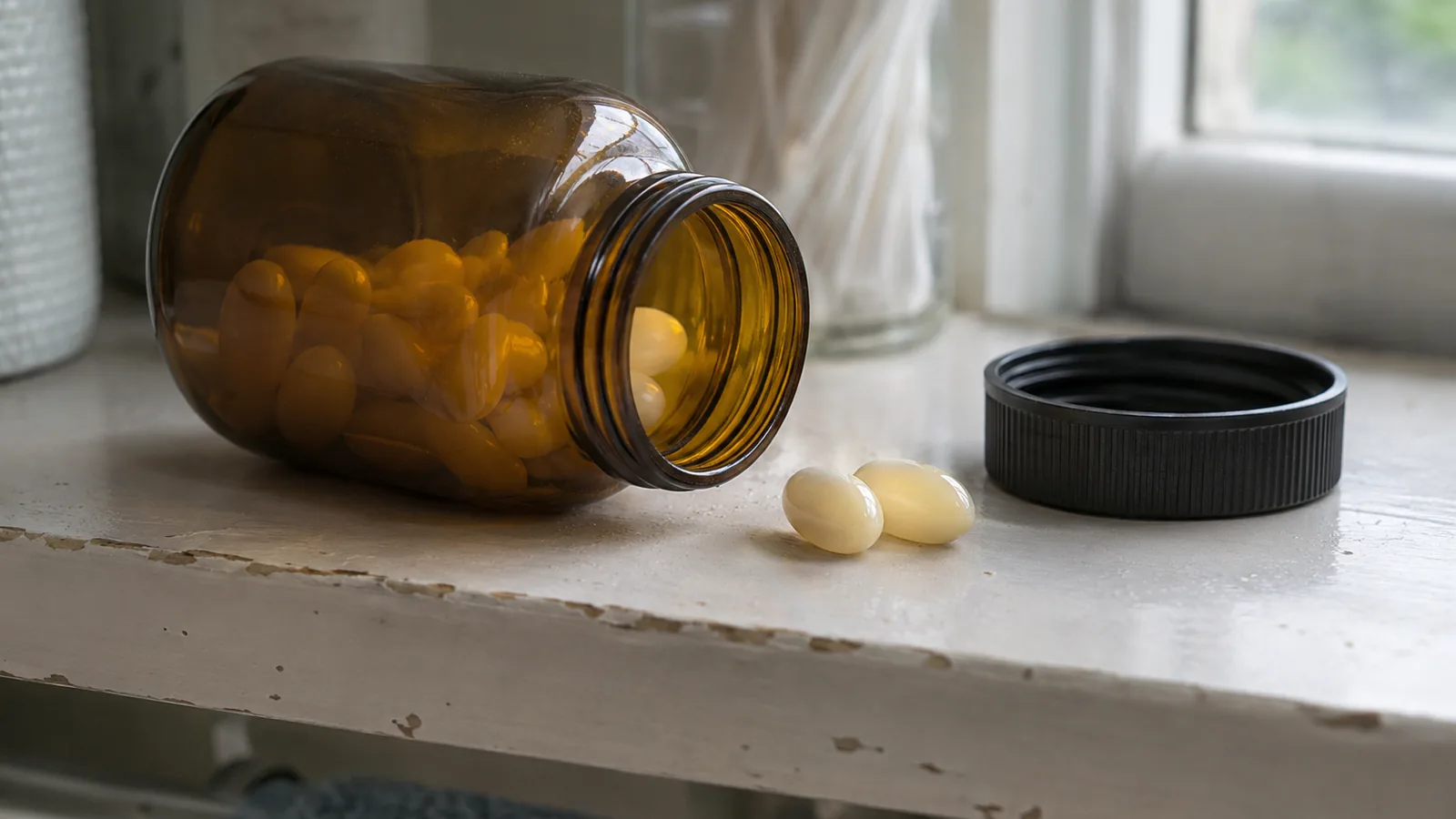
The patients who did best in a small psoriasis trial out of Beijing were the ones who walked in with bad cholesterol. All 24 of them spent 12 weeks applying the same prescription ointment, a calcipotriene and betamethasone combination dermatologists have handed out for years, and half of them also took a pill twice a day. The pill was pantethine, a derivative of vitamin B5 that has sat on supplement shelves for decades, usually sold to people trying to nudge their LDL down without a statin.
The pantethine group improved more on psoriasis severity scores than the group on ointment alone, according to the Rockefeller University Press summary of the paper, and the gain was concentrated among patients whose blood cholesterol was high at baseline. Patients with high cholesterol pulled ahead. Patients with normal lipids, StudyFinds reported, showed little difference between the two arms. No treatment-related side effects were reported.
The trial sits at the end of a long chain of laboratory work by a group led by Wei-Na Zhang of the State Key Laboratory of Biomedical Analysis in Beijing, with co-authors at the First Medical Center of Chinese PLA General Hospital, published in the Journal of Experimental Medicine. Their question was why certain immune cells in psoriasis behave like a smoke alarm nobody can switch off, and their answer runs through cholesterol.
An enzyme that eats the supplement
The cells in question are dendritic cells, the immune system’s scouts, which pick up signs of trouble and present them to T cells, which then mount the attack. In psoriasis that attack lands on the skin and produces the thick, scaling, inflamed plaques patients know too well.
Zhang’s team found that dendritic cells from people with psoriasis, and from people with several other autoimmune conditions, carried unusually high levels of enzymes called Vanins, whose job is to break pantethine down, converting it into vitamin B5. Too much Vanin activity drains the cell’s pantethine supply, and the researchers traced what follows: cholesterol and lipid rafts, the cholesterol-dense patches that cluster signaling machinery on a cell’s outer membrane, pile up on the surface, and a dendritic cell loaded that way becomes hyperactive and far more eager to switch on T cells.
The mouse work is the strongest part of the package. Mice whose dendritic cells lacked Vanin developed milder psoriasis-like inflammation, and a Vanin-blocking compound called RR6 prevented the disease from developing at all. “We found that pantethine administration effectively alleviated psoriasis in mice,” Zhang told News-Medical. In the dish, pantethine and RR6 also calmed dendritic cells taken from human patients.
What the paper proposes, in other words, is that some autoimmune inflammation is partly a metabolic fault inside one cell type, and that topping up a cheap nutrient derivative can turn the volume down.
A risk factor that may be doing more than riding along
People with psoriasis carry more lipid trouble than everyone else, a fact that usually gets filed as a cardiovascular problem to mention to the patient’s internist. A 2023 meta-analysis in Cureus put their odds of dyslipidemia at 1.40 times those of people without the disease (95 percent confidence interval 1.24 to 1.58), although the pooled studies disagreed with one another enormously, with heterogeneity of 97 percent. The Beijing work suggests the arrow may run in both directions, with cholesterol inside the immune cell helping to drive the skin disease rather than merely keeping it company.
| Result | Value (OR) | Lower bound | Upper bound |
|---|---|---|---|
| Psoriasis vs no psoriasis | 1.40 | 1.24 | 1.58 |
Pantethine’s own cholesterol record is modest and comes with an asterisk. In a triple-blinded, placebo-controlled trial published in Vascular Health and Risk Management in 2014, 32 adults were randomized between pantethine and placebo, with the pantethine arm taking 600 milligrams a day for eight weeks and 900 milligrams a day for eight more. At 16 weeks, LDL in the pantethine arm sat 11 percent below baseline, while the placebo arm’s had risen 3 percent. Two of the authors were with Kyowa Hakko USA, which sells the ingredient as Pantesin, and another with a Japanese fine-chemicals company, and Kyowa announced the result under the headline “New Study shows that Pantesin Pantethine significantly lowers bad cholesterol by 11%.” It is a small study with a sponsor’s fingerprints on it, and it is still more than most bottles on that shelf can show.
Statins lower cholesterol far harder, which raises the obvious question of why anyone would bother with a supplement. The authors note that statins have had inconsistent effects on dendritic cell function in past studies, and their claim is narrower than “lower cholesterol, calm the skin.” It concerns one enzyme, one depleted molecule, and cholesterol accumulating on one cell’s membrane.
The human trial is where the claim thins out. It was small, it ran at a single center, and Zhang described it to GEN as an investigator-initiated study showing “encouraging therapeutic efficacy of pantethine as an adjunctive therapy in psoriasis,” then added that the results “should be interpreted as proof-of-concept for clinical feasibility rather than direct mechanistic validation.” The patients improved; nobody has yet shown they improved because of the cholesterol switch the mice revealed. The authors also concede that the evidence for the Vanin pathway in autoimmune diseases beyond psoriasis is still “largely associative.” Pantethine was an add-on to prescription ointment throughout, never a replacement for it.
The treatments it would sit beside are priced on another planet. AbbVie lists the wholesale acquisition cost of one dose of Skyrizi, its psoriasis biologic, at $23,838.42 as of January 6, 2026, with doses generally every three months after the start. The biologics arrived with full Phase 3 packages because a drug with that price can pay for one. Pantethine is an old compound already sold as a supplement, and no company can expect to recoup a large dermatology trial on an ingredient anyone can bottle, which is why the trial this paper calls for is the kind the market is least inclined to buy.
The first one was paid for by the National Natural Science Foundation of China and the Nanhu Laboratory. The second, the one that would tell a dermatologist whether to mention a vitamin-aisle pill to the patient with stubborn plaques and a bad lipid panel, has no obvious buyer.
Sources
- Journal of Experimental Medicine: Cao, Zhang et al., “Vanin-pantethine metabolic axis shapes dendritic cell function and affects inflammatory disorder progression” (2026)
- ScienceDaily / Rockefeller University Press: “Common supplement could help fight psoriasis, scientists discover” (2026)
- StudyFinds: “A pill already in the vitamin aisle may help calm psoriasis” (2026)
- GEN: “Vitamin derivative pantethine alleviates psoriasis symptoms in small human trial” (2026)
- News-Medical: “Vitamin B5 derivative pantethine helps prevent and alleviate psoriasis symptoms in mice” (2026)
- Vascular Health and Risk Management: Evans et al., pantethine and LDL cholesterol, placebo-controlled trial (2014)
- Cureus: Alshahrani et al., psoriasis, dyslipidemia and obesity meta-analysis (2023)
- Kyowa Hakko USA: press release on the Pantesin cholesterol study (2014)
- AbbVie: Skyrizi cost and wholesale acquisition cost disclosure