I had the arrow pointing the wrong way. When I picture a cytokine driving gut inflammation, I picture it pouring an aggressive signal into a tissue, and the fix as turning that signal down. The paper Sonnenberg and colleagues published on November 11 in Nature Immunology describes a circuit that does not work like a volume dial at all. Prostaglandin engages protein kinase A in the gut’s protective cells, and sustained PKA activation depletes them. The signal that keeps those cells doing their job is the same signal that wipes them out when it never lets up.
More signaling, fewer protective cells.
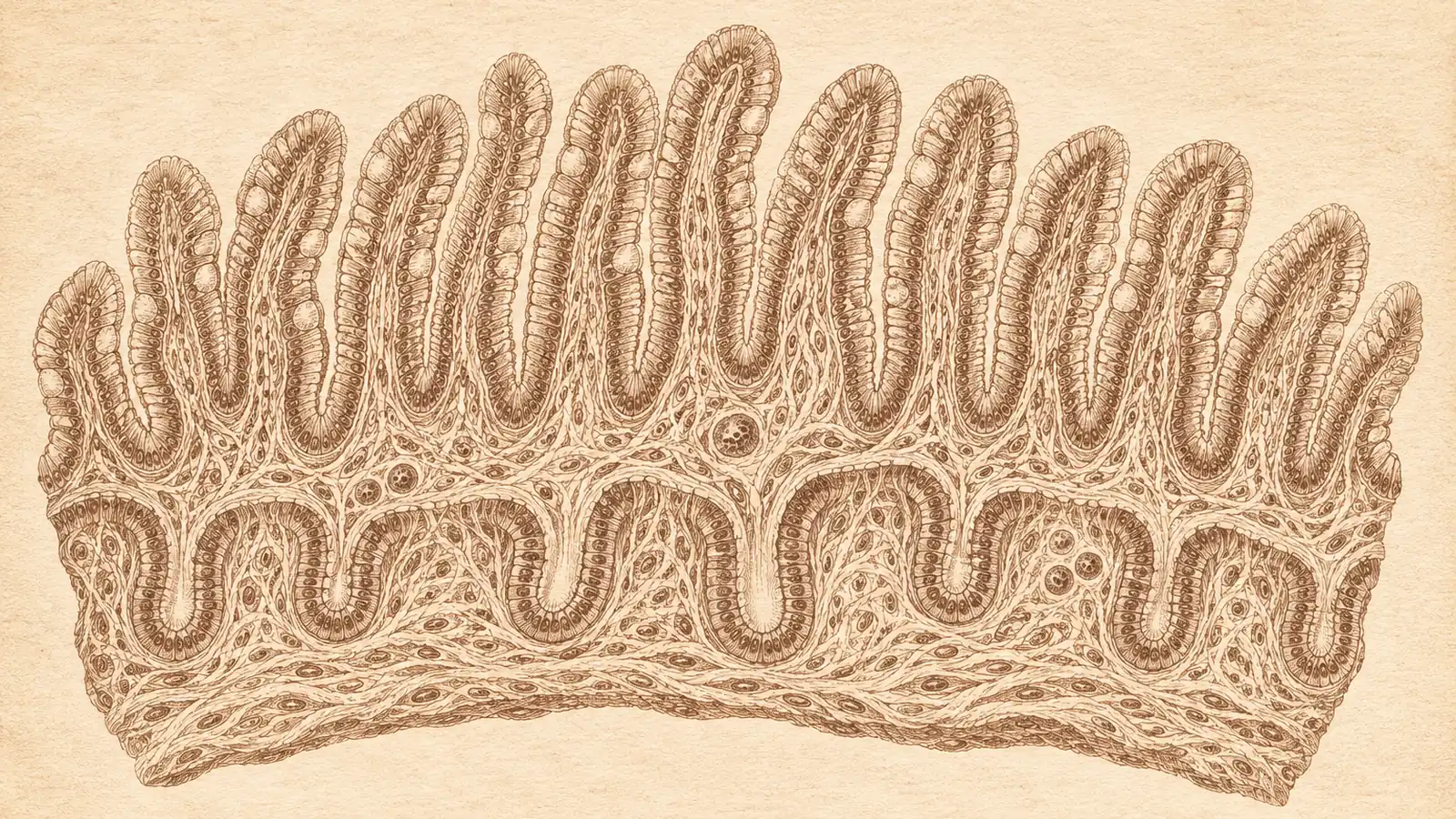
The cells in question are group 3 innate lymphoid cells, ILC3s, and they are the ones I find myself rooting for. They sit in the lining of your intestine, underneath the single layer of epithelium that separates you from several pounds of bacteria, and they do maintenance: they tell the epithelium to tighten its junctions, to pour out mucus, to make antimicrobial peptides. They are not the cavalry. They are the crew that keeps the wall standing so the cavalry never has to come.
So why would one node run protection in one hand and depletion in the other? The answer in this work is not about direction. It is about whether the signal gets held. PKA has to be modulated, not maximized, and a brake that comes off is as dangerous to these cells as a signal that never arrives. More signaling, fewer protective cells. That is the shape of the finding, and it is reported in mouse and human intestinal tissue, not in patients followed over time.
The protective half of this story does not rest on one lab. A separate group reported in PNAS this year that colonic eosinophils crank up COX-2 during colitis, and that the prostaglandin E2 they make lands on EP4 receptors on ILC3s and drives them to produce IL-22, which holds the epithelial barrier. Delete COX-2 in eosinophils alone and the mice lost weight faster, shortened their colons, and showed worse crypt damage in two colitis models. Total ILC3 numbers held steady; the IL-22-producing ones fell. Give those mice a stable prostaglandin analog and severity came back down toward normal. Block EP4 and the prostaglandin benefit disappeared.
COX-2 is not an obscure enzyme. It is the target of the painkillers in everyone’s medicine cabinet. That experiment was a genetic deletion in one cell type in mice, and it says nothing yet about what a week of ibuprofen does to a human gut. But the protective arm of this circuit runs through an enzyme that an entire drug class, the NSAIDs and the COX-2 selectives, exists to shut off on purpose, and I would like someone to go test that in people instead of leaving it as a footnote.
The tempting conclusion is that IL-22 is simply good and the move is to deliver more of it. Work from Marco Colonna’s lab, published in April in the Journal of Experimental Medicine, complicates that. Mice lacking LINGO4, a protein expressed most highly in ILC3s, had a cell-intrinsic IL-22 defect, a dysbiotic microbiota with fewer short-chain-fatty-acid producers, and worse outcomes against C. difficile and Citrobacter rodentium. Those same mice were more resistant to Salmonella Typhimurium, because the IL-22 that protects your barrier also suppresses commensals, and suppressing commensals is how that pathogen clears room to expand. A barrier molecule with a pathogen that exploits it, in mice. Anyone designing an IL-22 therapy should go find out whether that tradeoff follows the drug into humans.
Then there is the finding I keep coming back to, which is also the least glamorous one here. A team reported in Immunity last year that within 48 hours of high-fat feeding, mouse intestinal ILC3s lose capacity to make IL-22, alongside dysbiosis, higher gut permeability, and drops in antimicrobial peptides, mucus and tight-junction proteins. Forty-eight hours, not months of obesity. And the split is in the fat itself: saturated fatty acids impair these cells when they get oxidized, while unsaturated fatty acids sustain IL-22 secretion by being packed into lipid droplets. Same cells, same tissue, opposite outcomes depending on which fat the gut was handed. In mice, on a controlled diet, with no human version of that experiment yet.
Now hold the mechanism next to the market. IL-23 blockade is what an expensive corner of gastroenterology was built on, and the returns are thinner than the prices. In a cost analysis published this year in Advances in Therapy, the placebo-adjusted clinical remission rate at week 52 in moderately to severely active Crohn’s disease was 11.6 percentage points for risankizumab, an IL-23 blocker, against 17.0 points for vedolizumab, which works on a different pathway. Roughly one extra remission per nine patients treated, over a year, versus placebo.
The modeled cost of getting there was €285,939 per remission for risankizumab and €114,098 for vedolizumab, at Italian list prices.
Read that analysis with your eyes open. Takeda, which sells vedolizumab, funded it; three authors are Takeda employees and two are consultants the company paid. There has never been a head-to-head trial, the comparison is indirect, and the 5.4-point gap between the two drugs was not statistically significant (p = 0.497), so this does not establish that risankizumab works less well. What survives the sponsorship is the absolute figure on the IL-23 arm, because that one does not depend on the comparison: eleven or twelve patients in a hundred beat placebo into remission at a year, and the modeled price of each of those remissions runs into six figures.
That gap between the slogan and the ledger is where the drug class lives. A cytokine’s name went on the label and the bill while the account of what that cytokine does to the gut’s protective crew is still arriving in late 2026. The new mechanism is not a refutation of IL-23 blockade. If IL-23 strips the brake, then blocking IL-23 might help restore it, which is the honest reading and also an untested hypothesis. But a node that has to be held rather than switched is a hard target for a blunt antibody, and the protective arm of the same circuit, prostaglandin into PKA, has nothing like the same money chasing it. Nobody has tried tuning this switch in a person, and I would want the human arm of this work to grow considerably before anyone builds a pipeline on it.
So no, I am not dropping ibuprofen on the strength of a mouse colon, and I am not treating olive oil as a therapy. But I do not have a drug that modulates my ILC3s, and the only input in this whole circuit I control three times a day is the fat on my plate. When my gut is already unhappy, that is the variable I move, and I move it toward the olive oil.
Sources
- Nature Immunology – “PKA signaling controls ILC3 homeostasis and IL-23-mediated inflammation in the gut” (2026)
- PNAS – “Eosinophil-derived COX-2 protects against experimental colitis through the PGE2-IL-22 axis” (2026)
- Journal of Experimental Medicine – “LINGO4 coordinates ILC3-intrinsic IL-22 production and microbiota-mediated ILC3 homeostasis” (2026)
- Immunity – “Acute exposure to high-fat diet impairs ILC3 functions and gut homeostasis” (2025)
- Advances in Therapy – Brook, Hardern, Langer, Viti & Nucit, “Cost Per Remission of Vedolizumab Versus Risankizumab … in Italy” (2026), funded by Takeda
- Nature Immunology – Zhou et al., “Group 3 innate lymphoid cells produce the growth factor HB-EGF to protect the intestine from TNF-mediated inflammation” (2022), vol. 23, pp. 251-261, PMID 35102343