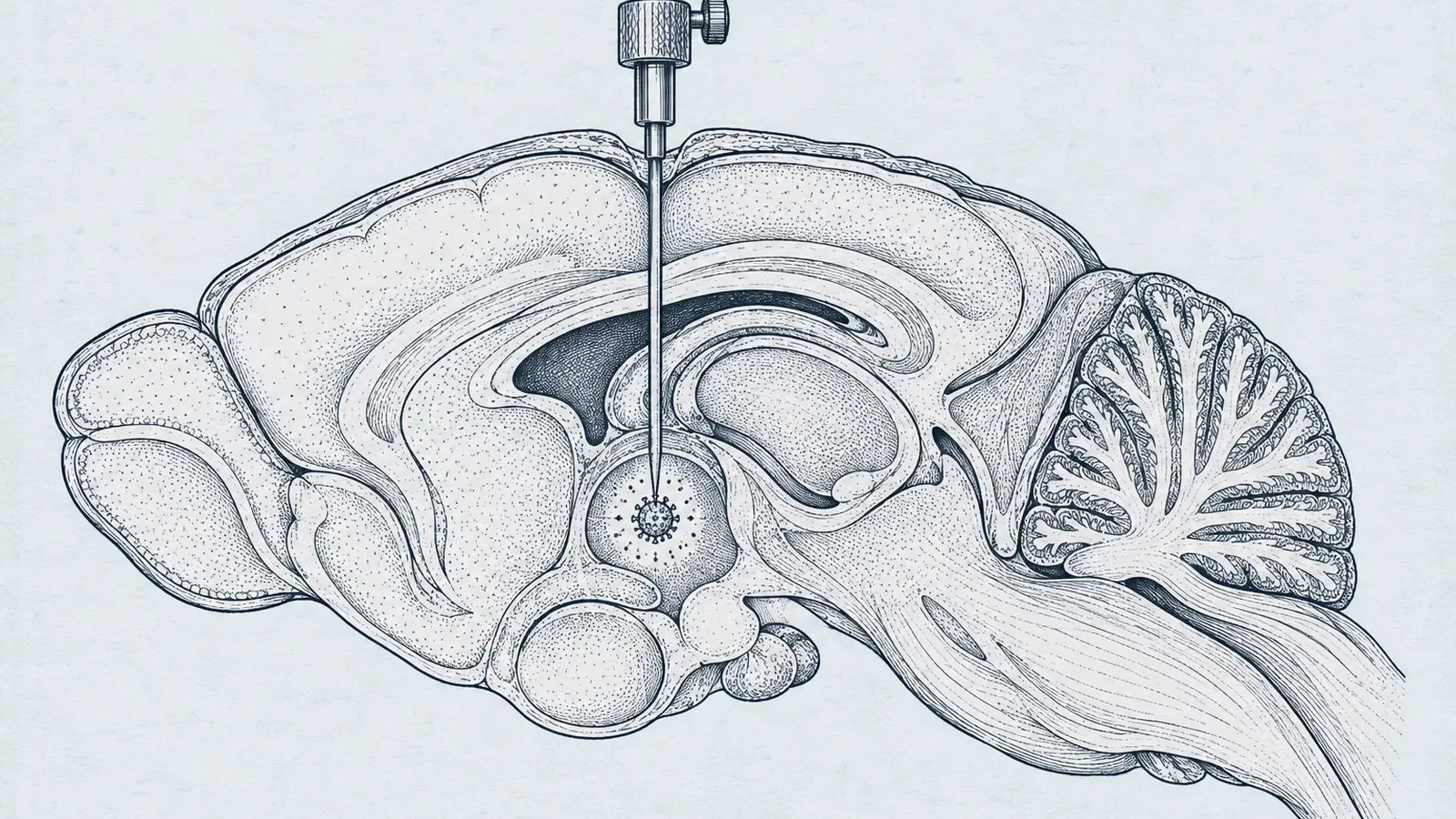
I clicked the headline ready to be annoyed. “Scientists restore a brain protein and reverse signs of aging in mice,” it said, and the version going around this week files it under the anti-aging supplement you can order online tonight. Here is what that framing quietly drops: the reversal that actually thickened skin and rebuilt bone took a virus carrying a gene, stereotaxically injected into a mouse’s brain. The pill you can buy reached the memory and left everything else exactly as old as it was.
The underlying work is not even new. It was published in March 2023 in PLOS Biology by Lige Leng, Jie Zhang, and colleagues at Xiamen University in China, and every time it resurfaces it gets a little more supplement-shaped. That is the swap I want to slow down on, because the part they cut is the part doing all the work.
The protein is Menin, and it lives in the ventromedial hypothalamus, a node the size of a rice grain buried deep in the brain. In these mice, Menin fell with age, and its job turns out to be restraint: it clamps onto NF-κB, the master switch for inflammation, and holds it shut. When Menin drops, the brake comes off and the region starts to smolder. Here is where I had to stop and reread. Why would a protein tucked inside one metabolic speck of brain have any say over how thick your skin is, or how much bone you carry on your frame? The study’s answer is that the hypothalamus is not only minding your appetite. It appears to broadcast an aging signal outward to the whole body, and Menin is one hand on that dial.
What makes this more than a correlation is that the team pushed it both ways. Knock Menin down in young mice and they age early: the hypothalamus inflames, bone mass drops, skin thins, learning falters, lifespan shortens. Then run it backward. They built an AAV virus carrying the Menin gene and injected it into the hypothalamus of 20-month-old mice, and 30 days later the treated animals had thicker skin, more bone, better balance, sharper learning, and a survival curve that bent up and to the right. One brain region, one month, and the effects poured out into skin and skeleton.
D-serine is the thread tying the brain half to the memory half. It is a small amino acid that acts as a co-agonist at the NMDA receptor, which is the fancy way of saying it helps neurons talk to each other well enough to lay down a memory. It also shows up in soybeans, eggs, fish, and nuts, and it is sold on supplement shelves, which is exactly why the recirculated headlines reach for it. When Menin fell, the mice made less D-serine in the hippocampus. Restore Menin, and D-serine climbed back alongside the cognitive gains.
So the team ran the obvious test. They gave aged mice D-serine directly, 600 mg/L in the drinking water for three weeks, no gene therapy at all. And it worked, but only halfway. Cognition improved. The physical aging did not budge one bit: the authors write plainly that the rescue “is limited to cognitive improvement, leaving peripheral systems aging phenotypes unchanged.” Thin skin stayed thin. Low bone stayed low. The stuff you can actually swallow reached the memory and stopped there. The full-body reversal, the one in the headline, required an AAV injected into the brain. That is not a supplement. That is neurosurgery on a rodent.
I want to be fair to the compound, because the cognitive signal is not nothing and the safety profile is reassuring. D-serine has already been through human hands: it has been tested in people with schizophrenia at doses from 30 up to 120 mg/kg, and a cross-species review found it well tolerated, with a single participant across all published studies showing abnormal kidney values that resolved on stopping. There is a genuinely strange species gap underneath that: high-dose D-serine reliably wrecks rat kidneys but appears to spare mice, rabbits, and people. So the molecule is not the scary part. The problem is that being safe in a schizophrenia trial tells you nothing about whether it will make a 60-year-old’s bones denser, and this very study says it will not.
The rest of the honest frame matters too, and it is not hidden: these are 20-month-old mice, watched for 30 days, in work funded by the National Natural Science Foundation of China and a stack of other Chinese state programs, with the authors declaring no competing interests. No human has taken D-serine to reverse aging on the strength of any of this. A hypothalamic protein pacing whole-body aging through inflammation is a beautiful, plausible idea, and right now it is an idea living in one lab’s mice.
Would I do anything differently tomorrow? I am not buying D-serine, and I would tell a friend eyeing the supplement aisle the same thing, gently: the data in front of us says the pill reaches your memory at best and your skin and bones not at all, so paying for it to “reverse aging” is paying for a headline the study itself contradicts. What I will do is keep an eye on Menin, because the finding worth remembering is not a product on a shelf. It is that inflammation in one grain-sized hub of the brain may be setting the tempo for the whole body, and that is a thread I would pull long before I would swallow anything.
Sources
- PLOS Biology (PMC) – Leng et al., “Hypothalamic Menin regulates systemic aging and cognitive decline” (2023)
- ScienceDaily – “Scientists restore a brain protein and reverse signs of aging in mice” (2026 recirculation)
- EurekAlert – “Loss of Menin helps drive the aging process, and dietary supplement can reverse it in mice”
- Frontiers in Psychiatry (PMC) – Meftah, Hasegawa & Kantrowitz, “D-Serine: A Cross Species Review of Safety” (2021)