For as long as I have been reading aging science, I treated one idea as bedrock: your DNA frays, the breaks and copying errors pile up over a lifetime, and that slow accumulation is what wears you down. Now a team in Jerusalem is arguing that in the fastest-aging fish they could build, the broken DNA is only half the story, and the other half is the cell mistaking its own shattered chromosomes for a virus and turning its immune guns on itself. I did not plan on rewriting the textbook in my head this week. Here we are.
the body's response to that damage, an exaggerated, chronic inflammatory reaction, that drives much of the degeneration
The work comes from Marva Bergman, Itamar Harel and their colleagues at the Hebrew University of Jerusalem, published in Genes & Development. They took two of the most brutal genetic aging disorders we know, ataxia-telangiectasia and Bloom syndrome, and rebuilt both in a fish. Both are DNA-repair diseases: the cells cannot fix their own genome properly, and the children who carry them age fast and hard. The assumption has always been simple. Repair machinery fails, damage runs wild, the body breaks down. Cause, effect, done.
Except that is not quite what the fish showed. The trouble starts when broken bits of DNA slip out of the nucleus and drift into the cytosol, the watery space inside the cell where chromosomes have no business floating. Waiting there is a sensor called cGAS, and this is the moment the biology genuinely surprised me. cGAS is an immune alarm. Its entire job is to catch loose DNA in the cytosol, because loose DNA in that spot almost always means a virus has broken in. It cannot tell your own shattered chromosome from an invader. So it does exactly what it evolved to do: it screams, and the cell mounts a full antiviral inflammatory response against itself, over and over, with no virus anywhere. Harel is blunt about it: the damage “isn’t acting alone,” and it is “the body’s response to that damage, an exaggerated, chronic inflammatory reaction, that drives much of the degeneration.”
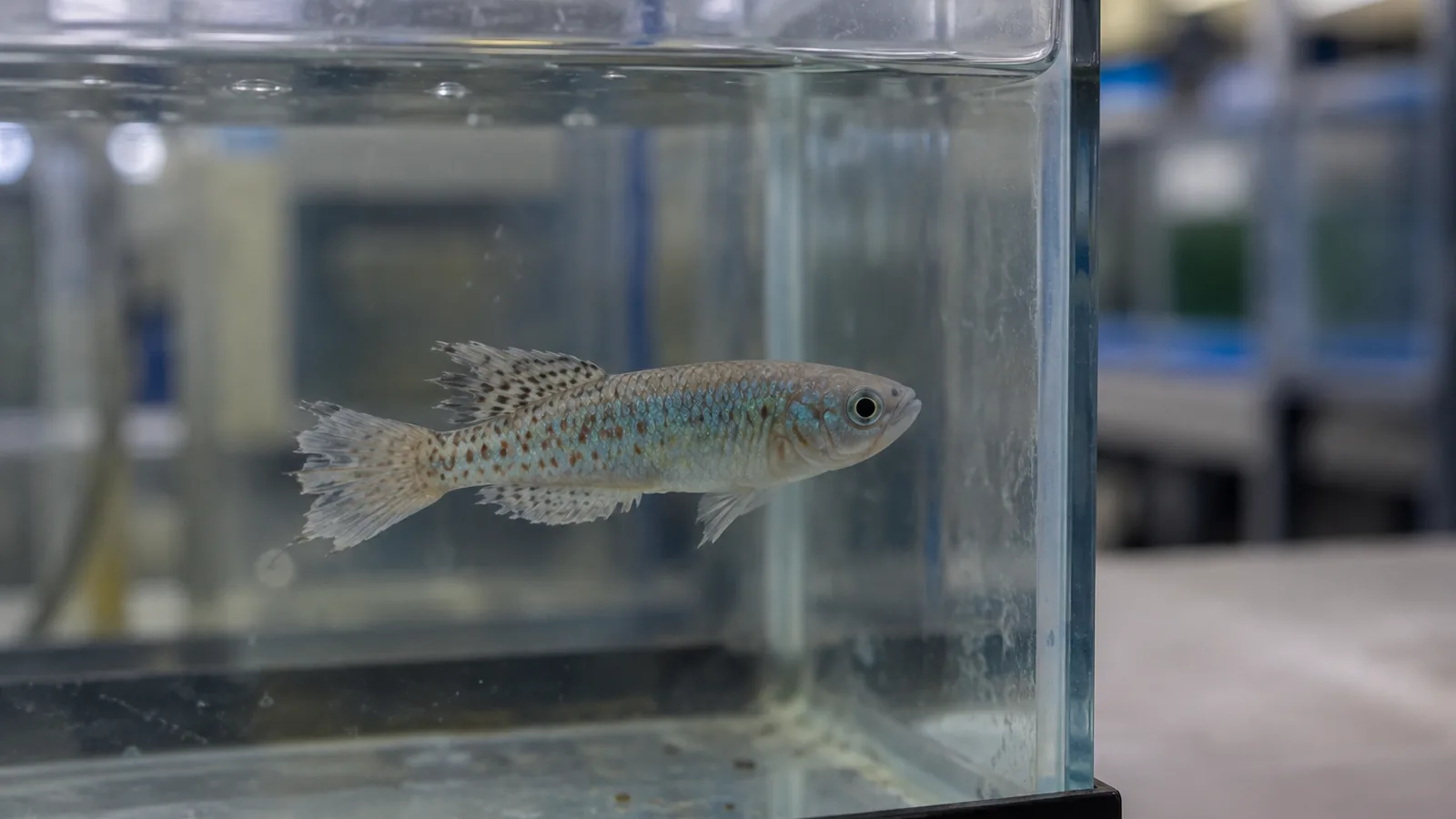
To find out whether that false alarm was a bystander or a driver, they ran the clean experiment. They deleted cGAS in the ataxia-telangiectasia fish, the more severe of the two models, and watched a body that should have been coming apart. The turquoise killifish they use is a small, gorgeous, doomed little animal, one of the shortest-lived vertebrates going, with a natural lifespan of about 4 to 6 months, which is exactly why aging researchers love it. In the fish missing the alarm, the germline failure eased, the liver senescence eased, and the inflammation in the cerebellum, the part of the brain ataxia-telangiectasia wrecks in children, calmed down. Bergman does not undersell it: “We weren’t just slowing decline. We saw broad restoration of tissue function.”
Then it turned in a way I did not see coming. Cutting cGAS did not only quiet the inflammation out in the cytosol. It reached back into the nucleus and improved the genome itself: fewer micronuclei, those little bags of stray chromosome that flag a cell in trouble, better telomere integrity, and a restored pattern of heterochromatin, the tightly wound, silenced DNA that keeps a genome orderly. The sensor was not just raising a false alarm. It was somehow interfering with repair inside the nucleus, making the original damage worse.
So why would the same molecule protect a healthy genome one moment and sabotage a broken one the next? That is the puzzle the paper chases, and it is the part I keep turning over. cGAS plays a dual, context-dependent role. In normal tissue, losing it lets instability creep in, which is why you would not want to be born without it. But in tissue where the repair program is already failing, that same cGAS activity tips from guardian to accelerant, and removing it lets the genome steady itself. Same protein, opposite job, depending on the neighborhood it is standing in.
The killifish result did not land in a vacuum. The cGAS-STING pathway has been closing in on aging from several directions at once. A 2023 paper in Nature showed cGAS-STING driving inflammation and neurodegeneration in the aging brain, and blocking its downstream partner STING quieted the inflamed state of the brain’s immune cells. Two years before that, another group showed that inhibiting cGAS-STING calmed the premature-aging hallmarks in lab-grown ataxia-telangiectasia brain tissue. The Jerusalem work pushes the story out of a dish and a mouse brain into a whole living vertebrate, and adds the twist that the benefit runs partly through the nucleus, not only through the inflammatory switch everyone was watching.
Here is where the same finding turns into its own warning, because cGAS is the tempting target and the reason this is dangerous in the same breath. It is a frontline antiviral sensor, not a spare part, and the fish that thrived without it were living in a tank, not in the world. Quiet that alarm across a whole human body and you have to ask what walks through the door you just stopped guarding. The researchers say so themselves: suppressing cGAS to slow degeneration risks blunting the defense that catches real infections. That trade is the constraint, and it is why I would not read this as a longevity shortcut for anyone who is not already sick with one of these repair disorders, where the risk-benefit math is a different thing entirely.
What this shifts is subtler than a drug, and I think more useful. For decades the field mostly blamed the wreckage itself. This says a good share of the harm is the panic: the body treating its own broken DNA as an enemy and burning itself down in the response. A pile of damage is hard to reverse. An overactive sensor is something you can imagine switching off.
So no, I am not about to hunt down a cGAS blocker to buy myself a few extra years, and I would be wary of anyone selling you one. But I will be watching this pathway more closely than almost anything else in aging right now, and if I had a child with ataxia-telangiectasia, this is the line of research I would be reading every new paper on, because for the first time the false alarm looks like something we might one day be able to tell to stand down.
Sources
- Genes & Development – Bergman et al., cGAS’s dual role in shaping responses to genomic instability (2026)
- PubMed Central – full text, Bergman et al., cGAS dual role in genomic instability (2026)
- ScienceDaily – Scientists find an immune “false alarm” that may drive rapid aging (2026)
- Nature – Gulen et al., cGAS-STING drives ageing-related inflammation and neurodegeneration (2023)
- Aging Cell – cGAS-STING inhibition ameliorates premature senescence in ataxia-telangiectasia brain organoids (2021)
- MedicalXpress – How a misdirected DNA alarm could reshape treatment for rare rapid-aging diseases (2026)