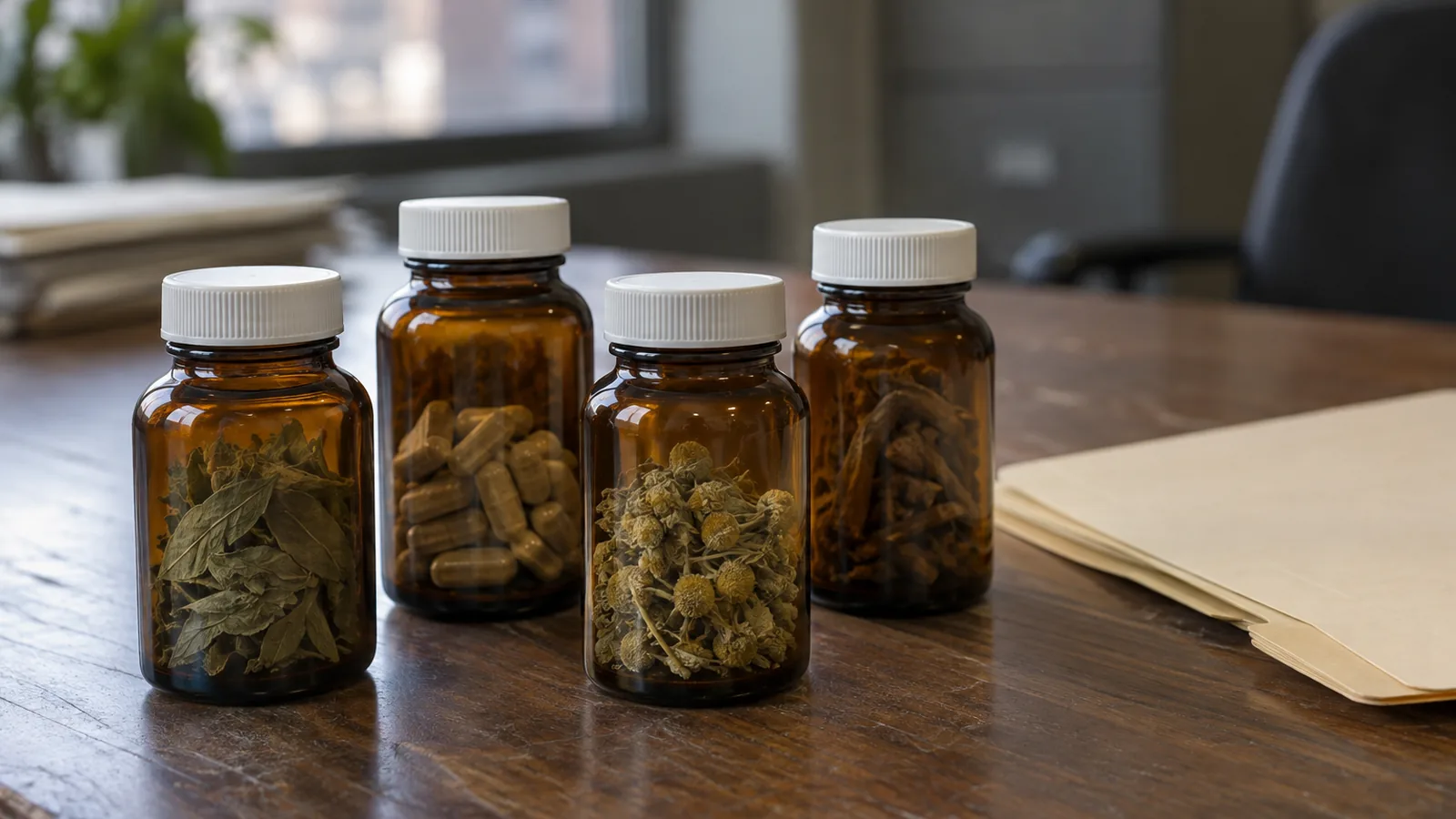
Four. That is how many botanical drugs the FDA has approved in the twenty years since it built a formal pathway for them, and in a normal year the agency clears dozens of conventional drugs without breaking stride. Plant medicine, by the agency’s own accounting, is a rounding error. Now, inside Robert F. Kennedy Jr.’s Department of Health and Human Services, that same agency has asked the public why so little gets through, and the question tells you more than the answer will.
Start with why the count is so low, because it is not a story about plants failing. It is a story about a chassis. American drug approval was built around one idea: a single purified molecule, at one known dose, doing one measurable thing you can hold constant from batch to batch. A botanical is the opposite of that. Green tea leaf, birch bark, the blood-red latex of a South American croton tree, a concentrate of enzymes squeezed from pineapple stems, these are mixtures of dozens or hundreds of compounds whose ratios drift with soil, season, and harvest. When CDER finalized its first botanical drug guidance in June 2004, it was trying to fit a living, variable input onto machinery engineered for chemical purity. The four that squeezed through show how narrow the opening is: Veregen, a green-tea ointment for genital warts, cleared in 2006; crofelemer, the first oral botanical drug, a croton extract for HIV-related diarrhea, in 2012; then a decade of nothing, until NexoBrid, a pineapple-enzyme concentrate for burn wounds, in 2022 and Filsuvez, a birch-bark gel for a rare blistering disease, in 2023. Four drugs from four plants is proof enough that the biology can clear the bar. The drought is the chassis, not the chemistry.
The ask itself is a formal Request for Information, docket FDA-2026-N-9550, published in the Federal Register on September 4. It seeks comment on the barriers researchers hit, on trial designs that can handle complex mixtures, on quality standards, and on whether real-world evidence should count toward approval. That last item is the tell. The reason a whole-plant extract struggles in the standard system is exactly that you cannot always isolate “the active ingredient” and hold it steady across every batch, the same tangle the literature on botanical-drug interactions keeps running into. Asking whether the evidence rules themselves should bend is the first substantive question in the whole exercise.
Here the skepticism has to come in, because an RFI is the cheapest thing a federal agency can do. It is not a rule, not a guidance, not a dollar of funding or a single changed standard. It is a 60-day comment window, closing November 3, plus a joint workshop with the European Medicines Agency on September 25. Agencies collect comments constantly and then let them sit. So the question that decides whether this matters is not what the announcement says. It is what follows it.
Read the framing closely and you can see the fight already built into it. Acting FDA Commissioner Kyle Diamantas said the agency is “committed to modernizing regulatory frameworks to ensure promising, natural health options are evaluated through rigorous science.” The two halves of that sentence pull against each other. “Natural health options” is the language of the movement now running HHS. “Rigorous science” is the language of the framework that approved four drugs in twenty years. If “rigorous” means the same single-molecule standard as before, nothing moves, and the RFI is a press release with a docket number. The whole game sits in which of those phrases wins.
The wire coverage tends to bury the context here, and the context is political. Kennedy has spent years arguing that the FDA has aggressively suppressed vitamins, herbal remedies, and other natural products, and his Make America Healthy Again movement treats that suppression as a central grievance. The botanical RFI is not the only front. This spring the same agency signaled it would weigh easing limits on peptide therapies favored by Kennedy and MAHA figures. No document ties the RFI to a direct order from the secretary, and it does not need one: read alongside the peptide move, it looks like the early throat-clearing of an administration trying to pry open a door the agency has kept shut. Cheer it or fear it, the diagnosis underneath is simply correct. The existing pathway failed plant medicine, and the count of four is the proof.
That is why a careful reader should not wave this off as MAHA theater. The same critique runs through the clinical literature, where researchers describe botanical drugs as a long-overlooked class of medicines that could finally gain traction if the regulatory chassis were rebuilt to fit how plants actually work, instead of forcing plants to imitate synthetic drugs. The argument is not fringe. It is mechanistic, and it predates the movement now carrying it.
So watch two dates and one decision. September 25 will show whether the FDA and its European counterpart are converging on real standards or just comparing notes. November 3 closes the comment window and starts the clock on the only thing that counts: whether Diamantas and the Center for Drug Evaluation and Research turn any of this into a revised guidance or a proposed rule, or let it die in the docket the way so much collected comment has died before it. That next move is where reform and theater part ways. An RFI costs nothing and proves nothing. The one that follows it, or does not, will tell you whether the agency meant a word of this.
Sources
- FDA – Seeks Public Input to Advance Development of Botanical Drug Products (Sept 3, 2026)
- Federal Register – Advancing Development of Botanical Drug Products; Request for Information, docket FDA-2026-N-9550 (Sept 4, 2026)
- FDA – What is a Botanical Drug? (four approvals; June 2004 guidance)
- FDA – Regulatory Perspectives on Herbal Medicinal/Botanical Drug Product Development, Joint FDA/EMA Workshop (Sept 25, 2026)
- PBS NewsHour – FDA to weigh easing limits on unproven peptides favored by RFK Jr. and MAHA supporters
- Nutritional Outlook – Oral Botanical Drug First Ever to Gain FDA Approval (crofelemer, 2012)
- FDA – Filsuvez (birch triterpenes) label, approved 2023
- Vericel – FDA Approval of NexoBrid for Severe Thermal Burns (2022)
- Journal of Integrative Dermatology – A New Pathway: Botanical Drugs and the FDA
- Open Access Government – Understanding botanical-drug interactions