I used to file childhood stress under memory. Something the brain holds onto, a wound in the story a person tells about themselves, the kind of thing you work through in a room with a therapist. I did not file it under chemistry, as a physical thing sitting on a gene, waiting for a bad day years later to switch it on. A study this month in Neuron moved that folder for me, and here is why it rattled me: the researchers did not just find the chemistry. They reached in and changed it. In mice, turning down a single enzyme kept early stress from wiring in the anxiety that usually follows.
if we can step in with supportive care, therapy or social resources to buffer children during those sensitive windows of development, we may be able to protect the epigenome
The work came out of Princeton and Washington University School of Medicine in St. Louis, and the enzyme has a name most people will never hear: SETD7. In animals that had already been through early-life stress, dialing SETD7 down left them steady instead of anxious. The mark that stress leaves behind, it turns out, only sets if this one enzyme is allowed to write it.
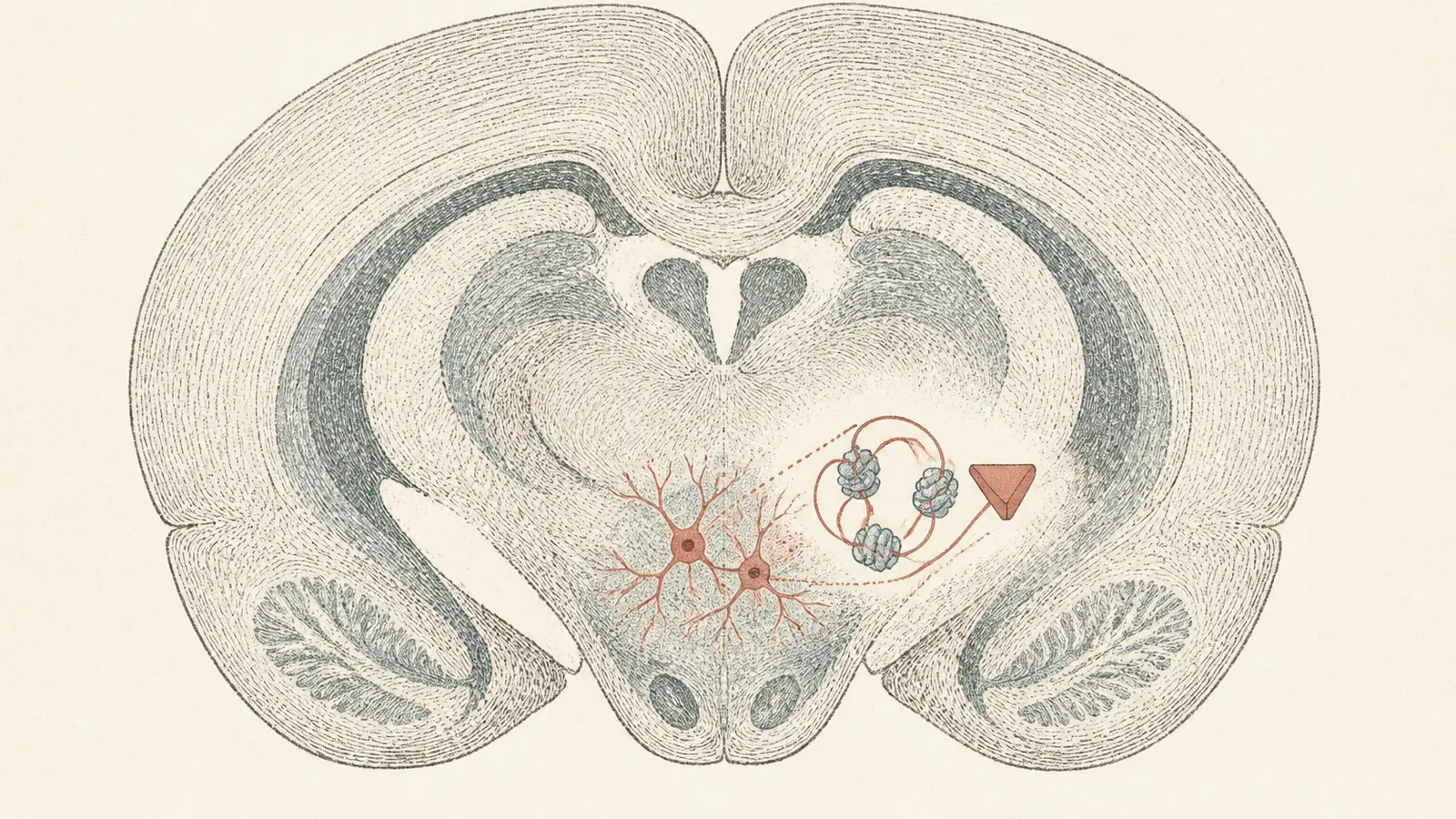
Here is what SETD7 does, and why the location is the trouble. Your DNA does not float loose. It is wound tight around spool-shaped proteins called histones, and how tightly it is wound decides which genes are easy to reach and which are locked away. SETD7 is a tagger. It clips a small chemical mark, H3K4me1, onto those histone spools, and that mark tells the cell to loosen its grip: unwind here, keep this stretch of DNA accessible. In the mice that went through early stress, SETD7 climbed inside the dopamine-producing neurons of the ventral tegmental area, the little hub deep in the brain that runs motivation and reward. The enzyme pried open the DNA sitting near stress-responsive genes and left it open. Primed. Cocked.
So when adult stress arrived, those genes did not have to be coaxed awake. They were already unlocked, and they fired harder and faster than they should have. That is the “scar.” Not a gouge in the tissue, but a setting left flipped, a piece of the genome held ajar into adulthood by a molecule the size of nothing.
But wait, why would one loosened spool in one cluster of neurons decide whether an animal spends its adult life on edge? That was the question I could not let go of, and it is the one the team actually chased down. They did the experiment in both directions, which is what lifts this above a correlation. First they took young, stress-free mice and artificially boosted SETD7 in the developing brain. Those animals, who had never been through anything, started behaving as though they had: their dopamine neurons ran hot, and their tolerance for stress in adulthood dropped. The enzyme alone was enough to plant the vulnerability.
Then they ran it the other way. In mice that had been through early stress, they blocked SETD7 from piling that H3K4me1 mark onto the histones, and the loosening near those stress genes never took hold. Those mice grew up resilient, as social and curious and willing to explore as animals that had lived easy lives, their dopamine neurons holding a normal, level reactivity. Block the tagger, and the priming never sets.
“This finding reveals a physical scar left by trauma experienced during development inside brain cells,” said Meaghan Creed of WashU Medicine, and I understand why the word scar is doing the heavy lifting in every headline, this one included. It is vivid and it is earned. But I want to be careful with it, because the reverse experiment shows the mark is not inevitable. Keep the enzyme from over-tagging during that window and it never gets written. That is a more hopeful and a more demanding story than “the damage is done,” and it is the honest one.
Now for the reflex I want to slow down. The instant you name an enzyme, someone in a lab or a boardroom starts drawing a pill. And SETD7 is druggable: chemists at the Structural Genomics Consortium and Pfizer built a potent, selective inhibitor called (R)-PFI-2 years ago, a tool compound that shuts the enzyme down at nanomolar doses in a dish. So the temptation is obvious. But a chemical probe in a cell culture is a universe away from a drug you would hand a developing human brain. SETD7 is not tidy or local. It works across the body and across many jobs, so blanket-blocking it in a child is not a plan. It is a hazard with a mechanism attached.
And notice what the scientists themselves reached for, which was not a molecule. Catherine Jensen Peña of Princeton, who has spent her career on this, put the payoff in almost startlingly low-tech terms: that if we can step in with supportive care, therapy or social resources to buffer children during those sensitive windows of development, we may be able to protect the epigenome. Sit with that. A stable adult, a safe room, someone who reliably shows up, may be doing molecular work on a child’s histones. This study hands biological teeth to exactly the interventions the establishment tends to underfund, because you cannot bill for a person who simply stays.
A word on where the money came from, because I always look. The disclosed funding was public and foundation money: a stack of NIH grants, the New York Stem Cell Foundation, Howard Hughes, a Princeton fellowship. No pharmaceutical sponsor is listed. That is worth saying out loud, because it is rarer than it should be, and it may be part of why the finding points at care instead of at a product you can package and sell.
The limits are worth stating plainly, and I will not bury the piece in them: this is mice, one enzyme in one small brain region, and no one has shown any of it in a person. A mouse ventral tegmental area is a lead, not a verdict. What it changes is how seriously I take early support, not whether anyone should go chasing a SETD7 pill.
So here is what it changed for me, concretely. I am not going to wait for a SETD7 drug, and I would be wary of anyone who tries to sell me one for a kid. What I will do is take the boring interventions as seriously as I take the biology, because now I know they are the same thing. If I am ever the steady adult in a child’s worst stretch, I will treat that steadiness as chemistry, not just kindness, because a mouse just told me it might be.
Sources
- Neuron – Early-life stress increases H3K4me1 and SETD7 in VTA dopamine neurons to prime stress sensitivity (Creed, Peña et al., 2026)
- WashU Medicine / The Source – “How early-life stress leaves a ‘scar’ inside brain cells” (Creed quote, funding)
- Neuroscience News – “Early Stress Heightens Adult Anxiety” (Peña quote)
- Princeton Neuroscience Institute – “Early-life stress leaves a lasting mark on the brain”
- GEN – “Early-Life Stress Leaves Epigenetic ‘Scars’ That Prime Stress Sensitivity”
- PNAS – Barsyte-Lovejoy et al., (R)-PFI-2 is a potent, selective SETD7 inhibitor (2014)
- Structural Genomics Consortium – (R)-PFI-2 chemical probe for SETD7
- ScienceDaily – “Childhood trauma may leave a lasting ‘scar’ inside brain cells”