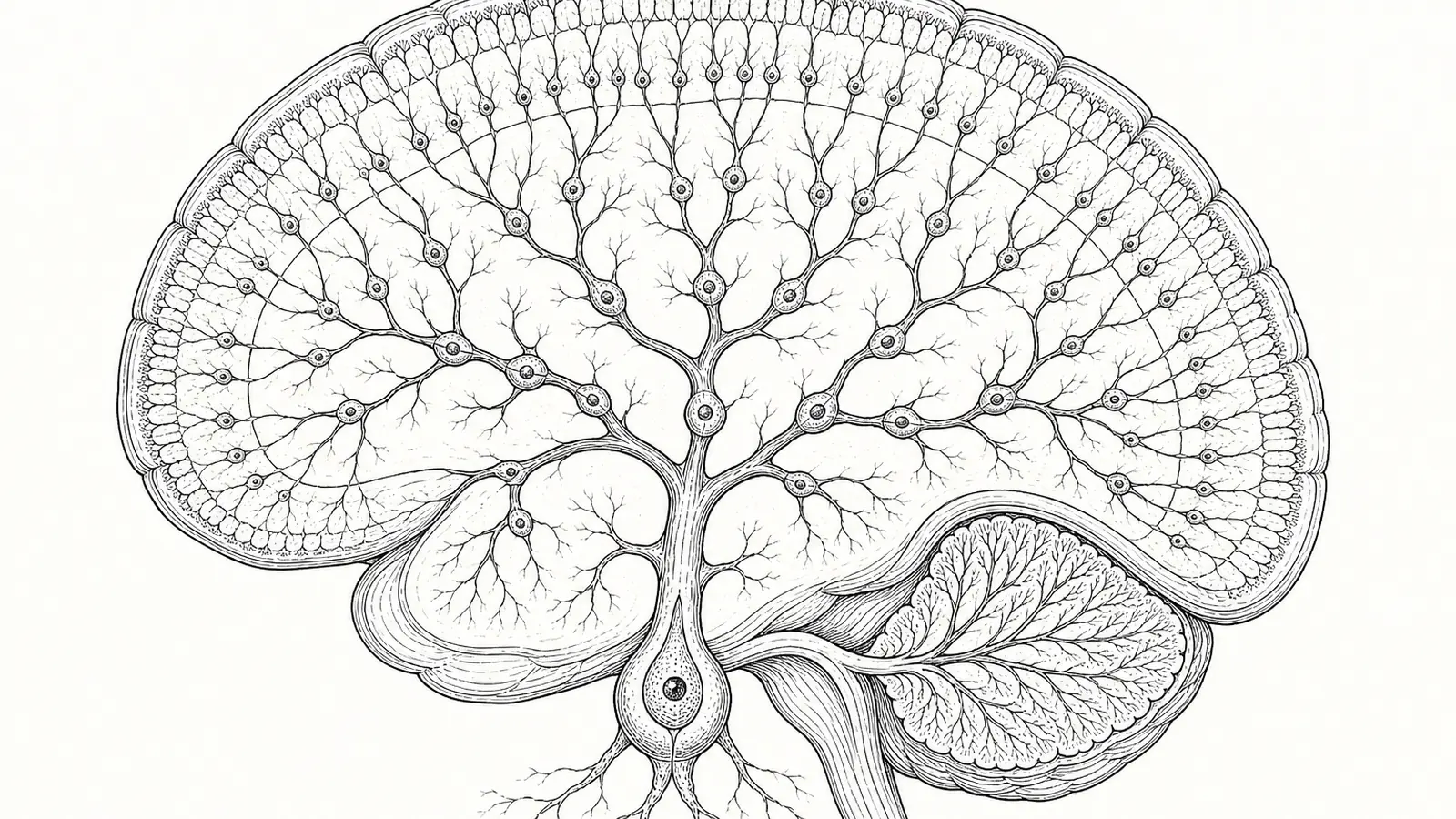
I always assumed building a brain took a blueprint. Some master plan, drawn up in advance, that hands each of billions of cells an address and says: you go there, you over there, you all the way at the back. Then I read the new work out of Cold Spring Harbor Laboratory, and the master plan I’d been picturing fell apart. There may be no central map at all. The thing that takes its place is so much simpler that I keep turning it over: a cell inherits its address from its own family tree.
Start with the puzzle, because it is a genuinely hard one. Your brain holds something like 170 billion cells, and every one of them grew from a single fertilized cell. That first cell divides into two, the two into four, on and on, until you have an organ where a neuron in the visual cortex has to wire to a neuron in the thalamus with a precision that would shame a factory. So how does a cell that started as one of millions of near-identical siblings end up in exactly the right place, doing exactly the right job?
For half a century the answer has been chemistry. The dominant idea, going back to Lewis Wolpert’s positional-information model, is that tissue lays down chemical gradients: a signaling molecule pours out from a source, sits thick nearby and thins the farther you go, and each cell reads the local dose like an altimeter reading altitude. High concentration means you are near the front. Low means you are near the back. It works beautifully in a fruit-fly embryo a few hundred cells across, and it earned its place in the textbooks honestly.
But here is where I started to squint. A gradient that can organize a fly is being asked to stretch across a human brain with billions of neurons, and chemicals do not cooperate at that size. Chemical signals can only travel so far before they fade out, and the math runs out long before the brain does. You cannot diffuse a molecule across the whole developing brain and still keep a difference sharp enough that a cell can tell here from a millimeter over and read its address off the concentration. The signal smears into noise. The model that built the textbook can’t scale to the organ the textbook is about.
So Kerstjens, Professor Anthony Zador, and collaborators at Harvard and ETH Zürich proposed something else in the journal Neuron: position is not broadcast to the cell at all. It is inherited. Cells that descend from the same ancestor stay near one another, so as the lineage divides and divides, family members end up clustered into neighborhoods. The map is not a chemical signal washing over the tissue. The map is the family tree itself.
Kerstjens reaches for an analogy I found weirdly perfect: people spreading across a country over generations. “Descendants settle near their parents, so people who share ancestry end up in neighboring regions,” he says, “producing large-scale geographic structures without long-range communication.” Nobody ever sends a memo across the country, and yet a whole geography of related communities emerges anyway. The brain, on this view, organizes itself the same way, descendants settling next to descendants until the structure falls out of the begetting.
And here is the moment that got me. Kerstjens frames the cell’s predicament like this: “The only thing a cell ‘sees’ is itself and its neighbors. But its fate depends on where it sits.” Read that twice. A cell is functionally blind. It has no view of the whole brain, no GPS, no idea where it sits in the larger structure. So how does a blind cell know its address? Wait, why does that even work? Because it never has to ask. It already sits next to its own relatives, and its relatives are its coordinates. The information about where was never sent through the tissue, it was passed down through the lineage, generation to generation, so the cell is born already knowing its neighborhood because it is surrounded by kin. That reroutes the whole problem from communication to inheritance, and once I saw it that way the older model started to look like it was answering the wrong question.
This is a proposal, not a settled fact, and it is worth being precise about what the team did and did not do. They did not film a single cell building a brain. They started with theoretical calculations to ask whether lineage could carry positional information at all, then went hunting for its fingerprint in real data: gene-expression patterns across developing mouse brains, where cells that share ancestry should show related expression in neighboring regions. Then they checked the same signature in zebrafish, across brains of different sizes, to see whether it held across species. It did. What they have is a model that fits the existing biology strikingly well, with cross-species support behind it. What they do not yet have is anyone tracing every lineage live and watching the neighborhoods assemble. The idea is strong and the data point its way; the direct lineage-by-lineage proof is the next mountain.
It is also not a story about chemistry being wrong. The gradients still look like they do the close-up work, patterning small fields of cells the way they always have. What lineage adds is the scaling, the long-range organization that no diffusing molecule can reach. The two run together, and that is the part that makes the idea feel less like a coup and more like a missing piece sliding into place.
One detail I keep coming back to is who paid for it. The work was funded by the Mathers Foundation and ETH Zürich, not a company with a product waiting downstream. That matters here, because a clean origin story for how brains wire themselves is exactly the kind of finding that gets oversold when someone has a therapy or a chip to sell, and this one arrives without that thumb on the scale. The reach of the idea runs well past brains, too. The same inherit-your-position logic could organize any tissue that has to build itself at scale, anywhere a structure has to come together without a central planner.
I came into this assuming development was a plan being executed. I am leaving convinced it is closer to a family tree unfolding, at least in the stretches of a brain too big for any single signal to cross. I would not bet that chemistry is gone. But for the long-range map, the part that always seemed to demand a master planner, I would put my money on lineage carrying the load. I am done reaching for the blueprint metaphor. There was never one central plan to find. There was ancestry, handed down, until a brain fell out of it.