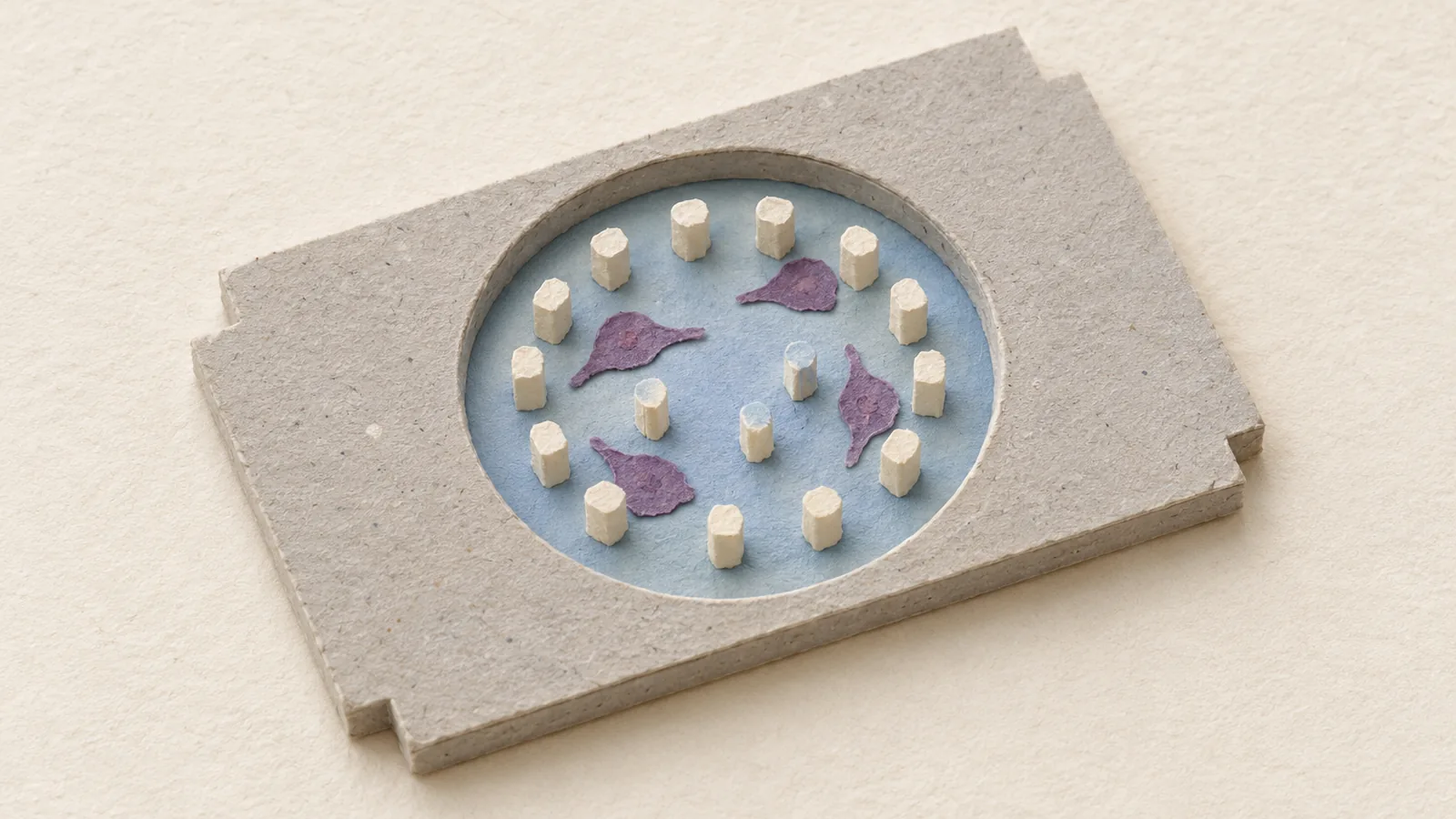
On April 13, thirteen researchers from Chongqing General Hospital and Chongqing University, with Haotian Jiang listed first, published the results of a month-long experiment in a dish. They grew two lines of human glioblastoma cells in fluid thickened to 7.1 centipoise, which they chose to match the fluid at the tumor’s invasive edge. Then they let the cells loose through a ring of tiny pillars on an open chip they had built for the job. The cells raised in thick fluid came out smaller, softer and faster than their counterparts, and some of what changed in them stayed changed after the fluid thinned. The paper ran in Microsystems & Nanoengineering, an engineering journal in the Nature family, under the title “Open micro-valley chip reveals long-term viscosity-induced glioblastoma cellular invasion states.” Nobody was going to put that on a front page.
Five weeks later, on May 20, the Chinese Academy of Sciences’ Aerospace Information Research Institute issued a release on EurekAlert headlined “Squeezed and sped up: viscous stress primes glioblastoma cells for invasion.” News-Medical ran it the same day, recast as fluid viscosity driving “mechanical memory.” On October 23, more than six months after the paper appeared, ScienceDaily republished the institute’s material under the kind of heading cancer readers have learned to distrust: “Glioblastoma breakthrough reveals how brain cancer cells become more aggressive.” The experiment had not grown in the meantime. The headline had.
In this disease that word sets a high bar. The modern standard of care came out of a 2005 trial of radiation plus the chemotherapy drug temozolomide. In 573 patients, median survival rose from 12.1 months to 14.6 months and two-year survival climbed from 10.4 percent to 26.5 percent, according to a critical review of the trial. Most of those patients were under 70, in good functional shape and had already had their tumors surgically debulked, and the reviewers found the benefit limited to tumors carrying a particular methylation marker. That works out to two and a half months at the median, for the patients best placed to receive the treatment. Anyone who writes “breakthrough” about glioblastoma is putting it next to that record.
Smaller, softer, faster
The Chongqing premise is physical, and it’s a good one. Most research on tumor spread follows the chemistry (growth signals, oxygen starvation) or the stiffness of the surrounding tissue, and the thickness of the fluid the cells move through gets far less attention. Citing earlier measurements, the paper puts the invasive periphery of a glioblastoma at about 6.6 centipoise and the dead tissue of the necrotic core at about 1.6. The periphery is where tumor cells push into healthy brain, beyond what a surgeon can cleanly remove.
The team kept U-251 and LN-229, two standard human glioblastoma lines, for a month in medium at 7.1 centipoise and compared them with cells kept in medium at 0.9. Then the cap came off. Intuition says cells raised in syrup should come out sluggish, but both adapted lines migrated farther and faster than the controls. They became smaller and more deformable and slipped through the narrow valleys between the pillars with visibly squeezed nuclei, while a mechanical-stress protein called YAP gathered inside those nuclei. The paper’s text describes greater migration distance and expansion rate but gives no numbers for them.
Then the two lines went separate ways. U-251 shifted toward what the authors call a mesenchymal-like state and switched on invasion-linked genes, among them CD44, FN1 and MMP9. LN-229 changed shape and migration in much the same way, yet changed little at the transcriptional level. Western blots showed some protein changes persisting after the cells were returned to ordinary medium, and the publicity calls that persistence “memory.”
Where the release outruns the paper
The first problem is the number the whole experiment rests on. The EurekAlert release says the fluid at the invasive edge is about eight times more viscous than the fluid at the core, and ScienceDaily repeats it. By the paper’s own figures, 6.6 against 1.6, the gap is a little more than four times, and the paper never states an eightfold difference. The ratio between the two culture media the team used, 7.1 against 0.9, does come close to eight. That is roughly the gap between the two dishes, which is not the gap the paper reports in the brain.
The second problem is the model. There were two cell lines, and they split on the lasting genetic response that the “more aggressive” headline depends on. The paper describes no animal experiments, and patient-derived cells appear only in a supplementary validation. ScienceDaily’s own text says further research is needed to determine how the findings translate to tumors in patients. That caveat survived every version of the release. It never reached a headline.
Then there’s the novelty. ScienceDaily’s summary says the work reveals something “previously overlooked.” In November 2022 a Johns Hopkins team, with Konstantinos Konstantopoulos as senior author, reported in Nature that thicker surrounding fluid makes cells move faster and helps cancer cells escape tumor spheroids. Breast cancer cells pre-exposed to high viscosity acquired what that paper called “mechanical memory,” and it went on to increase their migration in zebrafish, their escape from blood vessels in chick embryos and their colonization of mouse lungs. The Chongqing paper cites that work. What it adds is a month of exposure, two glioblastoma lines and an open chip that lets researchers watch cells squeeze through. That is a useful extension. It’s not the discovery of a forgotten variable, and unlike the 2022 study it never leaves the dish for a living animal.
The funding is public and listed in the release: three National Natural Science Foundation of China grants (82473430, 22304143, 32501283), Chongqing and Zhejiang provincial programs, a Chongqing General Hospital research fund, and Chongqing research centers for glioma and for neurodegenerative disease. The authors declare no competing interests.
For patients and families, nothing in the paper has been shown to help anyone. What it offers is a hypothesis worth testing. The thick fluid at a glioblastoma’s edge may do more than slow cells down. It may select for, or train, the cells best equipped to escape surgery, and the change may outlast the exposure. If that holds in tumor tissue and in animals, the mechanical environment at the edge becomes something to measure and perhaps someday disrupt. No one has shown any of that yet.
The chip may prove the paper’s most durable contribution: an open device that keeps cells alive for a month, controls when they start moving and lets researchers image their nuclei as they squeeze through a known geometry. That is what the paper’s title says it is about.
ScienceDaily ran it on October 23, under a different title.
Sources
- Jiang et al., Microsystems & Nanoengineering (2026)
- EurekAlert! release, Aerospace Information Research Institute, Chinese Academy of Sciences (May 20, 2026)
- ScienceDaily: “Glioblastoma breakthrough reveals how brain cancer cells become more aggressive” (October 23, 2026)
- News-Medical: “Fluid viscosity drives mechanical memory and invasion in glioblastoma” (May 20, 2026)
- Bera, Konstantopoulos et al., Nature (2022)
- Komotar et al., Clinical Medicine: Oncology (2008)