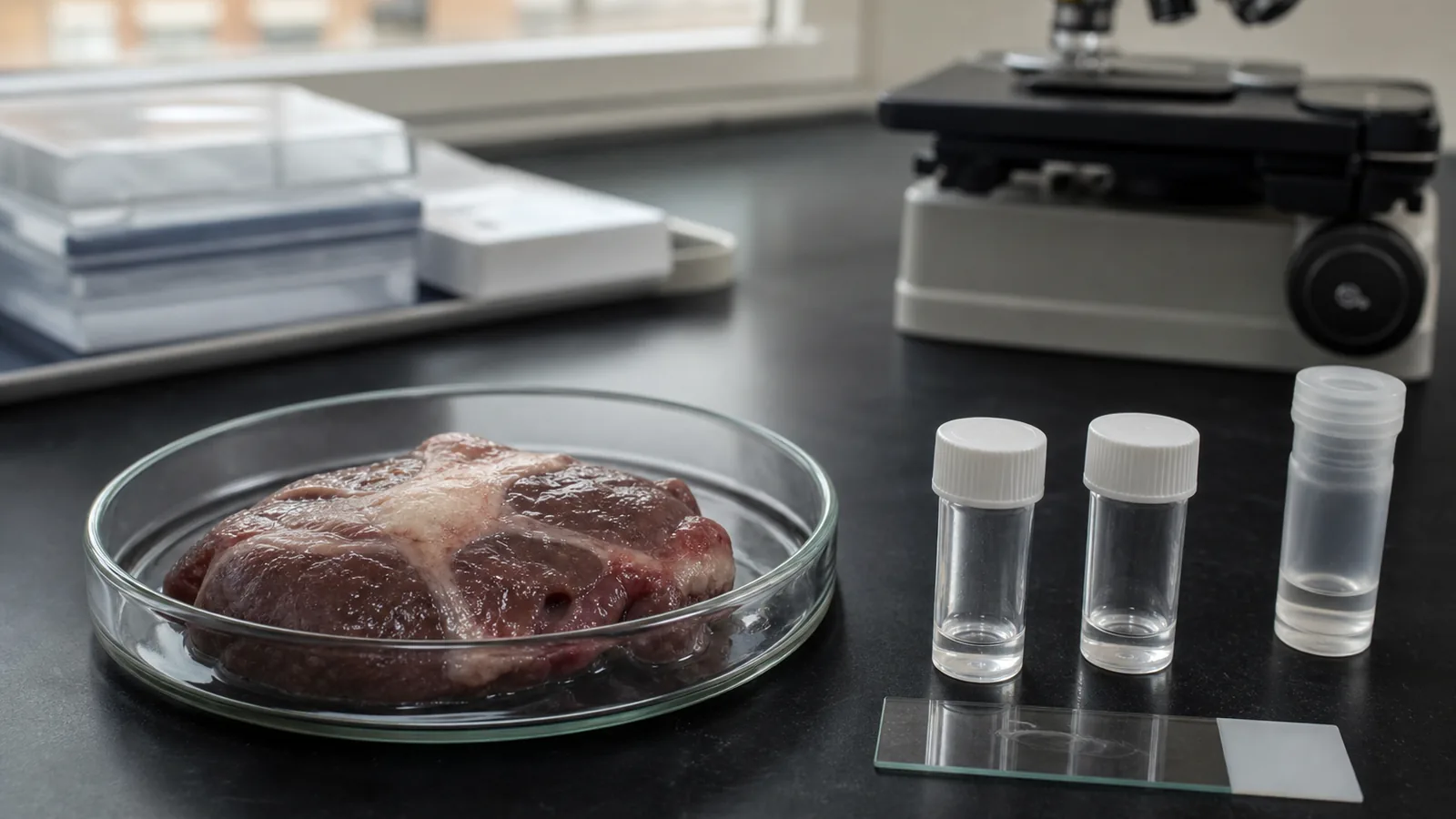
In a lab at the University of Washington, surgeons keep slivers of human liver tumor alive on a bench for a few days after they cut them out of a patient. The tissue is still organized the way it was inside a person: cancer cells in the middle, immune cells somewhere in the mix, and running through all of it the dense fibrous bands that give fibrolamellar carcinoma its name. Put that tissue under a microscope and you can watch the immune system show up for a fight it never joins. The T cells are there. They are just standing in the wrong room.
That observation anchors a study published this winter in Gastroenterology by a team from Cornell and the University of Washington, which resurfaced last week in a release headlined “FDA-approved drug may finally help immunotherapy defeat rare liver cancer.” The science underneath is genuinely interesting. The headline skips the one distinction that decides whether any of this helps a patient: everything that happened, happened in tumor tissue on a bench, not in a person.
Here is what the team found. Fibrolamellar carcinoma builds itself a defense out of scar tissue. Modified liver cells called stellate cells, sitting in those fibrous bands, give off a chemical signal, and the tumor’s T cells follow it away from the cancer and into the fibrosis, where they sit uselessly. The researchers call it T-cell exclusion, and it runs through a receptor named CXCR4 that the immune cells carry and the scar tissue exploits. “Our results provide among the first indications of why a type of immunotherapy called immune checkpoint inhibition hasn’t worked well in these patients,” said Praveen Sethupathy of Cornell, the study’s co-senior author, in the university’s account of the work. For a disease where checkpoint drugs have mostly bounced off, a clean mechanical account of why they fail is worth something.
Then the team reached for a compound that blocks CXCR4, and reached for one that already exists. AMD3100, sold as Mozobil and known generically as plerixafor, has been FDA-approved since December 2008, not for cancer but for a logistics problem: it mobilizes stem cells out of the bone marrow so they can be collected before a transplant in patients with multiple myeloma or non-Hodgkin lymphoma. It has spent the better part of two decades doing that quiet job. Applied to the living tumor slices, it pried the T cells loose from the fibrous bands and pushed them back toward the cancer, and paired with a checkpoint inhibitor it led to a significant increase in tumor-cell death.
That is a real result, and it is worth being precise about its size. This was human tumor tissue kept alive outside the body, not a cell line and not a mouse, which matters for a cancer this rare and this genetically specific. It was also not a patient. The drug rearranged immune cells in a dish of someone’s resected tumor and made the killing go up. That is a hypothesis with unusually good evidence behind it. It is not yet a treatment.
The people who did the work say as much. Sethupathy and his colleagues have not put this combination into a single patient; by their own account they are still looking for liver cancer clinicians willing to start a trial. The mechanism is worked out. The drug is approved. The trial does not exist.
It matters because of who has this disease. Fibrolamellar carcinoma is rare, somewhere between 0.5 and 9 percent of primary liver cancers depending on the case series, and it does not behave like the liver cancer most people picture. It strikes the young, usually before 40 and often in the teens and twenties, in livers that are otherwise healthy, with no hepatitis and no cirrhosis to warn anyone. It is driven by a single recurring genetic accident, a DNAJB1-PRKACA gene fusion pinned down in 2014. Chemotherapy does little. Surgery is the only thing that cures it, and only if you catch it early, which usually you do not: 5-year overall survival sits around 40.3 percent across all patients and climbs to 60.7 percent for the minority caught early enough to cut the tumor out, against a median overall survival of 32.9 months. Everyone diagnosed too late lives in the distance between those numbers.
There is a version of this story where the villain is a drug company sitting on a cure. This is not that one, and pretending otherwise would be its own kind of dishonesty. The work was paid for by the Fibrolamellar Cancer Foundation, a patient-driven outfit, not by pharma. The reason no trial has started is more mundane and, in its way, more damning. A drug approved back in 2008 has little exclusivity left to reward whoever runs the study, and an orphan disease with a few hundred patients a year generates none of the commercial pull that organizes a trial on its own. Someone has to choose to do it, against the gravity of a market that points elsewhere.
So the receipts here are modest, and worth stating plainly. A repurposed stem-cell drug, approved the year the iPhone got an app store, flushed excluded T cells back into tumors taken from real patients and made checkpoint immunotherapy bite. That is the finding, no smaller and no larger. The “may finally defeat” belongs to the release, not to the data, which has not met a single living patient.
The drug has been on the shelf since 2008. The cancer has been killing people in their twenties the whole time. What stands between them now is not the science and not the FDA. It is a clinician with the time, the funding, and the will to write the protocol, and the team in Seattle is still waiting for one to call.
Sources
- Gastroenterology – “Overcoming CXCR4-Mediated T-Cell Exclusion Potentiates Antitumor Cytotoxicity in Fibrolamellar Carcinoma” (2026)
- Cornell Chronicle – “Drug lifts barrier for immunotherapy to fight rare liver cancer” (Feb 2026)
- ScienceDaily – “FDA-approved drug may finally help immunotherapy defeat rare liver cancer”
- Drugs.com – Mozobil (plerixafor) FDA approval history (December 2008)
- Current Advances in the Treatment of Fibrolamellar Carcinoma of Liver – review (PMC)
- Science – Honeyman et al., “Detection of a Recurrent DNAJB1-PRKACA Chimeric Transcript in Fibrolamellar Hepatocellular Carcinoma” (2014)