Victoria Gibson is used to being told her idea is impossible. She is a research scientist at the University of Vermont, and when she stands up at oncology meetings to explain how her team means to kill cancer, colleagues wander over to tell her why it can’t be done. “People will come up to us at conferences and state that you can’t target the mitochondria because they’re too important,” she told UVM’s newsroom. Mitochondria are the cell’s power supply. Poison them, the reasoning goes, and you poison everything, the healthy cells along with the malignant ones.
Her lab has spent a decade arguing the objection is wrong, at least for one cancer. This month that decade produced a headline: a new drug that turns cancer’s own defenses against it. What the headline compressed into a job title is that the human evidence behind it runs fifteen patients deep, carries no control arm, and the scientist vouching for the survival numbers is also the chief science officer of the company that owns the drug.
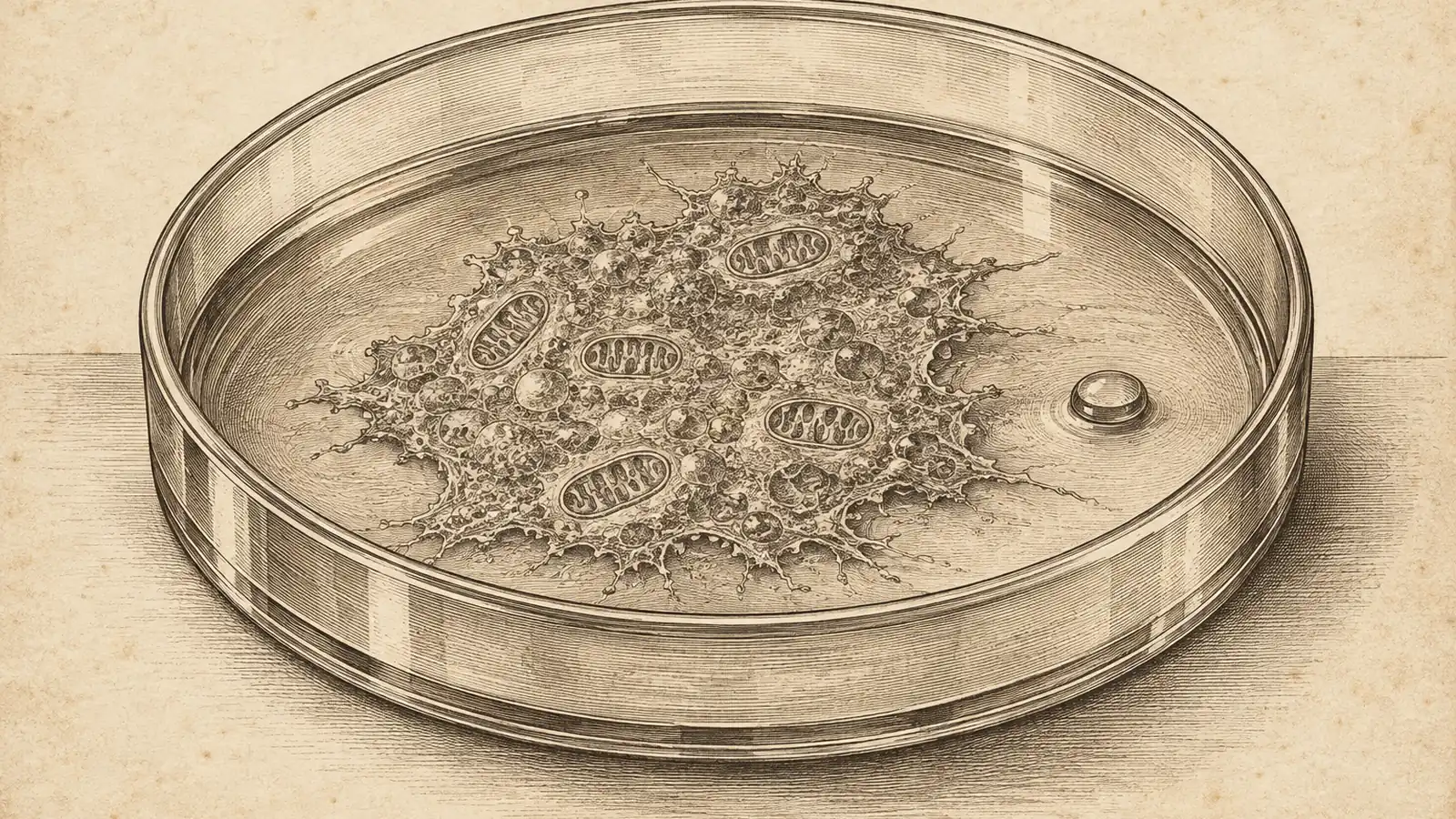
The biology is genuinely clever, and it is worth understanding before the packaging goes to work on it. The weapon is an old one: thiostrepton, a naturally occurring antibiotic reformulated into a clinical drug called RSO-021, which jams a single enzyme called peroxiredoxin 3, or PRX3. PRX3 is the tumor cell’s cleanup crew, mopping up the corrosive byproducts of its own overclocked metabolism. RSO-021 cuts the lights in that engine room. Block the enzyme and hydrogen peroxide floods the mitochondria until the cell drowns in its own oxidative exhaust. Cancer cells, the theory goes, lean on that cleanup harder than healthy cells do, so they die first. The science is not the same thing as proof that a patient lives longer, and the headline was built to blur the difference.
Here is what the trial, called MITOPE, actually was. Fifteen patients with relapsed mesothelioma, treated in the United Kingdom between 2022 and 2023 under the eye of the MHRA, Britain’s drug regulator. The drug went in by catheter, straight into the pleural space, the fluid-filled lining around the lungs where this cancer grows and where it produces the effusions that make breathing feel like drowning. It was an open-label, non-randomized dose-escalation study, the kind built to answer one question before any other: does the drug hurt people. It did not appear to. The safety endpoint was met, and no deaths were attributed to the treatment. That is a result worth having. A Phase 1 trial is a toxicity screen, not an efficacy verdict, and by that measure RSO-021 did its job.
The trouble starts when the efficacy language shows up anyway. The drug “controlled disease progression in 67 percent” of the patients, the reports say, and in some, tumors shrank. A disease-control rate of 67 percent, across 15 patients, is 10 people. Disease control is a generous instrument by design: it folds the tumors that shrank together with the tumors that merely stopped growing for a while, and reports the sum as one reassuring figure. Progression-free survival averaged 4.2 months. Overall survival, Cunniff said, is “better than what is seen with existing treatments,” which may well be true, but nothing in this trial establishes it, because there was no comparison arm. The benchmark is history, and fifteen patients measured against historical averages is a hypothesis, not a finding.
None of this would matter if the packaging matched the evidence. It doesn’t. The mechanism is a decade in the making and worth taking seriously. The clinical proof that it extends a human life is fifteen patients deep and uncontrolled.
Then there is the line the breakthrough coverage folds into a credential. Brian Cunniff, quoted throughout as the trial’s authority, is an associate professor at the University of Vermont. He is also the chief science officer of RS Oncology, the company that owns RSO-021, sponsored the trial, and was founded on the very discovery his UVM lab made. This is not a scandal. It is how a great deal of academic drug development works now, and it is disclosed plainly enough if you go looking for it. But it is exactly the fact a reader should hold while reading the survival numbers: the man vouching for them is an officer of the company whose value rises and falls on them.
The reason to be fair to this drug is the disease it is aimed at. Mesothelioma is an asbestos cancer, a slow verdict handed down decades after the exposure, and the people who receive it have almost nothing. The standard menu is a chemotherapy doublet and, more recently, an immunotherapy combination, and neither buys much time. Into that vacuum, a repurposed natural antibiotic that goes after tumor metabolism through an unfashionable target is exactly the sort of unglamorous, non-blockbuster idea that deserves a genuine trial. It is getting one. A Phase 2 study is already underway, and that is the study that will say whether the mechanism means anything to a patient rather than to a cell in a dish.
Until it reports, the honest sentence is the modest one, and it happens to be Cunniff’s. The overall survival data, he said, is “very promising and will hopefully persist with additional patients.” It is careful, measured, and accurate. It was also spoken by the company’s chief science officer, who has more reason than anyone to hope it holds.
Sources
- Nature Communications – MITOPE first-in-human Phase 1 trial of RSO-021 (PRX3 inhibition) in mesothelioma (primary trial report: patient count, endpoints, safety, survival, funding, conflicts; published July 14, 2026)
- University of Vermont – “New Cancer Drug Shows Promise in Mesothelioma Trial” (patient count, 67 percent figure, progression-free survival, Gibson and Cunniff quotes, Cunniff’s dual role)
- ScienceDaily – “New mesothelioma drug turns cancer’s own defenses against it” (the September coverage wave and its framing; mechanism)
- RS Oncology – the PRX3 program and its University of Vermont origin (Cunniff as chief science officer, the company’s founding on the UVM discovery, trial sponsorship)