The people who were told the truth did just as well as the people who were lied to. Sometimes a little better. That is the result I cannot stop chewing on.
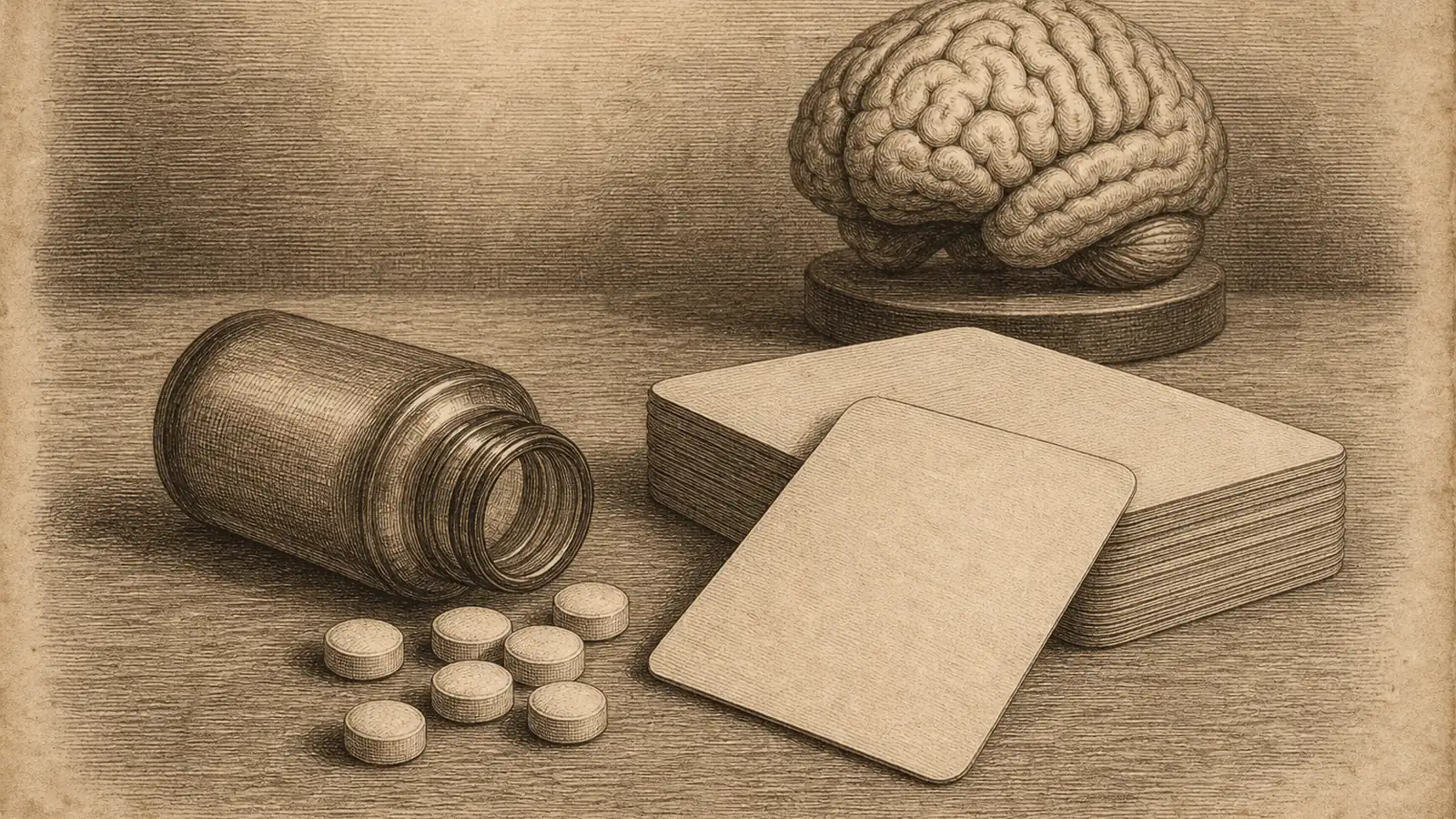
A team at Università Cattolica in Milan took 90 healthy older adults, aged 65 to 90, split them three ways, and handed two of the groups identical inert pills for three weeks. One group got the classic con: take this, it has active ingredients, it will help you. The other group got something stranger. The researchers looked them in the eye and said these pills are placebos, there is nothing in them, and they may still trigger real benefits in your body. No deception. Full disclosure. The trick laid out on the table.
And then that open-label group posted some of the biggest gains in the study.
Here is why that lands harder than the usual placebo headline. A pill with nothing in it is, right now, the entire business model of a huge slice of the supplement aisle aimed at aging adults. Memory support, brain health, vitality blends. This trial says the ritual itself may be doing the work those products take credit for, and that you do not need to be conned, or charged, to get it. That is a quietly subversive finding, and it is why I kept reading past the cute-psychology-demo reflex I walked in with.
Because it is not only about feelings. The team, led by Diletta Barbiani, Alessandro Antonietti, and Francesco Pagnini, measured things you cannot just talk yourself into on a survey. Short-term memory through a number-recall task, repeating digit sequences forward and backward. Selective attention through a color-word task, naming ink colors while ignoring the word. Physical function through walking speed, standing balance, and how fast someone can rise from a chair, over and over.
The numbers, before the hype gets to them
Across three weeks, physical performance rose about 7 percent in the deceived group and 9.2 percent in the open-label group. On the cognitive tasks, the deceived group climbed a tight 12.6 to 14.6 percent, while the open-label group swung across a much wider band, from a modest 6.9 percent up to 21.5 percent depending on the measure. And on stress, the group that knew the pills were fake reported the lowest levels of anyone, beating both the control group and the people who thought they were getting a real supplement.
Knowing it was fake did not blunt the effect. In several places it sharpened it.
So what is happening? The researchers’ working explanation is Pavlovian, and I find it genuinely satisfying. The daily ritual of taking a pill is a learned cue. You have swallowed pills your whole life and felt better afterward, again and again, so the act itself becomes a trigger the body answers automatically, the way Pavlov’s dogs salivated at a bell. By that logic the conscious belief was never the load-bearing part. The conditioned response was. That is why you can tell someone the pill is inert and still get the cascade: you are not persuading their mind, you are cueing their physiology. It reframes the placebo effect from gullible people fooling themselves into something closer to a trainable bodily reflex, one that apparently does not need a lie to fire. For older adults, who get written off as too far down the road to move the needle on memory or stamina, that is not nothing.
Now the cold water
This is one small study, and small studies oversell. Ninety people split three ways is roughly 30 per arm, three weeks is a blink, and the design has gaps the researchers themselves name: no formal screening for early dementia even though they tested cognition, and no biology measured underneath the behavior, no cortisol, no heart rate, no brain waves. Nobody knows whether a single bit of it survives past week three. A 30-person group improving on a digit-recall task over three weeks is a signal worth chasing, not a prescription, and the headline version, “their memory still improved,” is true and analytically reckless at the same time.
Look back at that wide cognitive band and you can see the fragility. The open-label group’s gains ran from 6.9 to 21.5 percent, a spread that big across a tiny sample is exactly what noise looks like before replication tightens it. This is the seam where the broader placebo literature gets honest with itself. The 2025 updated meta-analysis of open-label placebo trials in Scientific Reports and an earlier review of non-clinical samples land in roughly the same place: open-label placebos reliably move how people report feeling, with respectable effect sizes, while their grip on hard, observable outcomes is thinner and shakier. Tell people a pill might help and they will tell you it did. Whether the underlying machinery actually shifted is a higher bar, and this trial’s cleanest lead came on stress, a self-report, with the objective gains real-looking but small enough to want a much bigger replication before anyone throws a party.
The funding is worth naming, because it cuts the other way. The work was paid for through Italy’s PNRR recovery funds via the Age-IT project, a national push to study healthy aging. No pharma sponsor, no supplement brand with a product to move. That is the cleaner kind of money, and it is part of why I take the result seriously instead of assuming someone is selling something downstream of it.
What I actually make of it
I am not going to tell you to swap your medication for a sugar pill, and neither would these researchers. What the study opens up is narrower and more interesting than a miracle: the possibility of building the placebo response into care on purpose, out in the open, with no deception required. If a transparent ritual can be conditioned into a genuine physiological assist, that is an ethical tool rather than a parlor trick, and it sidesteps the lie that has always made doctors squeamish about prescribing hope.
What I would watch for is the replication, bigger and longer, with biology measured underneath the self-reports. If a hundred-person, six-month version still shows older adults gaining on objective tests after being told flat-out the pills are fake, then this stops being a curiosity. It becomes a real question about how much of getting better was always partly the body answering a cue it already knew. I came in skeptical. I left wanting that bigger trial, badly.
Sources
- ScienceDaily – “They knew the pill was fake but their memory still improved” (June 25, 2026)
- International Journal of Clinical and Health Psychology – Barbiani, Antonietti & Pagnini, open-label placebo in older adults (2026)
- PsyPost – “Fake medicine yields surprisingly real results for older adults’ memory and stress”
- SciTechDaily – “This ‘Fake’ Pill Improved Memory and Physical Performance in Just 3 Weeks”
- Scientific Reports – updated meta-analysis of open-label placebo RCTs across populations and outcomes (2025)
- Scientific Reports – meta-analysis of open-label placebos in non-clinical samples (2023)