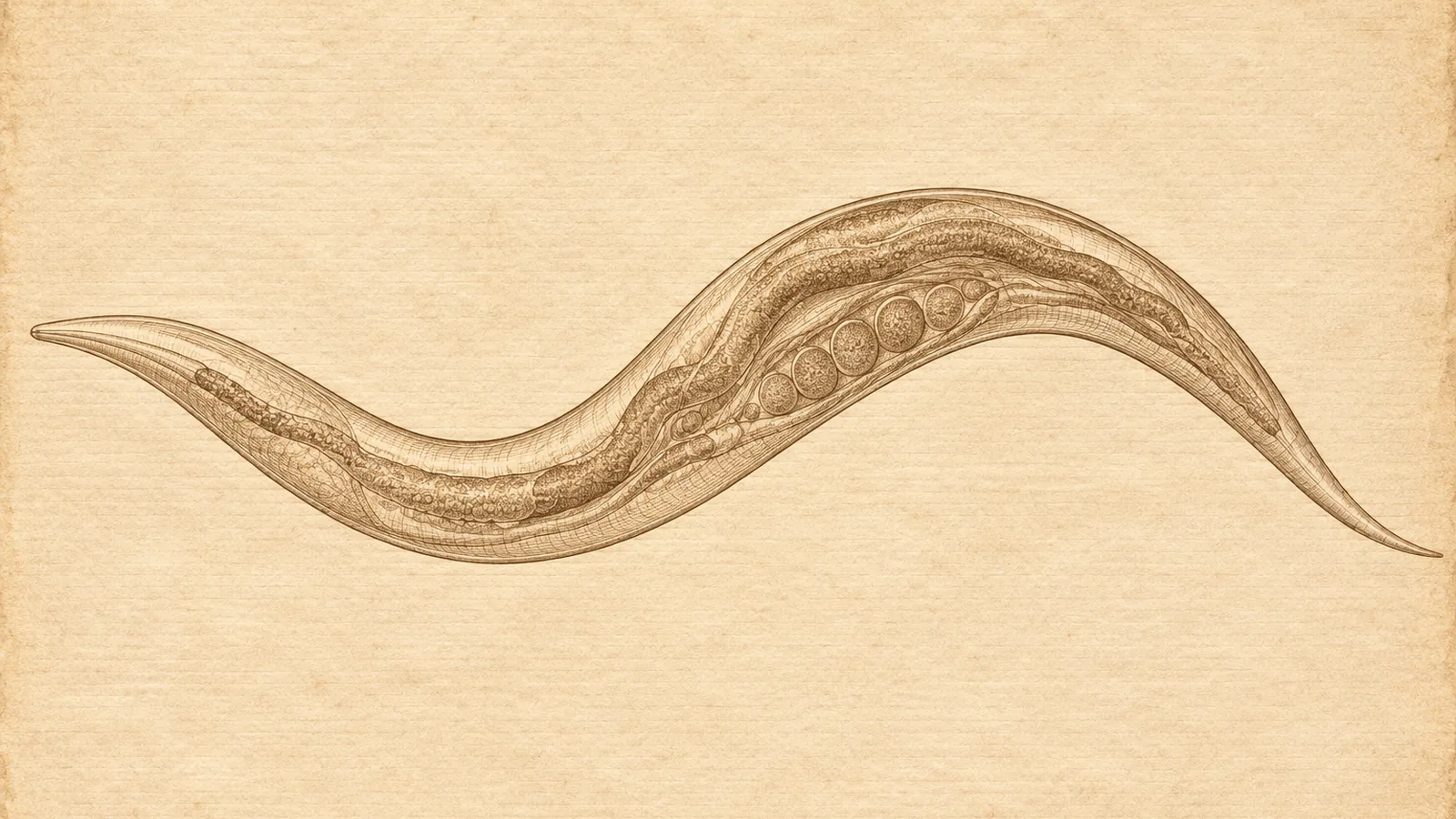
Jonathan Kölschbach was looking for genes that make animals live longer, and he found one that also kept them from growing up. In Adam Antebi’s lab at the Max Planck Institute for Biology of Ageing in Cologne, he had a roundworm mutant that outlived its siblings but developed slowly, stayed small and laid fewer eggs. The broken gene, rnp-6, is the worm counterpart of human PUF60, whose mutations cause a rare developmental disorder called Verheij syndrome. A little extra vitamin B12 in the worms’ food then undid most of the damage.
“We were able to largely correct the consequences of this change in the worm model using vitamin B12,” Kölschbach said in the institute’s announcement, which went out in August alongside the paper in Nature Communications. This week the result reached the wider press, and ScienceDaily’s headline said B12 “may hold the key to treating” the disorder. The study gave the vitamin to worms. The institute’s own release says future studies must determine whether it can help patients, which is a more modest sentence than the headline, and a more accurate one.
One symptom at a time
PUF60 makes a splicing factor, part of the machinery that cuts and rejoins messenger RNA before a cell builds proteins, and when it fails the damage turns up all over the body. A 2024 case report in Cureus counted only 73 cases in the published literature, with skeletal abnormalities in about 80 percent of them, eye malformations in about 70 percent, intellectual disability in about 60 percent and heart problems in about 40 percent. Short stature and developmental delay are typical, and the authors write that no targeted therapy exists.
| Group | Value (percent of published cases) |
|---|---|
| Skeletal abnormalities | 80 |
| Eye malformations | 70 |
| Intellectual disability | 60 |
| Heart problems | 40 |
Their patient was an 11-year-old girl in India with absence seizures, short stature, a split fifth cervical vertebra and an undersized right kidney. Doctors started daily growth hormone, and within weeks of a progressive headache an MRI showed idiopathic intracranial hypertension, a dangerous rise in pressure around the brain, so the hormone was stopped. Hers is one case, not a survey of care, but it shows what treating a syndrome symptom by symptom can look like: the drug aimed at her height raised the pressure inside her skull, and at her six-month review she had grown 3.2 centimeters after coming off it.
Pulling the chain apart
The Kölschbach et al. preprint, the version posted before peer review, lays out why the worms were sick. The mutation did not scramble cells at random; it mis-spliced genes in methionine and phospholipid metabolism, which starved cells of methyl groups, a basic chemical currency, and disrupted production of phosphatidylcholine, a major ingredient of cell membranes. B12 fits into that chain at one link. The enzyme that regenerates methionine needs B12 to work, methionine becomes SAM, the cell’s main methyl donor, and SAM feeds phosphatidylcholine production.
So the team took the chain apart. Deleting the worm’s methionine synthase gene abolished the benefit of B12 completely. Deleting the gene for the enzyme that makes SAM abolished it too, while choline, which enters the pathway further down, still rescued body size without that enzyme. A nutrient that improves sick animals is a hopeful observation. A nutrient whose benefit vanishes each time you remove one of the steps it is supposed to act through is a mechanism.
The dose was 1 nanomolar cyanocobalamin added to the worms’ standard bacterial food throughout development, and treatment before the L4 larval stage, the authors report, “fully restored normal development.” Even a 24-hour dose starting in young adulthood significantly increased body size. Growth rate, cold tolerance and fertility improved as well. Then came the result the longevity screen had been built to find. Vitamin B12 gave the worms back their size. It did not take away their longer lives.
Eight patients, three controls
The human half of the paper came through Hormos Dafsari, a neuropediatrician at University Hospital Cologne who obtained blood from people with Verheij syndrome. The Kölschbach et al. preprint compares eight patients, six male and two female, with three controls who carry no PUF60 mutation, and in the patients plasma methionine ran about 85 percent lower and tryptophan about 90 percent lower, while Krebs-cycle intermediates such as citrate, malate and fumarate ran higher. Three controls is a thin baseline for numbers that large, and the paper is not consistent about it: its results call the controls age-matched, while its discussion concedes the samples came from subjects of different ages and genders.
The connection to the worm mechanism is partial. Phosphatidylcholine, the molecule at the center of the worm story, did not change in patient plasma, and SAM could not be measured at all because it was too scarce to detect. The team also mined public data from a lung-cancer cell line, PC9, in which PUF60 had been experimentally silenced, and found 2599 altered splicing events across 1730 genes; the institute says those cell data showed related metabolic changes. That is a separate laboratory model, not confirmation in patients’ cells. The authors ask for exactly what is missing: validation in plasma and in patient-derived cells such as fibroblasts, a larger age- and gender-matched cohort, and a test of what B12 supplementation does.
The funding list is short and entirely academic. The preprint thanks the Max Planck Society for funding the project, along with CECAD postdoctoral seed funding and the Cologne Graduate School for Ageing Research, and the authors declare no competing interests. No company appears on the paper, and the molecule in question is a vitamin already sitting on pharmacy shelves. The case for worry is an argument rather than a finding, but it is not hard to make. Drug development tends to follow exclusivity, a disorder with 73 published cases is a small patient population to build a program around, and a generic vitamin gives a sponsor little to protect, so the follow-up experiments the authors describe look like academic work that will need academic money.
Antebi called the study “a good example of how basic research on model organisms can provide new insights into human diseases.” The next experiment the paper names would use cells grown from the same patients whose blood went to Dafsari’s clinic. Until someone grows them and adds the vitamin, the lead stays where Kölschbach found it, in a millimeter-long worm that lives longer than it should.
Sources
- Kölschbach et al. preprint: “Vitamin B12 alleviates spliceosomopathy via phospholipid remodeling,” with methods, patient cohort, funding and competing-interest statements
- Kölschbach J, Dafsari HS, Baum E, Löhrke A, Kew C, Dikic I, Huang W, Antebi A. “Vitamin B12 alleviates spliceosomopathy via phospholipid remodeling,” Nature Communications 17, 8011 (2026)
- Max Planck Society, “Unexpected help from vitamin B12”
- 2024 case report in Cureus: Sivasubramanian and Ayyavoo, “A Case Report of Verheij Syndrome”
- ScienceDaily, “Vitamin B12 may hold the key to treating a rare genetic disorder” (November 2026)