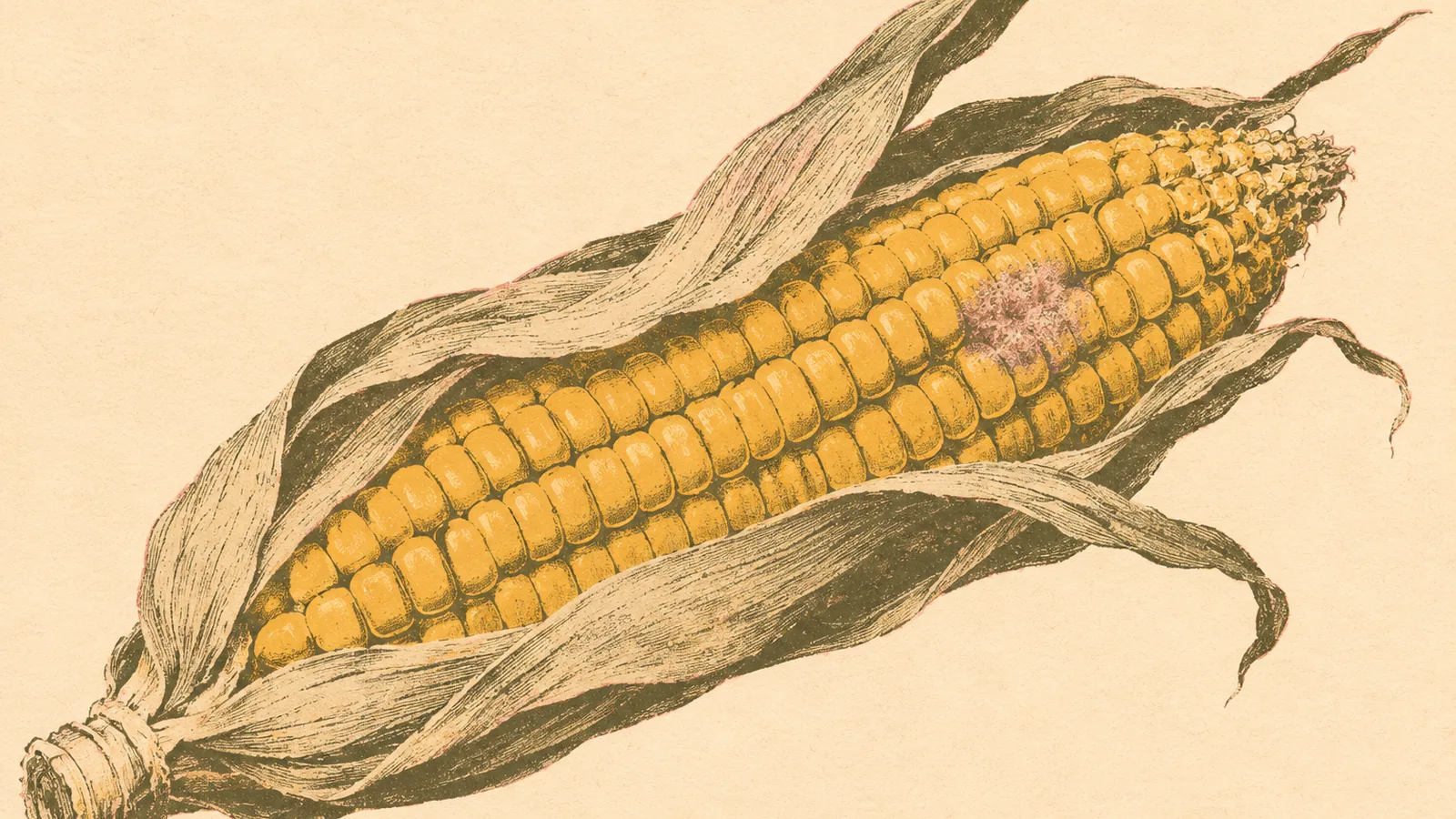
I’ve eaten more cereal bars in parked cars than I’d like to admit, and I never once wondered what grew on the corn before it got to me. Then I saw the numbers for the girls in Rochester. Daughters whose mothers carried more zearalenone, an estrogen-mimicking toxin made by molds that grow on corn and wheat, scored lower on cognitive testing at age two. Europe has capped that toxin in baby cereal since 2007. The FDA’s own mycotoxin page lists no limit for it at all.
The study, published November 11 in Environmental Health as an accepted early version, followed 215 mothers in the UPSIDE pregnancy cohort and their children. In every trimester the researchers measured zearalenone (ZEN) in the mothers’ urine, along with alpha-zearalenol, one of its breakdown products, and a summed total of ZEN plus five metabolites. Among the girls, each log-unit rise in the mother’s ZEN went with a Bayley cognition score 5.37 points lower at 24 months (95% CI −8.87 to −1.87), an interval that sits well clear of zero. The summed measure showed a smaller drop of 2.67 points, and its interval (−5.25 to −0.10) only barely clears zero. The authors call their work “the first evidence that mycoestrogens may impact neurodevelopment in children.”
I went in expecting to roll my eyes. Small cohort, one city, a scary-sounding chemical: I’ve read that paper many times, and it usually falls apart on a second read. This one held up better than I expected on that second read, partly because the authors don’t oversell it. Their conclusion is a single careful sentence: “Mycoestrogens may be associated with adverse effects on neurodevelopmental outcomes, particularly in females.”
The other signals are thinner. Across boys and girls together, each log-unit rise in first-trimester ZEN went with a 17 percent lower rate of succeeding on successive trials of a snack-delay test, the one where a two-year-old has to hold off on a treat (the rate ratio’s 95 percent interval ran from 0.72 to 0.96). Boys showed few associations of any kind. The exceptions pointed upward: first-trimester ZEN and alpha-zearalenol tracked with higher language scores at six months, by 3.30 and 3.10. That’s a different test at a different age from the girls’ cognition result, so it isn’t a mirror image. The abstract also presents sex-stratified models, not a formal test of whether boys and girls differ.
So why would a mold toxin care whether a fetus is a girl? Zearalenone is shaped so much like the body’s own 17β-estradiol that it binds the same estrogen receptors, which is why it’s called a mycoestrogen, a fungal toxin that mimics a hormone. A developing brain grows in a bath of hormones whose recipe differs by sex. In 2024 the same Rochester group looked at 297 pregnancies and found ZEN in more than 93 percent of urine samples and more than 57 percent of placentas. With female fetuses, higher ZEN went with higher estradiol, while with male fetuses it went with lower estrone and lower free testosterone. Wait, one molecule tracks with a hormone going up in one sex and down in the other? Once I saw that, the split between sons and daughters stopped looking random to me. It’s still a plausible pathway, not a traced one. Those are hormone associations, and nobody has followed the molecule from a trimester urine sample to a toddler’s test score.
The exposure is about as ordinary as food gets. ZEN comes from Fusarium molds on corn, wheat and other cereals, and it also turns up in animal products. It is heat-stable and resistant to common food-processing steps, which is how it carries through into cereal bars, breads and corn products. Zorimar Rivera-Núñez of the Rutgers School of Public Health, who led a 2025 study on how a common genetic variant shifts mycoestrogen effects on birth outcomes, says pregnant people “can lower their exposure by avoiding those foods when possible”. She means ultra-processed grain products such as pasta, breakfast cereals, baked goods and breads. She also expects the problem to grow: “We expect mycoestrogen exposure to increase worldwide due to climate change.”
Now look at the regulators. The FDA’s mycotoxin page points to action levels for aflatoxin, an advisory level for deoxynivalenol in finished wheat products, guidance levels for fumonisins and an action level for patulin in apple juice. Zearalenone gets a line saying it “can possibly cause reproductive issues in both humans and animals,” and no level of any kind. Europe has set legal maximum levels since 2007, now carried in Regulation (EU) 2023/915: 20 micrograms per kilogram in maize-based and other cereal-based foods for young children, 100 in maize-based breakfast cereals and cereal snacks, and 50 in other bread, pastries, biscuits, cereal snacks and breakfast cereals.
Meanwhile, a synthetic version of ZEN is commonly given to U.S. cattle to speed their growth. Washington signed off on a lab-made relative of this estrogen for beef production, yet it still lists no number for how much of the fungal original can sit in a toddler’s breakfast cereal. Federal health officials who promise to clean up the food supply have an easy test case here. The FDA doesn’t need a new theory or a new office. It needs to explain why four mold toxins get numbers and this one doesn’t, and to publish what American grain products actually carry. Europe’s limits are already on paper for comparison.
The study has clear limits. It covers 215 children in one city, and the abstract doesn’t say how many girls were tested at 24 months. Spot urine samples catch a moment, not a whole pregnancy. Three exposure measures across three trimesters, three ages, two tests and two sexes make a big grid, and a grid that size will produce some significant results by chance. The work was funded by NIH environmental-health and child-health grants plus the Wynne Center for Family Research, and the authors declare no competing interests. More research on the exposure is already funded: Rutgers has more than $2 million from NIEHS to study ZEN in the multi-site TIDES cohort, following maternal hormones, pregnancy weight gain and children’s growth from birth through age 14. That project tracks growth, not toddler cognition, so it won’t settle the girls’ result by itself.
One cohort doesn’t justify panic over a slice of toast. Nobody has shown that cutting these foods lowers what reaches a fetus. Still, if I were pregnant, I’d drop the cereal bars and corn-heavy packaged snacks for those nine months, because it would cost me almost nothing, and I wouldn’t wait for the FDA to write down a number first.
Sources
- Environmental Health: Prenatal exposure to mycoestrogens and early childhood neurodevelopment (UPSIDE cohort, 2026)
- Rutgers Health via EurekAlert: zearalenone and sex hormones in the UPSIDE cohort (2024)
- Rutgers via EurekAlert: Rivera-Núñez et al. on mycoestrogens and the ABCG2 variant (2025)
- Rutgers via Newswise: NIEHS-funded TIDES study of zearalenone in mothers and children
- U.S. Food and Drug Administration: Mycotoxins
- Measurlabs: EU maximum levels for food contaminants, including zearalenone