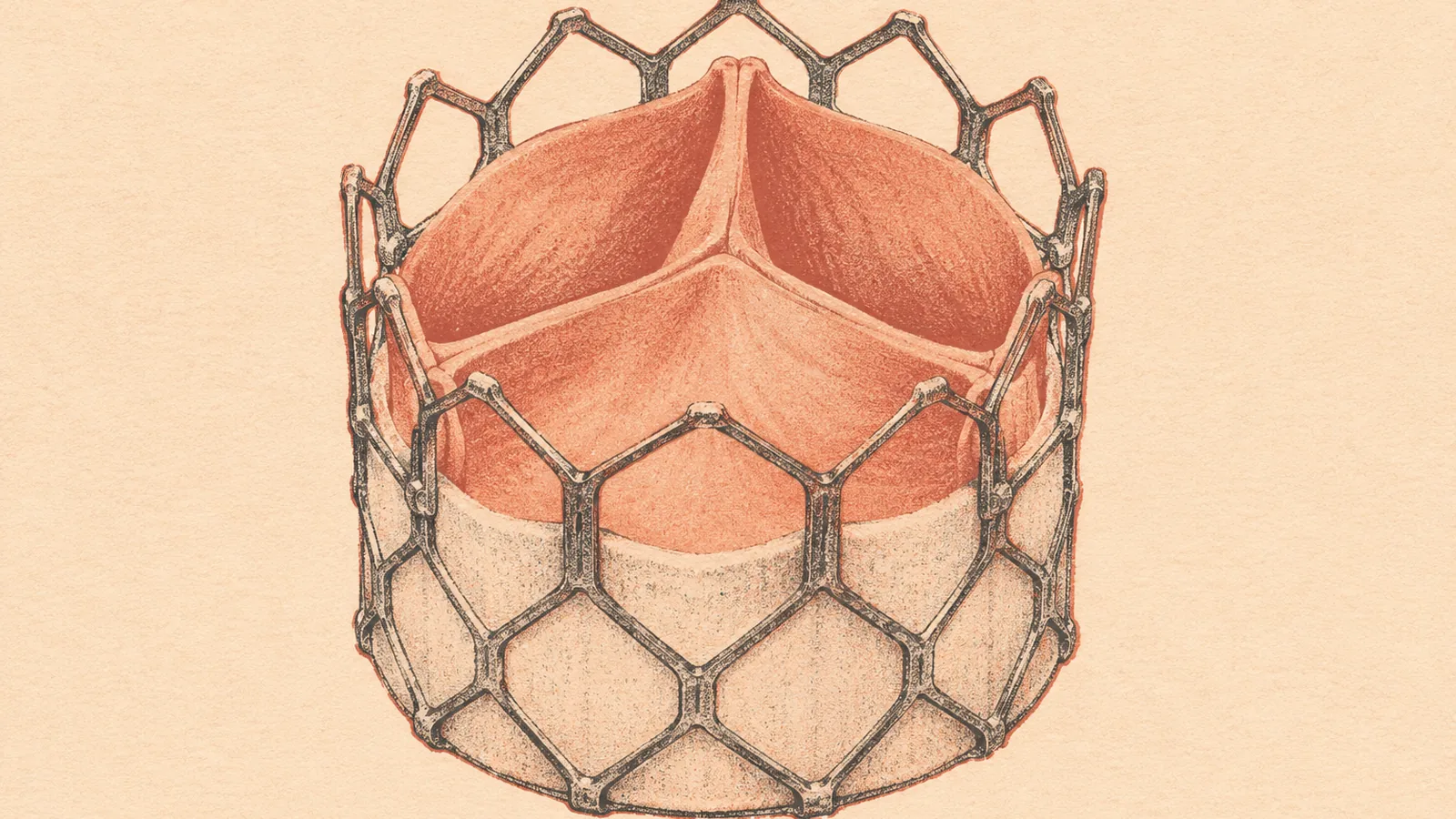
On Monday, Philippe Généreux, director of the structural heart program at Morristown Medical Center in New Jersey, presented the PROGRESS trial at TCT 2026. Much of his audience implants heart valves for a living, and he called his results “a turning point in the way that we see patients with moderate aortic stenosis.” The trial was paid for by Edwards Lifesciences, which makes the valve it tested, and was published the same day in the New England Journal of Medicine. It found that putting in a new valve before a narrowed one turns severe roughly halved the share of patients hospitalized for heart failure over two years. It did not show that those patients lived longer. Deaths ran 8.4 percent among patients who got the valve early and 7.3 percent among those assigned to watch and wait.
Aortic stenosis is a narrowing of the valve the heart pumps blood through on its way to the body. It affects more than 3 percent of adults 65 and older. For moderate disease, current guidelines call for an echocardiogram every one to two years and generally reserve valve replacement for severe disease. Transcatheter aortic valve replacement, or TAVR, delivers a new valve through an artery instead of opening the chest. It began as a procedure for patients too frail for surgery and has since worked its way down the risk ladder, one sponsored trial at a time. Généreux led the previous step, EARLY TAVR, which tested the procedure in patients with severe stenosis and no symptoms. On the strength of that trial, Edwards in May 2025 won FDA approval of its valve for asymptomatic severe aortic stenosis. PROGRESS goes one rung lower, to patients whose narrowing has not reached the grade doctors call severe.
The endpoint with death in its name
PROGRESS randomized 744 patients aged 65 and older at 74 centers in six countries, average age about 78. Of these, 373 received Edwards’ balloon-expandable SAPIEN 3 right away and 371 were assigned to guideline-directed clinical surveillance. Entry required moderate stenosis plus at least one “at-risk” feature, and the list was broad enough to include atrial fibrillation, an ejection fraction under 60 percent, or significant valve calcification. Seventy-two percent of patients had at least two. The federal registry entry names Edwards as sponsor and lists the trial’s masking as “none.”
The primary endpoint was death or a heart-failure event within two years. It occurred in 16.7 percent of the TAVR arm and 23.9 percent of the surveillance arm, an absolute difference of 7.2 percentage points, or one event prevented for every 14 patients treated. Edwards, as RTTNews summarized it, described TAVR as “superior to clinical surveillance in patients with moderate aortic stenosis.”
| Outcome | Early TAVR (%) | Surveillance (%) |
|---|---|---|
| Death or heart-failure event | 16.7 | 23.9 |
| Heart-failure hospitalization | 7.4 | 14.9 |
| Death | 8.4 | 7.3 |
Pull the composite apart and it divides cleanly. Heart-failure events ran 10.8 percent with TAVR and 19.0 percent under surveillance, and heart-failure hospitalizations ran 7.4 percent and 14.9 percent, about half the share of patients admitted. Deaths ran 8.4 percent and 7.3 percent.
The hazard ratios follow the same split. For the composite it was 0.67 (95% CI 0.48 to 0.93), for heart-failure hospitalization 0.48 (95% CI 0.30 to 0.77), and for death 1.14, with a confidence interval running from 0.67 to 1.93 and a p-value of 0.61. That mortality interval is wide enough to hold a meaningful survival benefit or meaningful harm. The trial did not show that early TAVR helps anyone live longer, and it was not built to rule it out. A composite with death in its title was carried by its other half.
| Result | Value (HR) | Lower bound | Upper bound |
|---|---|---|---|
| Death or HF event | 0.67 | 0.48 | 0.93 |
| HF hospitalization | 0.48 | 0.30 | 0.77 |
| Death | 1.14 | 0.67 | 1.93 |
That other half is the part most exposed to the trial’s design. Deciding whether a patient with fluid in the lungs is admitted or sent home on a bigger diuretic dose is a judgment call. In PROGRESS it was made by clinicians who knew whether that patient had received a valve, and no committee reviewing the chart afterward can take back an admission that already happened. The quality-of-life results have the same exposure. On the Kansas City Cardiomyopathy Questionnaire, scores rose 15.5 points within 30 days in the TAVR arm and fell 9.3 points in the surveillance arm, as reported by patients who knew which arm they were in. Open-label assignment does not prove that expectation produced these differences. It does mean that the outcomes most open to expectation are the ones that moved, and death, the outcome least open to it, showed no difference.
The patients who were supposed to wait
Surveillance in PROGRESS did not mean going untreated. It meant watching under guideline care and treating when the disease progressed. Among surveillance patients, 10.6 percent had TAVR by 6 months, 27 percent by 1 year, and 57.4 percent by 2 years, and 81.4 percent of those who crossed over had progressed to severe stenosis. Aakriti Gupta, a co-author, read that as “suggesting that the disease can progress quickly from moderate to severe in some patients.”
| Group | Value (percent) |
|---|---|
| By 6 months | 10.6 |
| By 1 year | 27 |
| By 2 years | 57.4 |
For more than half the surveillance arm, then, PROGRESS compared a valve now with a valve later, once progression produced the indication the guidelines already recognize. Waiting cost some of those patients a hospital stay. The trial did not show that it cost them their lives. Surveillance patients who did get the valve later gained 22.3 points on the same questionnaire within 30 days of their procedure, more than the 15.5 points the early arm gained. Nor can the trial yet identify the surveillance patients who would never have needed a valve at all, the group for whom an early procedure would bring its risks and none of its benefit. The procedure itself was safe in the short term. Major adverse events at 30 days ran 5.9 percent against a prespecified performance goal of 13.7 percent, with no deaths or disabling strokes in the TAVR arm in that first month. That is still an implanted valve, with its wear starting early.
The field has seen this setup before. The TAVR UNLOAD trial tested early TAVR in patients with moderate stenosis and reduced ejection fraction. It was sponsored by the Cardiovascular Research Foundation and funded by an investigator-initiated grant from Edwards. It targeted 600 patients, cut the goal to about half that, and was stopped at 178 because of funding constraints and slow enrollment, which was partly blamed on competition from PROGRESS. Its primary endpoint looked significant at one year and then missed at longest follow-up, a median of 23 months (win ratio 1.31, 95% CI 0.91 to 1.88). Forty-three percent of its surveillance arm crossed over to TAVR, at a median of 12 months, all but three because their stenosis had become severe. The principal investigator, Nicolas Van Mieghem, concluded: “We should not change the current guidelines.” Amar Krishnaswamy of the Cleveland Clinic, looking at how quickly UNLOAD’s patients progressed, said it “does very much for me raise the concern whether what was called moderate AS was in fact severe.” In PROGRESS, 81.4 percent of the patients who crossed over had reached severe stenosis, and so far nobody has answered that question for this trial either.
The perspective Healio ran alongside the results came from Roxana Mehran of the Icahn School of Medicine at Mount Sinai, president of the American College of Cardiology. She called the benefit “tremendous,” with “a major reduction in the hard endpoint of HF hospitalizations and death, mostly driven by HF hospitalizations,” and the results “pretty decisive.” She also said, “I think we need more evidence,” and asked what the findings mean outside the trial’s age limit: “This trial included patients older than 65 years, but if the patients were of younger age, what does that mean?” Healio’s disclosures list consulting fees from Novartis and Novo Nordisk, equity in ControlRad and Stel, and research grants from a long list of drug and device companies for Mehran. Généreux reports consulting, advisory or speaking roles with device makers including Abbott, Edwards and Medtronic, holds equity in several of those firms, and is principal investigator for two Edwards-sponsored trials.
None of that is hidden. It does put the burden of proof on the people asking to move the line. Lowering the treatment threshold from severe to moderate would turn a large watch-and-wait population into a procedure population. The evidence offered so far is fewer hospitalizations in an open-label trial, funded by the valve’s maker, in which more than half the comparison arm received the same valve within two years. Whether a valve implanted early, in patients averaging 78, holds up for as long as they need it is unknown in this population. The investigators plan to follow participants for 10 years to see whether fewer heart-failure events ever become longer survival, and to assess durability.
Edwards shares closed Monday at $93.26, up 1.36 percent. The company reports third-quarter earnings on Wednesday.
Sources
- New England Journal of Medicine: TAVR in Patients with Moderate Aortic Stenosis with At-Risk Features (PROGRESS), 2026
- Healio: TAVR benefits high-risk patients with moderate aortic stenosis
- SOLACI: TCT 2026 PROGRESS trial, TAVI vs. clinical surveillance in moderate aortic stenosis
- ClinicalTrials.gov: PROGRESS, NCT04889872
- Medical Xpress: Earlier valve replacement benefits some patients with moderate aortic stenosis
- Journal of the American College of Cardiology: TAVR in Patients With Moderate Aortic Stenosis and Heart Failure (TAVR UNLOAD), 2025
- TCTMD: TAVR UNLOAD, No Rush to Do TAVI in HFrEF Patients With Moderate AS
- Business Wire: Edwards TAVR Receives FDA Approval for Patients With Asymptomatic Severe Aortic Stenosis (2025)
- RTTNews: Edwards’ TAVR cuts risk of death or heart failure events in moderate aortic stenosis trial
- MedPage Today: Upfront TAVR May Be the Way Forward in Moderate Aortic Stenosis, Trial Suggests