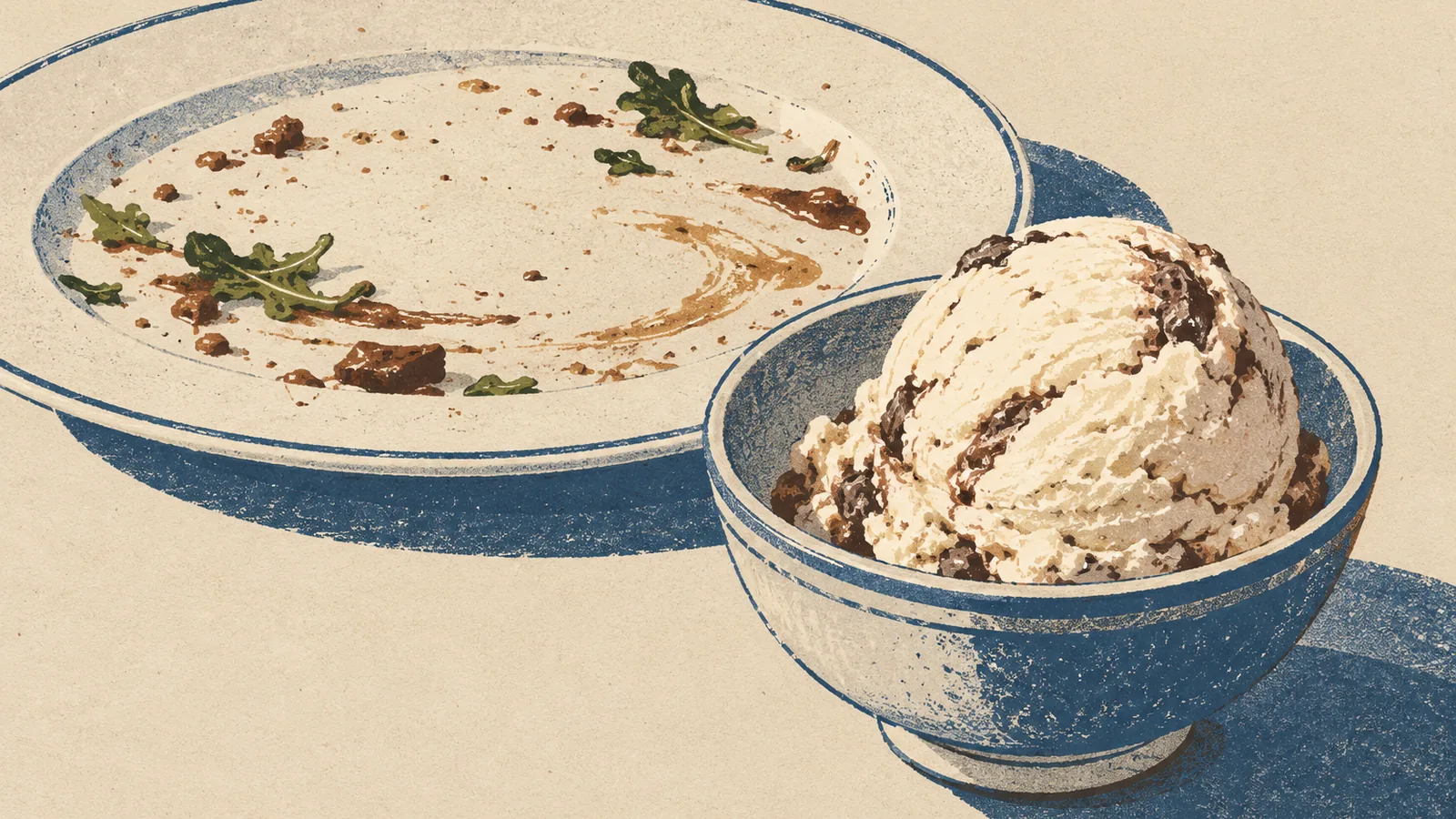
My working theory of the after-dinner sweet tooth has always been moral. The plate is cleared, my waistband is tighter, and some part of me is already opening the freezer to check on the ice cream, a habit I’ve filed for years under weak moment. So when appetite researchers at the University of Leeds published a review asking why food stays appealing after a satisfying meal, my first question was a little defensive: is this biology, or am I just bad at stopping?
Their own lab had already run the test that answers half of it. In an experiment published in Appetite in 2008, 70 young adults with an average age of about 22 sat at a computer while hungry and again right after a savory test meal. They rated food photos for how pleasant each would taste and how much they wanted it, then raced through a forced-choice round, picking one of two foods over and over while the computer timed every decision. The researchers turned those choices and reaction times into a score they call implicit wanting, a pull you never have to put into words.
After the meal, hunger fell and the ratings fell with it, for every category of food, though more steeply for savory foods than for sweet ones. Implicit wanting for the sweet categories, meanwhile, went up (p<0.01), while savory stayed flat. Hunger tracked the ratings closely and had no relationship at all to the timed measure.
Wait, why would a body that has just been fed start picking cake faster? Sensory-specific satiety is the explanation the authors favor, and it fits my freezer habit uncomfortably well. As you eat, pleasure fades fastest for the flavors actually landing on your tongue, so what you’re logging isn’t “food, finished” but “this salty, meaty thing, finished.” The sweets on the screen got dimmed less, and next to a plate’s worth of tired savory options they start winning the head-to-heads. That’s a reshuffled leaderboard, not proof that dinner makes you crave sugar more in absolute terms, since the sweet ratings dropped too. It’s also a pretty exact description of what the “dessert stomach” feels like from the inside.
The new review, published October 27 in the Proceedings of the Nutrition Society, builds its whole argument on that split. Graham Finlayson, John Blundell and five colleagues separate liking, the pleasure a food gives you, from wanting, the motivational pull that gets you out of the chair to go and fetch it. A meal turns both down unevenly, and dessert lives in the gap. They also throw out the pop-science line that dopamine is simply a “wanting chemical,” crediting opioid-related hotspots with amplifying pleasure and a broader set of reward circuits with the pull. Clock time seems to matter too: in a study of 44 young adults the review describes, liking and implicit wanting for high-fat foods, relative to low-fat ones, ran higher in the late afternoon or early evening than in the morning, which is roughly when most of us end up staring into the freezer.
Then the review walks into the snack aisle. “Hyperpalatable” food is usually defined by nutrient pairings (fat with sugar, fat with salt, or carbohydrate with salt), which describes most of what comes in a crinkly bag. In an analysis of 2,733 meals from four controlled diets, meeting those pairing criteria, along with energy density and eating speed, was each linked to eating more when people could eat as much as they liked. Across three UK online surveys of 3,364 adults, a food’s nutrient makeup explained about 20% of the variation in how much people liked it but 40–60% of the variation in how much they said they overate it for pleasure. The authors won’t say engineered food hijacks wanting, because the surveys never measured actual eating and a nutrient pairing is a recipe rather than a mechanism. Fair enough. But that recipe is a product decision, and the companies building snacks on fat-plus-sugar and fat-plus-salt now face data tying exactly those combinations to bigger meals in a controlled setting and to people’s own sense that they keep eating past enjoyment. “It just tastes good” doesn’t cover a formula that accounts for two to three times as much of the variation in overeating as in liking.
I had assumed a GLP-1 drug would simply turn the whole wanting dial down, and the evidence the review lays out refuses to cooperate. A 2018 systematic review it cites found 17 long-term weight-management studies that tracked food reward; reward changed in 12 of them, but only 3 linked that change to better weight outcomes. In a 12-week crossover trial of 30 adults with obesity, semaglutide lowered implicit wanting for high-fat savory foods (P = .0203), and people ate about 35% less of the high-fat savory items in an evening snack box. Implicit wanting for low-fat sweet foods went up (P = .0401). So what is a drug doing to desire when it quiets the pull toward chips while nudging it toward sweet, low-fat options? In the ranking task, at least, it makes the same move dinner made: it reshuffles the menu.
| Measure | Part | Whole |
|---|---|---|
| long-term studies linking a reward change to better weight outcomes | 3 | 17 |
A longer trial shows how slippery the “food noise” claim gets. In a 60-week trial that randomized 120 adults with overweight or obesity to semaglutide 2.4 mg or placebo, the drug group reported less hunger, better appetite control and fewer food thoughts through week 20, but by weeks 40 and 60 many of those differences from placebo were no longer statistically significant. At a lab lunch where they could eat as much as they wanted, people on semaglutide still ate roughly 24% to 30% fewer calories than the placebo group at follow-up assessments through week 60, and they ended having lost 15.1% of their body weight, compared with 3.4% on placebo. The review calls reports that these drugs quiet food noise “clinically important but mechanistically ambiguous,” and this trial shows why, since the eating stayed down while the self-reported appetite edge faded. Lower intake held for more than a year, which counts for a lot. It isn’t proof the shot rewired what you want, whatever you’ve heard about it silencing food noise.
Now the money behind the drug data. The review declares no specific grant and lists its competing interests as “None.” Three of its authors, Blundell, Finlayson and Catherine Gibbons, also wrote that 12-week semaglutide trial, which Novo Nordisk funded, alongside four Novo Nordisk employees; Blundell and Gibbons took Novo research grants for that study, and Blundell disclosed personal fees from the company outside it. The 60-week trial was supported in part by a Novo Nordisk investigator-sponsored grant, though its authors say the company had no role in running or reporting it. The crossover trial is nine years old, outside the window most journals ask authors to disclose, so “None” may be accurate by the rules, and the review is noticeably cooler on these drugs than a sales deck would be. You should still know that the semaglutide evidence it weighs was paid for, wholly or in part, by the company that sells semaglutide.
None of this turns a lab score into a craving meter. The authors say plainly that theirs is a selective narrative review leaning on their own Leeds task, and that evidence tying changes in liking or wanting to clinical outcomes remains limited. Still, it moves my dessert habit out of the willpower column: a savory dinner is exactly the setup that pushed sweets up the rankings in that lab, and I eat one most nights. So I’m done treating the pull as a character flaw, and I’m done keeping a pint of ice cream in the freezer as a standing invitation.
Sources
- Proceedings of the Nutrition Society: Finlayson et al., Liking, wanting and the limits of satiety (2026)
- Appetite: Finlayson, King and Blundell, The role of implicit wanting in relation to explicit liking and wanting for food (2008)
- Diabetes, Obesity and Metabolism: Blundell et al., 12-week semaglutide crossover trial on appetite, energy intake and food preference (2017)
- Newswise: Penn Medicine release on Tronieri et al., 60-week semaglutide trial in the American Journal of Clinical Nutrition (2026)
- News-Medical: Why you still want dessert even when you’re completely full (2026)