I spent most of my life assuming human blood came in eight tidy flavors: A, B, AB, O, each with a plus or a minus. It is the version we all learn, the one printed on the donor card, the one I would have bet money on. The real count of blood group systems just ticked up to 47, and the 47th reads like a detective novel with a body count that almost was.
The new system is called MAL, and it closes a case that had been open since 1972. That year, hematologists spotted a red-cell surface marker they named the AnWj antigen. More than 99.9 percent of people carry it. A tiny, unlucky few do not, and if one of them receives ordinary donor blood, their immune system can read those transfused cells as a foreign invader and attack them. The reaction can be serious. For more than fifty years nobody could say why some people lacked the antigen, which meant nobody could reliably find them before a transfusion went wrong.
A team led by NHS Blood and Transplant’s International Blood Group Reference Laboratory in Bristol, working with the University of Bristol and UWE Bristol, finally named the culprit in 2024, in the journal Blood. The answer is a single gene, MAL, which builds a small membrane protein of the same name that sits on the surface of red cells. Carry two working copies and you make full-length Mal protein and test AnWj-positive. Inherit two broken copies and the protein never gets made, the antigen never appears, and you become one of the rarest blood types on Earth.
The obvious question, the one a curious person asks before the scientists do, is why an antigen known since 1972 took until now to explain. Louise Tilley, the senior scientist who led the hunt, has an answer that doubles as a confession: she had personally been trying to resolve it for almost 20 years of her career. Two decades on one gene. So why would something this fundamental stay hidden for so long?
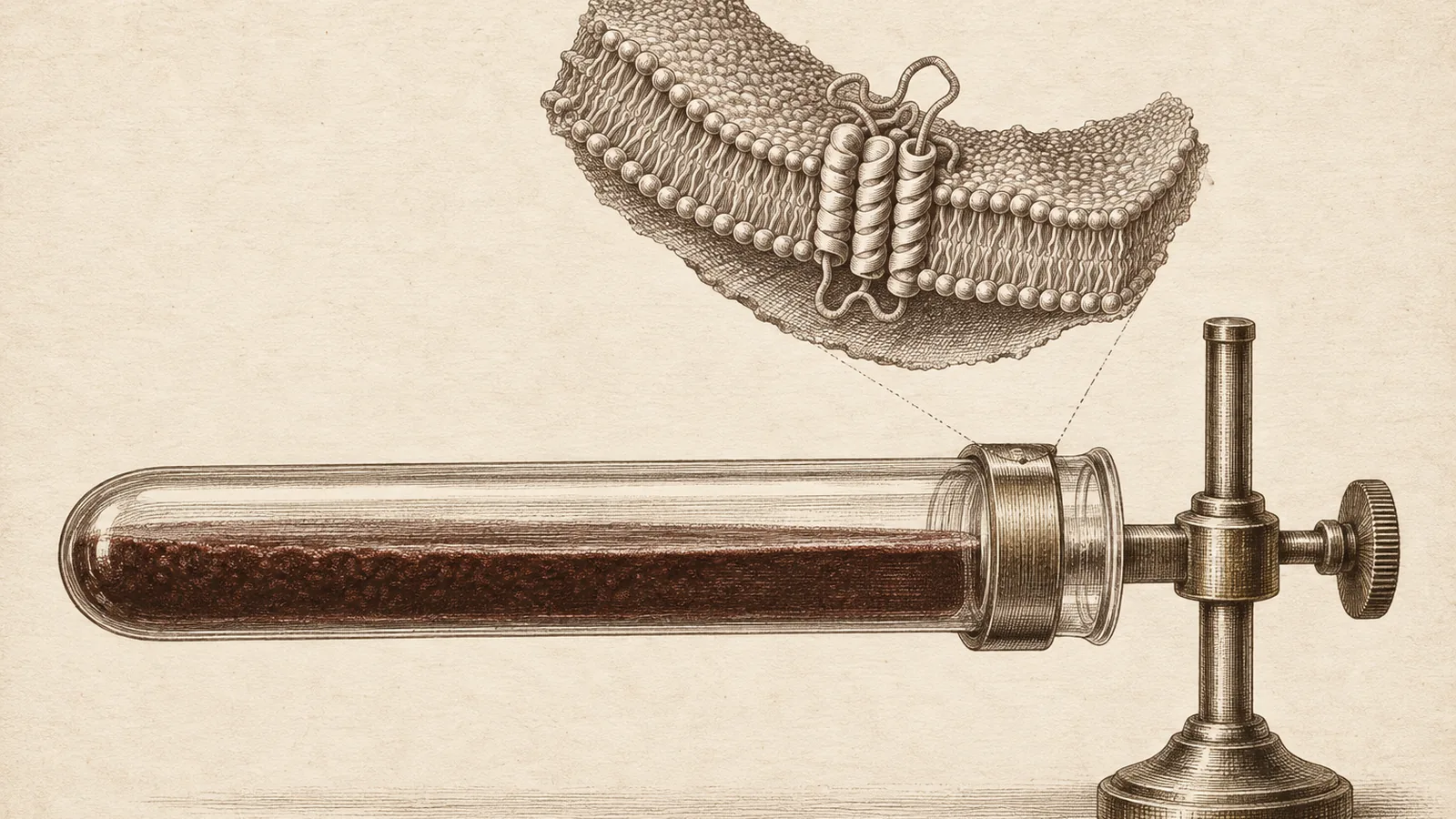
Because Mal is an awkward little protein. Tim Satchwell, one of the authors, called it very small, with some interesting properties that made it hard to isolate. That is where I stopped skimming and started actually reading. The big antigens sit up proud on the cell surface where you can grab them; Mal tucks into the membrane and keeps quiet. You cannot fish out what you cannot grip, and for decades the tools simply were not fine enough.
So the team went after the blueprint instead of the protein. They ran whole exome sequencing on the rare people who tested AnWj-negative and kept finding the same thing: homozygous deletions in MAL, both copies missing the same stretch. Just five genetically negative people turned up, including members of one Arab-Israeli family. Then came the step that turns a correlation into proof. Ash Toye’s group took blood-forming cells and switched the normal MAL gene back on, and the AnWj reactivity reappeared; feed the cells the mutant version and nothing came back. The protein was not merely linked to the antigen, it was the antigen’s home. You can rebuild the marker by handing the cell the right instructions, which is about as clean as biological proof gets.
The catch, and the announcement moves past it quickly, is that there are two ways to end up AnWj-negative, and this discovery only cracks one of them. The inherited form, the two-broken-copies version, is vanishingly rare. The common way to lose the antigen is acquired: certain blood cancers and hematological disorders switch its expression off later in life, and those patients are the majority of AnWj-negative cases. A genotyping test that scans for a MAL deletion will not flag them, because their gene is intact; their cells have simply stopped displaying the protein. So the new test is a gift for the rare inherited patients and for finding them matched donors, but it is not a universal AnWj detector, and a triumphant headline could easily blur that line.
There is also the unglamorous part. Knowing the gene lets you design a test, but a test only saves someone if the blood service screens for it, banks the rare compatible units, and can find a match fast when a patient is bleeding. That is logistics and money, not molecular biology, and it is exactly where rare-blood patients have always fallen through a system built around the common types. Credit where it is due: this was public science, funded through the UK’s NIHR Blood and Transplant Research Units and the national blood service, with no drug company’s name on the paper and nothing to sell at the end. A two-decade slog on a problem that helps a few hundred people and turns a profit for no one is the kind of research that almost never gets funded, and the kind we should want more of.
I give blood, and I have always handed over my arm on autopilot, trusting the little sticker on my file to tell the whole story. It does tell the truth, as far as it goes. It just does not know everything my blood might do inside someone else’s veins, and for the rarest patients that blind spot took more than fifty years and one nearly invisible protein to close. I will keep donating. I have stopped treating “compatible” as a simple yes or no, because for a handful of people it never was.
Sources
- Blood (American Society of Hematology) – Tilley et al., “Deletions in the MAL gene result in loss of Mal protein, defining the rare inherited AnWj-negative blood group phenotype” (2024; 144(26):2735)
- NHS Blood and Transplant – NHSBT-led team discovers new blood group system, MAL
- University of Bristol – Researchers discover new blood group system, MAL (September 2024)
- ScienceDaily – Scientists solve a 50-year mystery and discover a new human blood group