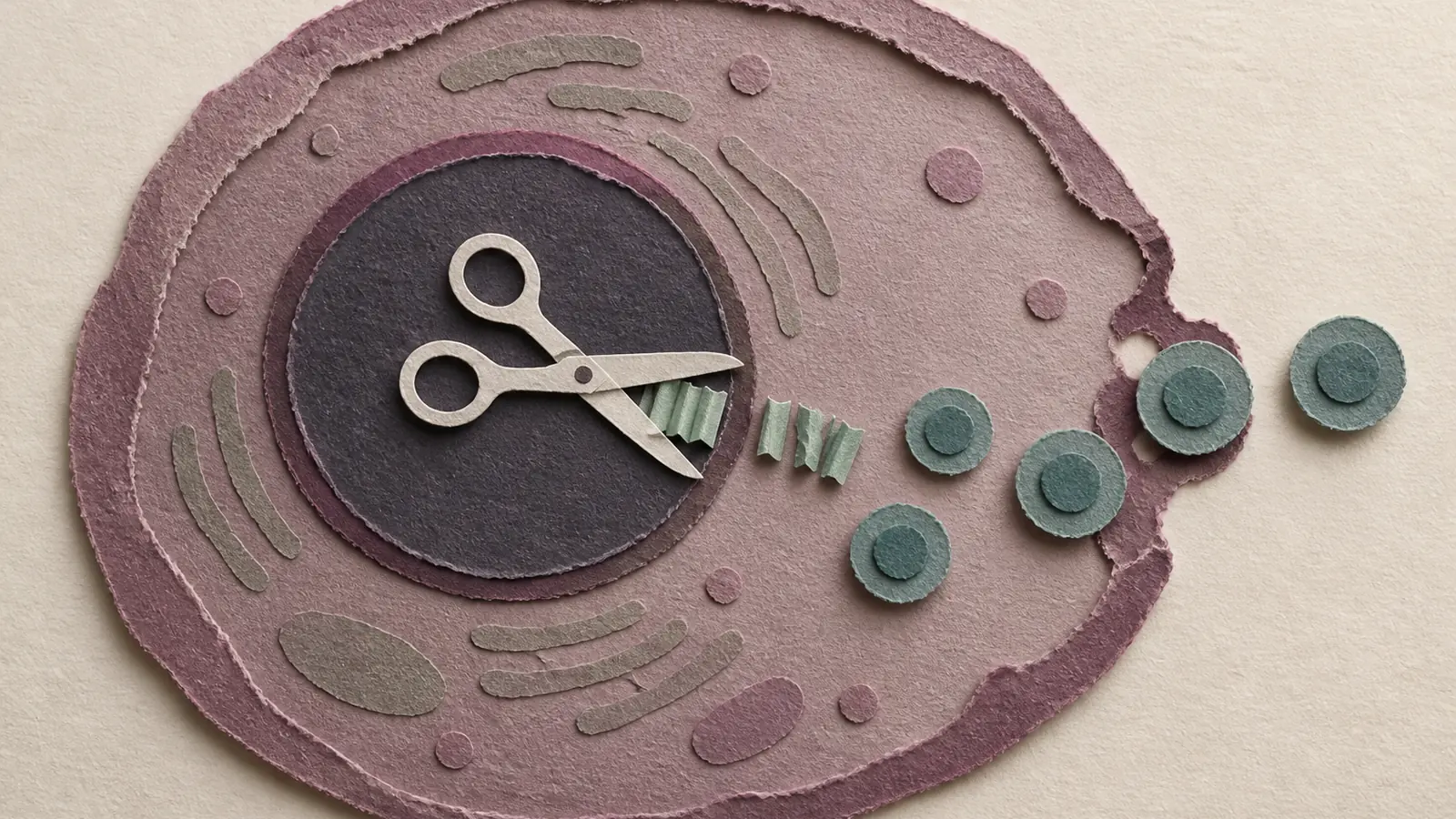
I learned caspase-3 as the executioner. It is the enzyme your cells switch on when it is time to die cleanly, the molecular scissors that snip a cell apart from the inside during apoptosis so nothing leaks and nothing inflames. One job, final and tidy. So when I read that the same enzyme also carves an anti-cancer alarm bell, I did not believe it. The cleanup crew does not also call in the hunters. Except it does.
The surprise runs through interleukin-18. Its textbook life is simple: caspase-1 trims the precursor into an 18-kilodalton mature form, the cell secretes it, and it docks onto its receptor on a neighboring immune cell to fire an inflammatory signal. What Guangxun Meng’s lab at the Shanghai Institute of Immunity and Infection and Chenying Liu’s team at Xinhua Hospital found is a second cut. In cancer cells, caspase-3 slices the same protein at a different spot and leaves a stubbier 15-kilodalton piece they call short IL-18. And short IL-18 breaks every rule the mature form follows. It is never secreted and never leaves the cell; instead of drifting out to a receptor, it turns around and goes inward.
Inward, as in into the nucleus. The commentary in Signal Transduction and Targeted Therapy lays out the route: caspase-3 cleaves after residue D69 in mice (D71 or D76 in humans), and the fragment slips into the nucleus even though it carries no nuclear localization signal, the molecular badge a protein normally needs to get through the door. It appears to hitch a ride through the nuclear pores instead. Why would a chopped-up cytokine sneak into the nucleus with no ticket? That is the question the study chases, and it is the one that pulled me in.
Once inside, short IL-18 grabs a kinase called CDK8 and cranks up its activity. That drives phosphorylation of STAT1 at serine 727, which switches on a transcription program, and the cell starts pouring out ISG15, a small ubiquitin-like protein. ISG15 leaves the cell and rings the doorbell on natural killer cells, docking onto their LFA-1 integrin. The NK cells wake up and come hunting. The shape of that is almost too neat: a tumor cell under stress flips on its own death enzyme, and that enzyme carves the exact signal that summons the cells built to kill it. The executioner does not only clean up the body. It leaves the address.
The evidence that this suppresses tumors is preclinical, and I want to be precise about that. In the Nature paper, the team ran it across three mouse cancers: a breast carcinoma, a colorectal line, and melanoma. Knock down IL-18 and the tumors grew faster; put back a cleavage-resistant version and NK cells stopped infiltrating. Block the ISG15 receptor on the NK cells and the tumor-suppressing effect collapsed, the kind of clean loss-of-function result that makes a mechanism believable. In human tissue, colorectal cancer patients whose tumor nuclei were rich in short IL-18 lived longer overall, especially when their STAT1 was switched on too.
There is an honest gap here, and the field’s own admirers point right at it. Whether caspase-3 is really the scissors doing this inside a living animal, rather than in a dish, has not been nailed down, and other apoptotic proteases could in principle cut the same site. The commentary says as much, noting that cancer cells with caspase-3 deleted are urgently awaited to prove the enzyme is actually responsible. Until someone runs that knockout, the central claim rests on strong inference, not a closed case. I buy the mechanism, and I still want to see that experiment.
One thing I appreciate: the record lists only government science funders behind this, the National Natural Science Foundation of China and the Chinese Academy of Sciences among them, with no company’s name and no industry sponsor disclosed. That does not make the result true, but nobody here is racing a recombinant product to a commercial milestone. It also means the obvious next step, some injectable short IL-18, does not exist. And it cannot be bottled: this molecule does its work inside a cell’s own nucleus, so any “IL-18 booster” on a supplement shelf is selling you a pathway no pill can reach.
So what do I do with it? Nothing to my routine, and I would side-eye anyone who told me otherwise this early. But I am keeping one eye on ISG15, because if this pathway holds, that little protein is the lever, the messenger that turns a dying cell into a beacon, and it is where I would bet the next round of NK-cell cancer work quietly builds. I would not wait for a headline to start watching it.
Sources
- Nature Immunology – Shen et al., Short IL-18 generated by caspase-3 cleavage mobilizes NK cells to suppress tumor growth (2025)
- Signal Transduction and Targeted Therapy – commentary: a short IL18 cleavage product promotes cancer immunosurveillance (2025)
- EurekAlert / Chinese Academy of Sciences – Researchers discover anti-cancer potential of immune modulator’s short form (2025)
- PubMed – record for the study, PMID 39891018