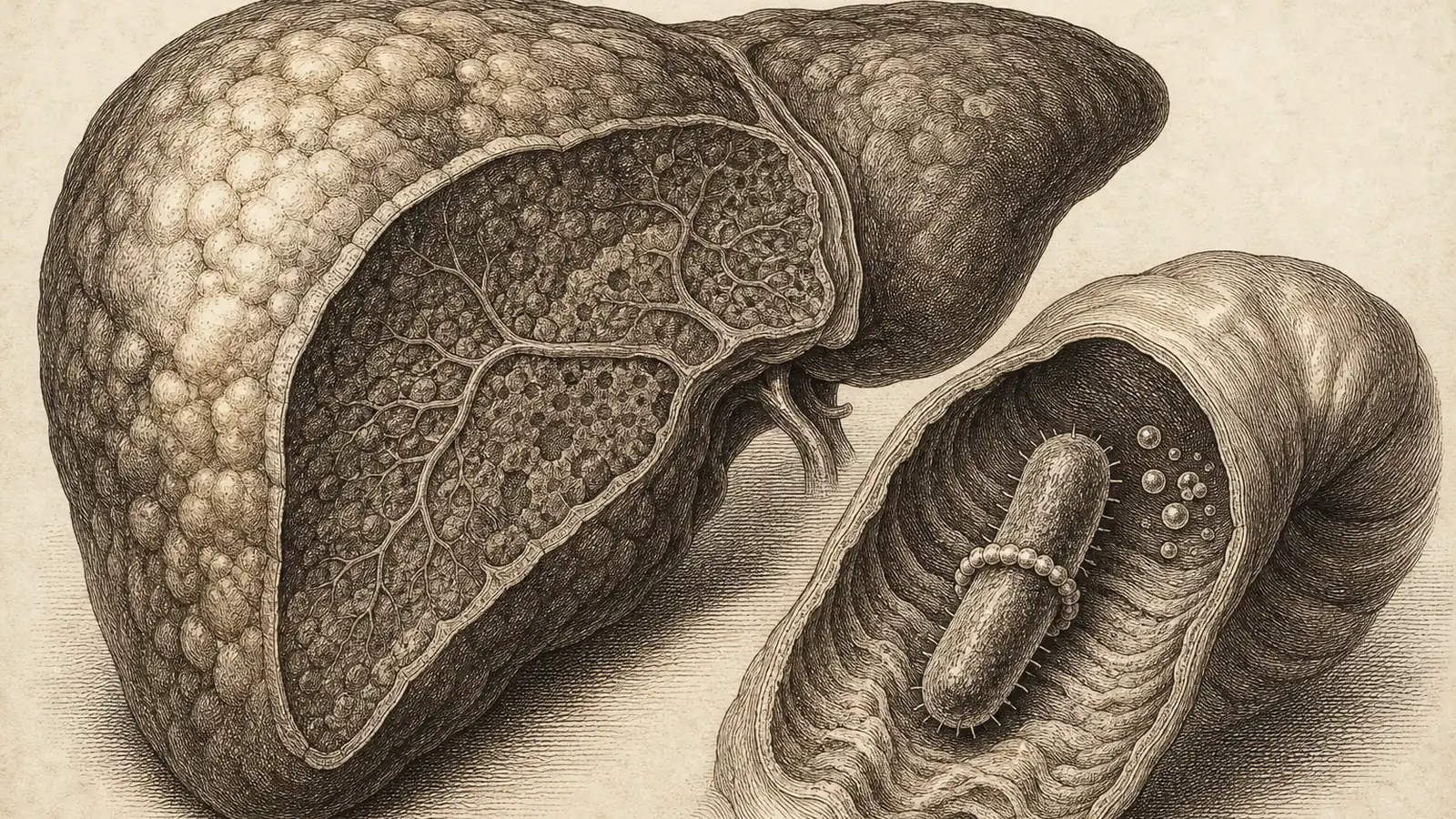
For years I filed fatty liver under problems that live inside the liver. Too much sugar, too much fat, too many spare calories the body parks in an organ that was never meant to be a pantry. Fix the diet, drop the weight, fix the liver. So the study that stopped me this week did something I did not expect: it left the liver alone and went after a bacterium in the gut, one quietly pumping out ammonia, and eased liver disease in monkeys by throttling it. The catch is who ran the experiment.
The disease is MASH, metabolic dysfunction-associated steatohepatitis, the aggressive form of fatty liver that scars the organ and can march it toward cirrhosis, liver cancer, and outright failure. It is not some niche condition. By the reckoning of an accompanying commentary in the Journal of Clinical Investigation, fatty liver in its broad form now sits in roughly 38 percent of the global population, and MASH is its dangerous, scarring slice. Until recently there was almost nothing to offer these patients but lose weight and hope.
So how does a bug in your intestine reach up and inflame your liver? The Michigan team, led by Eugene Chen, traces a very physical chain. A gut bacterium, Clostridium perfringens, runs an enzyme called nitrite reductase A that pumps out ammonia. The ammonia pours into the gut and springs leaks in the intestinal wall that is supposed to keep microbial waste sealed inside the tube. Once that wall gives, ammonia and other bacterial products flood up the portal vein straight into the liver, where they set off a specific immune crew, CD8+ T cells, that switch on an inflammatory signal (the paper pins it to FosB driving a chemokine called CCL5) and start burning the liver down from the inside.
DT-109 breaks the chain at the first link. It is not an exotic biologic, it is a three-amino-acid peptide, glycine-glycine-leucine, small enough to describe in one breath. In mice and then in nonhuman primates, whose gut and liver biology sit much closer to ours than a mouse’s, it knocked back C. perfringens, ammonia production dropped, the gut barrier tightened, and the T cells that had been going off like a smoke alarm settled. The researchers reported less liver inflammation and improved MASH severity. “DT-109 connects microbiota modulation with liver protection by restoring gut barrier integrity,” co-author Jifeng Zhang said. The liver never got a drug at all. The gut did, and the liver healed downstream.
Now, the press releases say DT-109 “reverses” severe fatty liver. The paper is more careful. Its own title says the disease is “attenuated,” not reversed, and the independent commentary in the same journal calls full reversal of established MASH “an important open question.” That gap between the headline verb and the paper’s verb is worth holding onto.
The gut-liver connection itself is old news. Reviews have linked a disturbed microbiome to fatty liver for years, mostly as correlation, mostly as “these people’s microbiomes look different.” What this team did was name a specific bug, a specific enzyme, a specific toxin, then remove it and watch the disease retreat. That is the jump from “associated with” to “caused it,” and it is why the study got attention.
Who owns the peptide
Here is what the press releases glide past. DT-109 did not come from a neutral academic bench. It came from Diapin Therapeutics, a University of Michigan startup founded by Chen, the study’s senior author. Chen and several co-authors hold patents on the compound, Chen and the university hold ownership stakes in the company, and Diapin both supplied the drug and continues to develop it. So the people who stand to profit if DT-109 works are the same people who ran the experiment showing it works. That does not make the biology wrong. It does mean the result needs independent hands to reproduce it before anyone calls it settled, and I would want to see exactly that before I got excited on a patient’s behalf.
There is a second flag. DT-109 is a molecule that keeps finding new diseases to treat. The same peptide has been pitched for atherosclerosis and vascular calcification, and now for MASH. Sometimes a compound really is that versatile. Sometimes a small company with one asset needs it to be. I hold both possibilities open.
The independent commentary is refreshingly unwilling to oversell. Its authors note that while C. perfringens makes ammonia, it “has not been widely associated in human MASH cohorts as a central player,” and that a bug with far stronger human ties, Klebsiella pneumoniae, may matter more in actual patients. They flag that it is unclear whether ammonia directly reprograms the liver’s own T cells or works more indirectly. Put plainly: this worked in animals, on a bacterium that may not be the human ringleader, and no human MASH trial stands behind the peptide yet.
That last point matters because there are already approved MASH drugs a patient can get today. The same commentary notes resmetirom improves liver fibrosis on biopsy in about 25 percent of patients, and semaglutide resolves MASH in roughly 60 percent, with about 37 percent seeing fibrosis improve. Different endpoints, same lesson: DT-109 is years and at least one human trial behind both.
So what do I take from a founder’s monkey data? The gut-liver ammonia route is what I find most convincing here, and it points where I already lean: the health of that intestinal barrier is not a side quest, it carries the load for organs far downstream. I will keep feeding my gut like it matters, because on this evidence it clearly does. But founder-run animal data is a reason to watch, not a reason to want the peptide. I would not chase DT-109, and I would not wait on it. What I am watching is the ammonia route, not the pill.
Sources
- Journal of Clinical Investigation – Chen et al., MASH exacerbated by Clostridium perfringens-derived ammonia is attenuated by tripeptide DT-109 (2026)
- Journal of Clinical Investigation – Commentary: Ammonia in the crosshairs, microbial targets for MASH (2026)
- Michigan Medicine Health Lab – Drug candidate treats severe fatty liver disease by protecting the gut in animal models (2026)
- ScienceDaily – Experimental drug reverses severe fatty liver disease by repairing the gut (2026)
- Signal Transduction and Targeted Therapy – Tripeptide DT-109 (Gly-Gly-Leu) attenuates atherosclerosis and vascular calcification in nonhuman primates (2025)
- Frontiers in Gastroenterology – Gut microbiome in non-alcoholic fatty liver disease (2025)