I have spent years telling people to eat more fiber for the sake of their own gut. It genuinely never occurred to me that I might also be setting the dinner table for a tapeworm, and that whether the worm does anything useful might hinge on what I put on the plate.
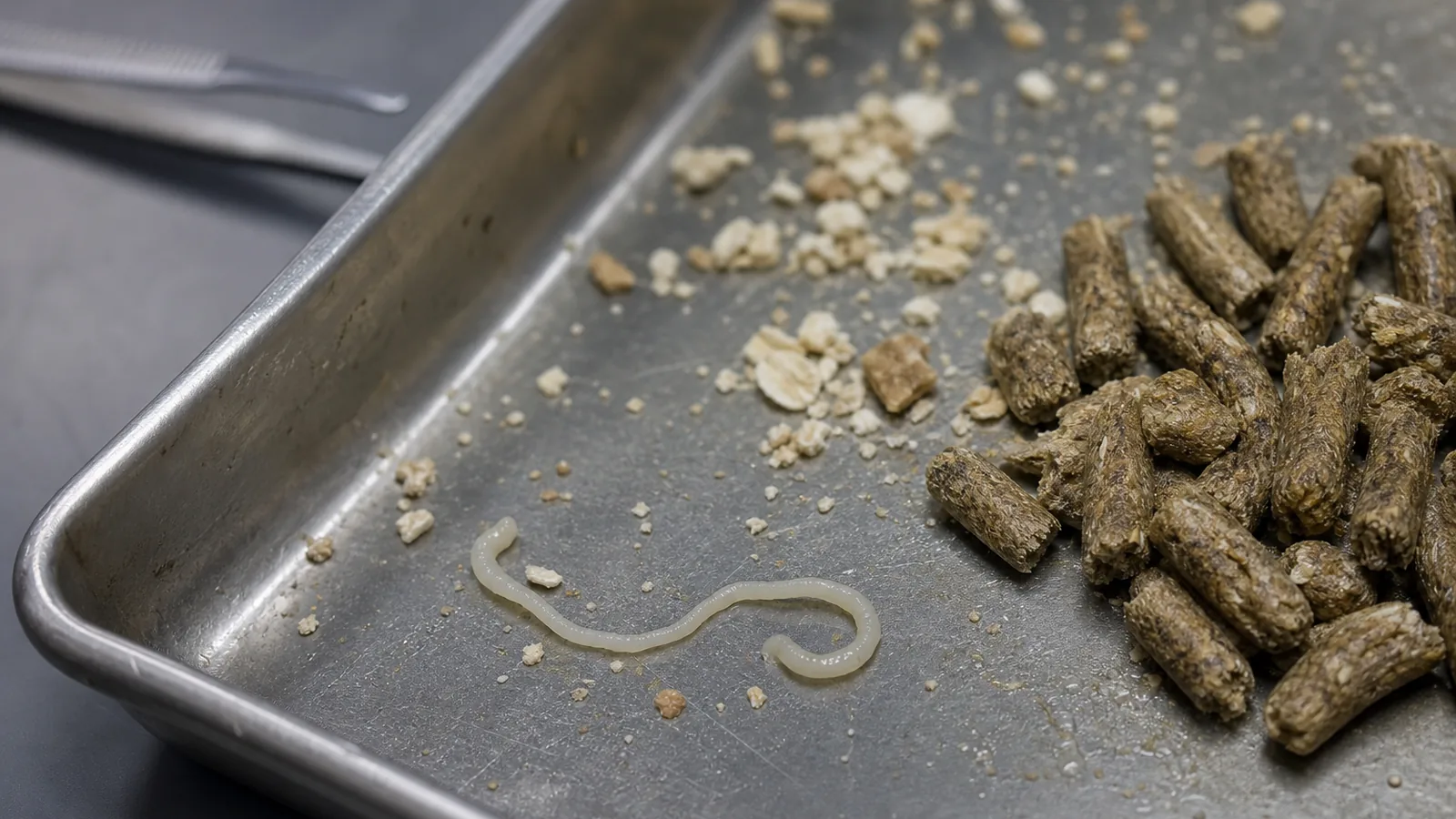
That is the strange little door a team at the Biology Centre of the Czech Academy of Sciences just opened. In a study published in Nature Communications, the researchers fed rats either a high-fiber diet or a lean, Western-style low-fiber one, and then watched what happened to a very particular guest living inside them: Hymenolepis diminuta, the rat tapeworm. On the fiber-rich diet the worm grew to full size, matured, laid eggs, and did the thing the whole field cares about, which is nudge the host’s immune system toward an anti-inflammatory state. Strip the fiber out, drop it to the intake most of us in the industrialized world actually live on, and the same worm switched all of that off. It stayed several times smaller. It never reached sexual maturity. It stopped laying eggs. And its anti-inflammatory effect simply disappeared.
That is what got me sitting up. This worm is not the researchers’ villain. It is their therapeutic model, a non-pathogenic species they study precisely because, under the right conditions, it calms inflammation instead of causing disease. Whether it calmed anything at all turned out to hinge on one variable: what the rat was eating.
“When fiber is lacking, the worm enters an energy-saving state resembling hibernation in mammals, and its anti-inflammatory effect disappears,” said Kateřina Jirků of the Institute of Parasitology, describing the finding to SciTechDaily. Hibernation. The worm does not die when you starve it of fiber. It powers down, pulls into itself, and runs on the metabolic equivalent of a pilot light until conditions improve.
So of course the question I kept circling was: wait, why would a tapeworm care how much fiber I eat? It has no teeth for a carrot. It cannot digest a bran flake. And that is exactly where the biology gets good, because the worm is not eating your fiber. Your bacteria are. When the researchers looked at what changed in the gut, the pattern was the one microbiome people have been sketching for a decade. A high-fiber diet fed the bacteria linked to a healthy gut and kept microbial diversity high; the low-fiber, Western-style diet dropped that diversity and let bacteria linked to dysbiosis expand into the empty space. The worm is reading the room. It senses the state of the bacterial neighborhood it lives in, and it develops one way in a thriving gut and another way in a depleted one.
The researchers call this developmental plasticity, and it rearranged how I think about the whole idea. The tapeworm does not run a fixed program. It has options. Given a fiber-fed, bacterially rich environment, it runs the full sequence: grow, reproduce, and shift the host toward a calmer, more tolerant immune posture. Given a barren one, its gene expression throttles down across development, metabolism, and reproduction, and it stops investing in the machinery that quiets your immune system. The paper does not pin down which molecules the worm sends across to do the calming, and that matters for honesty here, but the direction is clear: in this rat gut, the anti-inflammatory effect was conditional on a fiber-supported ecosystem, not a fixed trait the worm carries around regardless of what you feed it.
Now hold that next to something that has quietly frustrated this field for years. Helminth therapy, the deliberate use of gentle parasites like this one to treat autoimmune and allergic disease, rests on a serious idea. The biome-depletion thesis, associated in part with co-author William Parker, argues that scrubbing worms and microbial “old friends” out of the modern gut helped leave our immune systems trigger-happy, prone to attacking our own tissue and harmless allergens. Worms, the theory goes, nudge the immune system away from that hyperactive posture and toward regulatory tolerance. It is a compelling story, and the human trials have been inconsistent. Some patients improve. Many do not. The field has spent a lot of energy arguing about dose and species.
This study raises a quieter, more uncomfortable possibility: maybe some of those worms were starving. If a Western-diet gut puts an anti-inflammatory helminth into hibernation, then a trial that recruits patients eating a typical low-fiber Western diet may have been dosing dormant worms and reading the flat result as a failure of the therapy. The one variable nobody was controlling sat on the participants’ plates. I find that both humbling and a little thrilling, because it means the treatment may not have been broken so much as unfed.
I want to be careful about how far this travels, because I have watched too many mouse-and-microbiome findings get sold as human cures. This is rats and rat tapeworms. Nobody measured a single human autoimmune outcome, and the study does not yet show the human pathway or any clinical payoff. What it shows is a mechanism, elegant and testable, and a real reason to go back and ask whether failed helminth trials were fair tests of the worm at all.
But the finding that actually reaches my own kitchen needs no worms at all. The bacteria doing the work are already in there. Health guidelines put the target at 25 to 30 grams of fiber a day, and most of us in the West miss it; the traditional and hunter-gatherer diets our guts evolved alongside ran closer to 80 to 120 grams. That gap is what starves the neighborhood, worm or no worm. I came into this expecting to roll my eyes at another “good parasite” headline and left thinking the more interesting character was the fiber. I am not about to swallow a helminth. I am, tonight, going to eat the beans I keep meaning to eat, because whatever calm my gut can manage runs on feeding the bugs already living there.
- Nature Communications – “Developmental plasticity enables an intestinal tapeworm to adapt to dietary stress” (2026)
- Biology Centre CAS – “Gut microbiome thrives on fiber – tapeworms confirm it”
- SciTechDaily – “The Surprising Diet Rule That Makes ‘Good’ Parasites Work”
- ScienceDaily – “Scientists discover the one nutrient beneficial parasites can’t live without” (2026)
- Helminthic therapy and the biome-depletion thesis – background