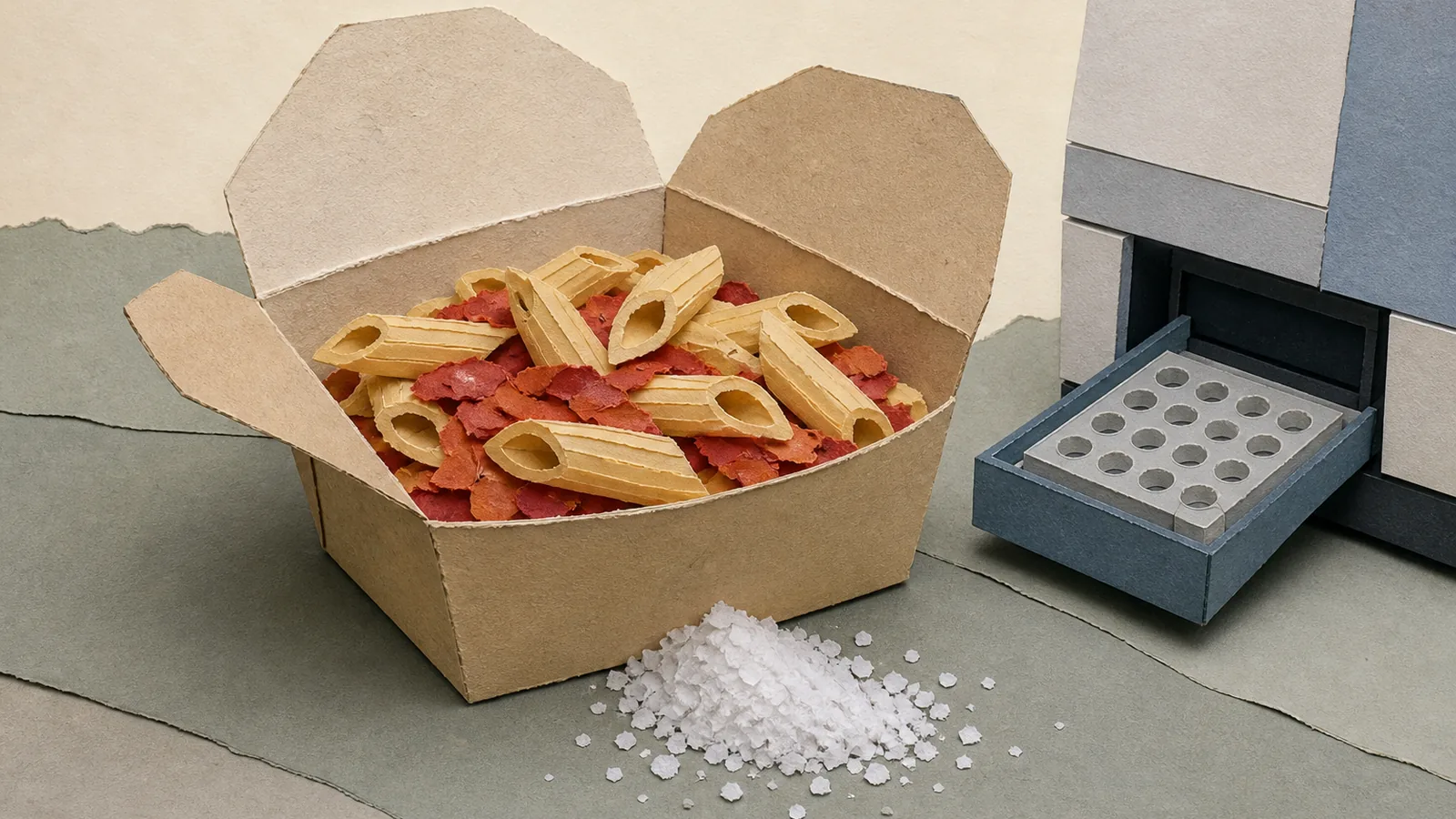
I have a small, slightly embarrassing habit: when a menu lists the salt in a dish, I believe it. So here is the finding that made me put my fork down. Chemists at the University of Reading took 39 real takeaway dishes into a lab, measured the sodium directly, and found that of the ones carrying a salt figure, almost half held more salt than they declared. One pasta dish had 11.2 grams in a single serving. That is nearly two full days of salt in a bowl the app had filed under “the lighter choice.”
The method is why I trust the finding, so let me walk you through it. Three chemists bought 39 dishes from 23 takeaway outlets around Reading in the summer of 2022, chains and independents both. Then they did the thing a menu app can never do: they took the food back to a lab and destroyed it to find out what was actually in it. The technique is inductively coupled plasma mass spectrometry, which vaporizes a sample in an argon plasma hotter than the surface of the sun and counts the sodium directly, three replicate samples per dish. This is not a survey of what kitchens claim. It is lab-measured sodium in the servings they bought.
And the measured sodium did not match the menu. Only 17 of the dishes carried usable nutrition information in the first place, which is its own quiet scandal, and of those, close to half ran higher than their labels admitted. “It’s virtually impossible to know exactly how much salt is being added to your dinner,” said Professor Gunter Kuhnle, who led the work. The team went in suspecting the labels were unreliable. The plasma torch agreed with them.
The category breakdown is where it got strange. Pasta dishes averaged 7.2 grams of salt per serving, and one hit 11.2. Curries swung wildly, from a reasonable 2.3 grams all the way up to 9.4. And the biggest surprise, the villain I had wrongly cast: chip-shop chips were the lowest-salt thing in the whole lineup, around 0.2 grams a serving, because the salt goes on by hand after the fryer, only if you ask. The food I had mentally labeled the guilty pleasure was the clean one.
So why does a hidden gram of salt matter beyond bruised trust in an app? Because of what sodium does once it is inside you, and the mechanism is more physical than most people picture. Sodium is an osmotic magnet. When it pours into your bloodstream, water follows it out of your tissues to keep the concentration balanced, and that extra water swells the volume inside your blood vessels. More fluid in the same pipes means more pressure against the walls. Do it once and your kidneys flush the excess overnight and you are fine. Do it three nights a week for twenty years and the vessels stiffen, the kidneys strain, and the pressure stops coming back down on its own. The World Health Organization ties excess salt to roughly 1.8 million deaths a year worldwide, nearly all of it through that slow hydraulic drip, not through anything you taste in the moment.
Which is what makes an inaccurate label worse than no label at all. A salt number you know you cannot trust is a nuisance. A salt number you think you are controlling, that is secretly running higher, is a trap, because it spends the exact attention that might otherwise have made you skip the meal. You did the responsible thing. The responsible thing was fiction.
I am not going to oversell 39 dishes from one English town. It is a small, single-location snapshot, not a randomized trial, and a Reading curry in 2022 tells you nothing precise about your local takeaway tonight. But the finding does not need to be big to be damning, because it is not really a claim about one town. It is a claim about how the food is made. A takeaway dish is assembled by hand, batch to batch, by a person with a shaker and no scale, so the “standardized” figure on the menu was never physically achievable. The label describes a recipe. The recipe is not what landed on your plate.
A label only means something if the food is measurably tied to it, and here it plainly is not. So why has nobody closed that gap? Because the tool both the UK and the US reach for is the same one: voluntary targets. Britain has spent years politely asking industry to reformulate, and Action on Salt’s own monitoring found the salt in everyday food barely fell across the prior five years. The FDA is running the identical approach, asking companies to drift sodium down on their own schedule from about 3,400 toward 2,750 milligrams a day, with no requirement to actually get there. “Voluntary” is the word agencies use when they want credit for acting without the friction of enforcing. This study is a receipt for what that buys you: labels that outrun the food, and a public trained to trust them anyway.
I do not think the answer is lying awake counting milligrams, because that way lies a joyless relationship with dinner, and the chip finding is a lovely reminder that the obvious villain is not always the guilty one. But I have changed one thing, and it is small and concrete. I have stopped reading the salt number on a takeaway menu as measurement. I read it now the way I read a horoscope: someone wrote it down, it is not entirely random, and it is absolutely not fact. So I will keep ordering the occasional takeaway, and I will keep asking for the chips with the salt on the side, because that portion, at least, is one I actually control.
Sources
- PLOS One – Variability in the sodium content of takeaway foods (Reading, 2026)
- University of Reading – “Takeaways have more salt than labels claim” (2026)
- ScienceDaily – “Takeaway meals contain more salt than advertised, study finds” (2026)
- FDA – Sodium Reduction in the Food Supply (voluntary targets)
- Action on Salt – UK Salt Reduction Timeline