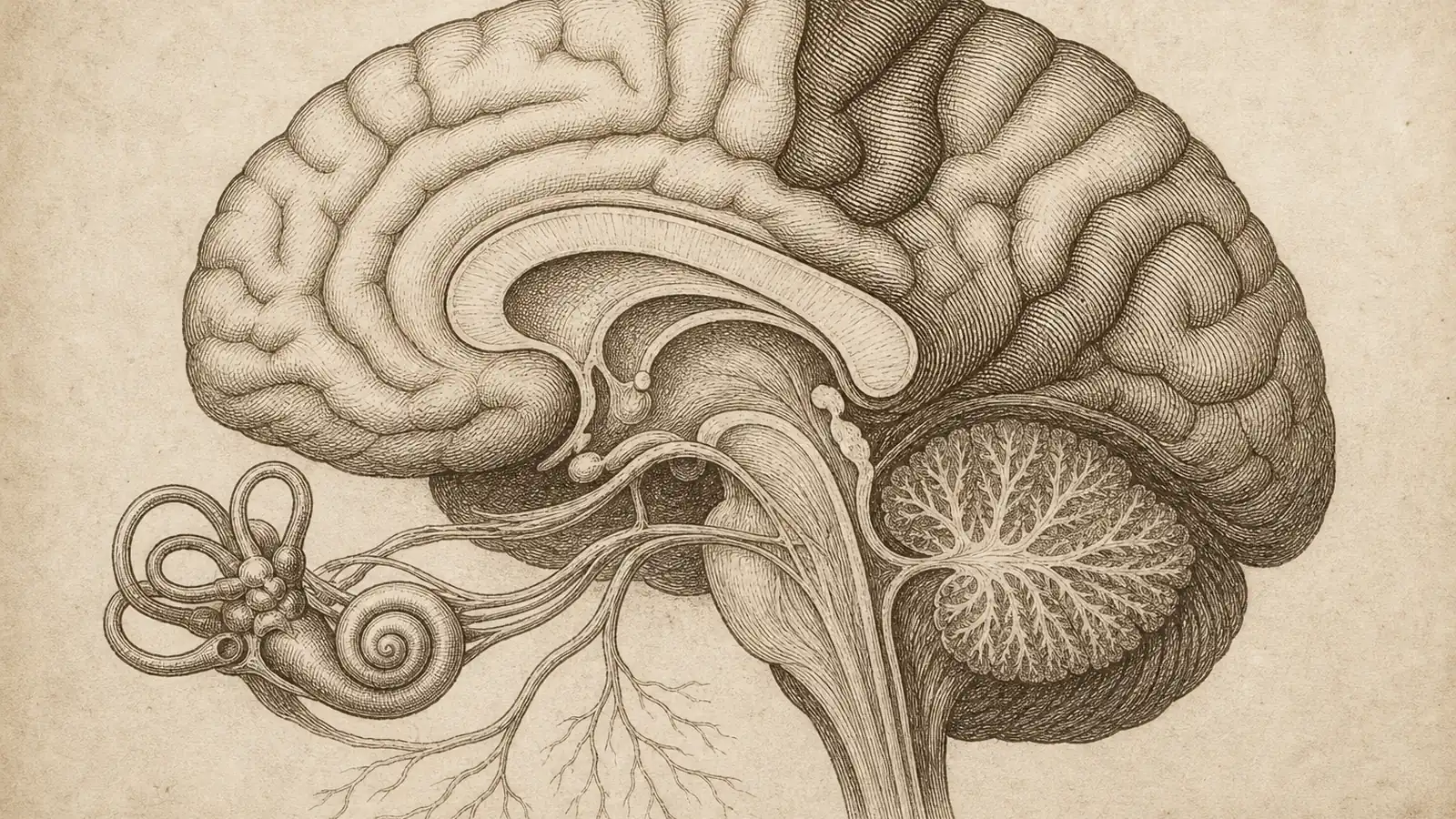
Here is something I assumed was settled, and I was wrong about it. When you learn to say a word a new way, the kind of relearning a child does drilling out a lisp or a stroke survivor does clawing speech back, the textbook says your motor cortex carries the load. It plans the lips, the tongue, the jaw. It is the part that moves you, so surely it is the part that learns you.
They were holding the melody the whole time.
A new study says no. The memory lives somewhere else, in the regions that hear and the regions that feel.
If that holds up, it reaches well past the wiring diagram. The headline-grabbing attempts to rebuild lost speech, the brain implants that decode words straight off the motor cortex, lean motor-first, and so does a lot of stroke rehab. The McGill and Yale team behind this work argues that may be aiming at the wrong target, and that the next generation of speech-restoration tools should be built sensory-first instead. Why, in a second, because first you have to see the experiment, which is almost mischievous.
Researchers at McGill University and the Yale School of Medicine piped participants’ own voices back through headphones in real time, but altered, so what you heard yourself say was not quite what you said. Your brain hates that mismatch. It quietly nudges your speech to close the gap, and that nudge is a clean, measurable form of motor learning. You teach yourself a new way to talk without noticing you are doing it. These were healthy adults learning an induced shift in the lab, not patients, which matters for how far you can stretch the result.
Then the clever part. The team used transcranial magnetic stimulation, a noninvasive magnetic pulse that briefly knocks a target region offline, and aimed it at one of three places: the auditory cortex (the superior temporal gyrus, where you process sound), the somatosensory cortex (S1, where you register the feel of your tongue and lips moving), or the motor cortex (M1, the supposed star of the show). A full 24 hours later, they measured how much of the newly learned pattern had stuck.
If the old story were right, hitting the motor cortex should have erased the new pattern. It did not. According to the reported results, disrupting M1 left 24-hour retention intact. Disrupting the auditory cortex impaired it. Disrupting the somatosensory cortex impaired it too. The two sensory regions were holding the memory; the motor region we have credited for decades did not carry this particular one.
“Sensorimotor neuroscience has traditionally focused on frontal motor areas as the principal drivers of movement,” said David Ostry, the McGill psychology professor who led the work. “This study changes that understanding by showing that human speech learning is extensively sensory in nature.” His Yale co-author Nishant Rao put it plainly: the assumption that new speech memories rest “solely” on changes in motor areas does not hold. What counts is what happens in the regions that hear and feel.
I want to sit with the mechanism, because this is what flipped me. When you learn a movement, you are not just learning to fire the right muscles. You are learning to expect the right sensations: how the corrected word should sound coming back at you, how your tongue should feel when it lands in the new position. The study’s logic suggests the brain stores the goal as a sensory target, a prediction of the right sound and the right feel, and the motor system is the thing that chases that target each time you open your mouth. Knock out the target, and the chasing has nothing to aim at. Knock out the chaser, and the target survives just fine, ready to be pursued again tomorrow.
This is not a bolt from the blue, and the honest version says so. Ostry’s lab has been building toward it for years; a 2024 paper in the Journal of Neuroscience from the same group found that consolidating newly learned movements depends on the somatosensory cortex. What is new here is speech specifically, and the causal cleanliness of the TMS approach. Correlation had long shown sensory regions lighting up during speech learning. This study went in and switched them off to see what broke.
So who should care, beyond people who find the brain’s wiring as fun as I do? Anyone counting on brain-computer interfaces to give speech back. The implants now giving a voice to people locked in by paralysis or ALS mostly work by decoding movement commands off the motor cortex and turning them into words, which is a sensible bet if motor cortex is where speech control lives. But if the learning and the memory are sensory, a system that ignores the auditory and somatosensory loops may be building on a shaky floor. The McGill and Yale team’s argument is that speech-restoration tech and stroke rehab should feed the brain the sound and feel of correct speech, not only read out motor intent. For someone relearning to talk after a stroke, that design choice is not academic.
Enthusiasm is no excuse for skipping the limits. TMS is a blunt instrument: it knocks a region offline briefly and imprecisely, and “this region is necessary for retention” is a weaker, different claim than “we know exactly what this region computes.” The public write-ups reported the direction of the effect but not its magnitude, and human TMS studies tend to run small, so I would want to see the size of these retention deficits and an independent replication before I call the textbook officially rewritten. On the money trail, it was funded by the U.S. National Institute on Deafness and Other Communication Disorders, public dollars, no industry sponsor in sight, which is the kind of disclosure I like to see on a finding this consequential.
Here is what I make of it. The direction of this result convinces me more than its precise size does, and the direction is what should make BCI builders nervous and stroke clinicians curious. We spent decades treating speech as a motor problem with a sensory accompaniment. This flips the billing. The sound in your ears and the feel in your mouth were never the backup singers. They were holding the melody the whole time.
Sources
- PNAS – Rao, Gendron, Manning, Ostry, “Sensory basis of speech motor learning and memory” (2026)
- McGill University Newsroom – findings challenge assumptions about how we learn and regain speech (2026)
- Neuroscience News – speech memories depend on sensation and sound over motor control (2026)
- ScienceDaily – new brain study on how speech learning works (2026)
- Journal of Neuroscience – Ostry lab, consolidation of newly learned movements depends on the somatosensory cortex (2024)