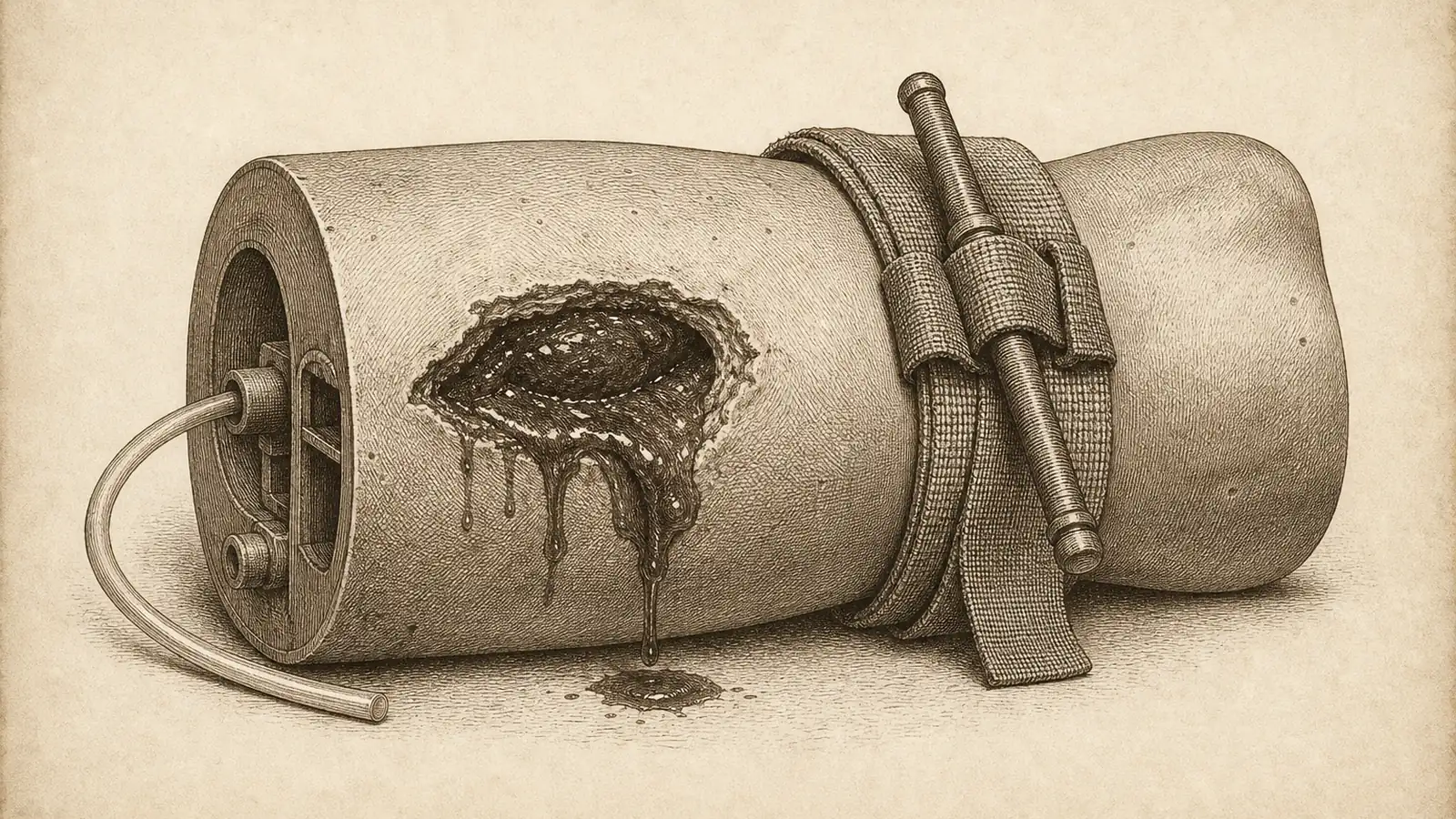
The thing that made hemorrhage stop killing soldiers was not a drug. It was a tourniquet, a checklist, and a lot of repetition against wounds that bled the way real wounds bleed.
In 2012, a team led by Brian Eastridge at the U.S. Army Institute of Surgical Research published the autopsy data on 4,596 American combat deaths from Iraq and Afghanistan between 2001 and 2011. Roughly a quarter of them were potentially survivable. Of those, more than 90 percent bled out, most before they ever reached a forward surgical team. The doctrine that would have saved many of them, Tactical Combat Casualty Care, had been written down in that same journal twenty years earlier by Frank Butler and the special-operations medical community, but it had not yet made the leap from the SEALs and the 75th Ranger Regiment to the rest of the force. The 2012 paper is what made the rest of the military stop arguing. Tourniquets went to every infantryman. Hemostatic dressings followed. Butler’s twenty-year retrospective in 2017 called the resulting drop in preventable combat death unprecedented in American military medicine, and it was.
TCCC was never really about the gear. The gear was easy. The discipline was harder, because keeping a junior medic’s hands steady when an arm has been blown off and the blood is coming faster than the body can replace it is not something you train into someone by handing them a checklist. The Defense Department’s answer was to make the practice look and feel like the thing. Which is where Katie Upton comes in.
Upton is a final-year student in Southampton Solent University’s BA program in Prosthetics and Special Effects Design, and she is graduating with two jobs already lined up. One is with the ambulance service. The other is at a British military training base in Cambridge, where she will sculpt the wounds recruits practice against. She works alongside amputee actors on those training grounds, fitting silicone limbs that end the way an IED actually ends a limb. “We create fake limbs,” she told News-Medical. “If someone’s whole arm is supposed to be cut off, we make their whole arm. We make the end of it look like it’s been torn apart.” She contacted roughly 50 different studios cold to land her first work experience. It is a small craft world.
What she does is moulage, one of the oldest tools in medical education (wax-and-pigment anatomical models date to the Renaissance) and one of the most cost-effective tools in modern simulation. The educational literature backs the intuition that realism changes outcomes. In a 2024 trauma-education study by Varghese and colleagues in Cureus, 89 percent of trainees rated indigenously prepared low-cost moulage as effectively providing high fidelity, and 95 percent said it would translate into their clinical practice. The StatPearls reference on moulage summarizes the comparative literature the same way: moulage versus no-moulage scenarios show improved learner performance and deeper immersion, and trainees engage their critical thinking earlier because the situation feels urgent. Without it, the learner is treating a mannequin with a sticker that reads “wound.” With it, the body in front of them looks the part.
By the time a TCCC-trained medic gets to a battlefield casualty, they have rehearsed the protocols against bleeding mannequins in chaotic scenarios where the wounds drip, the casualty screams, the light is wrong, and nothing pauses for them. The cognitive groove is already cut. That is deliberate.
The British military and the NHS are hiring a 22-year-old art-school graduate because realism has become part of trauma infrastructure. The labs and the AR headsets and the haptic-feedback mannequins matter at the margins. What bends the survival curve is whether the wound the trainee is treating looks, drips, and behaves like a wound. Building that turns out to be a craft. It cannot be automated, it cannot really be outsourced overseas, and the British military is not going to build it in-house because there is no military-medical pipeline for sculptors and special-effects designers. So they go to Solent.
This is the kind of public-health win the apparatus rarely manages, small and specific and craft-based. It did not come from a vaccine campaign or a regulatory framework or a billion-dollar surveillance program. It came from a generation of American trauma surgeons reading the autopsy data, a guidelines body willing to update its recommendations as the field learned, and a training apparatus willing to spend money on the unglamorous end of the discipline. Hemorrhage is also the leading cause of preventable death in civilian trauma, whether the cause is a gunshot wound, a motor vehicle collision, or an industrial accident. The lessons learned in Helmand and Anbar are why the Stop the Bleed campaign now puts tourniquets in airports, schools, and a growing share of trauma centers across the United States.
What to watch is whether the civilian systems running on those lessons keep funding the realism. NHS England’s major trauma networks, which Upton lists among her clients, draw on the same broad simulation logic the U.S. military exported through TCCC. If hospital budget cycles squeeze the moulage line item, and they always squeeze the unglamorous stuff first, the curve that took twenty years to bend will start to soften. Skills go where they are practiced. Practice goes where the wound looks the part.
The fake wounds aren’t the side show. They are the show.
Sources
- Eastridge et al., “Death on the Battlefield (2001–2011) and Implications for the Future of Combat Casualty Care” – Journal of Trauma and Acute Care Surgery (PubMed)
- Butler, “Two Decades of Saving Lives on the Battlefield: Tactical Combat Casualty Care Turns 20” – Military Medicine, 2017
- Varghese et al., “High-Fidelity, Indigenously Prepared, Low-Cost Moulage as a Valid Simulation Tool to Improve Trauma Education” – Cureus, 2024 (PMC)
- StatPearls – Moulage in Medical Simulation (NCBI Bookshelf)
- News-Medical – “Solent student masters the art of fake wounds to create life-saving simulations for the military and NHS”