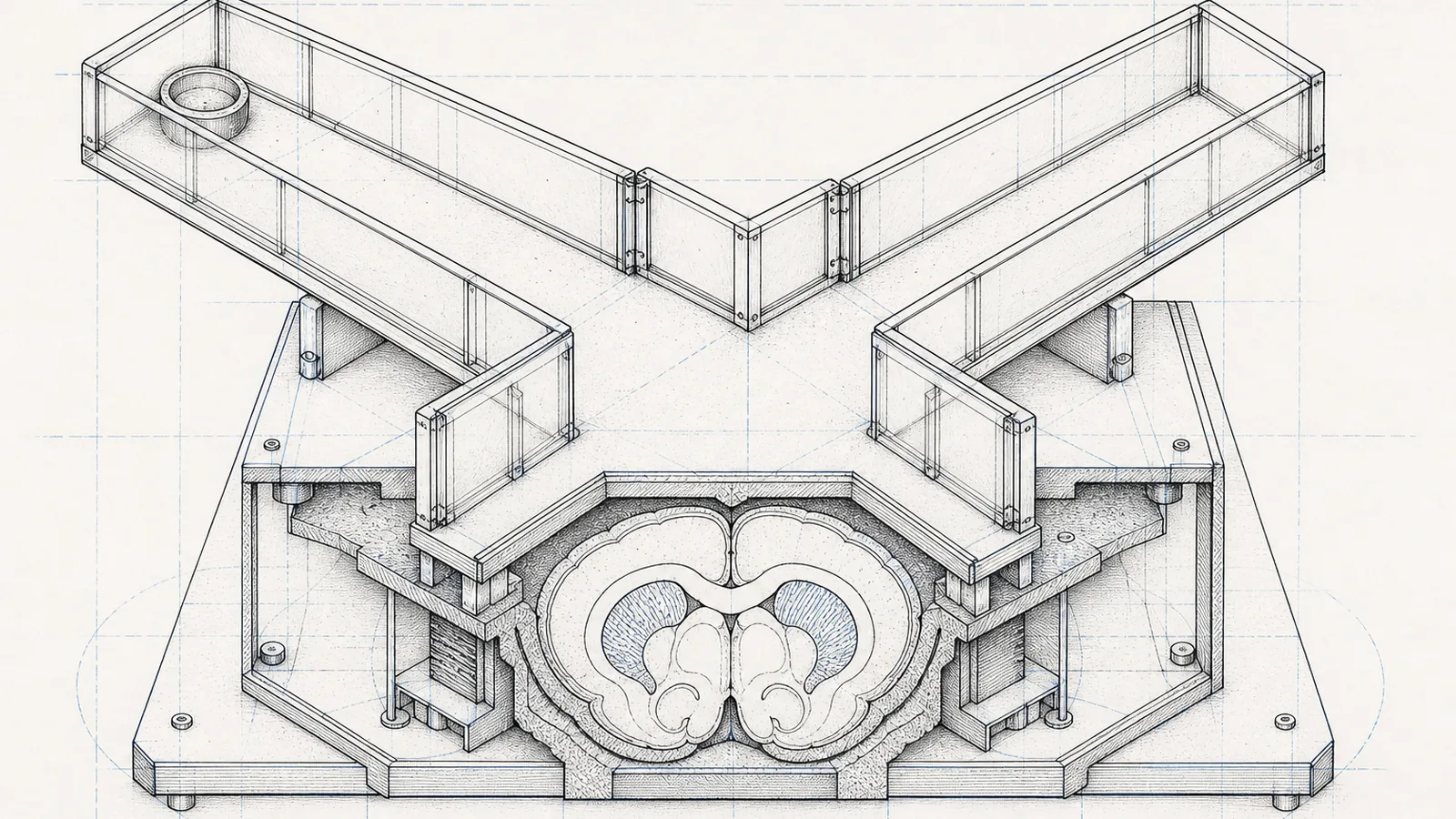
The mouse runs the arm it has learned. The reward lands, the way it has for days, and the sensor watching the dorsal striatum picks up a brief dip in acetylcholine, the brain confirming yes, this is still the thing. Then the lab quietly reverses the maze. The next time the mouse runs the familiar arm, the food doesn’t come. And in that small beat of mouse disappointment, the acetylcholine signal doesn’t just stay flat. It surges. The bigger the surge, the more likely the mouse is to break pattern on the next trial and try the other arm.
The signal the brain uses to break a habit isn’t the reward. It’s the letdown.
I would have moved past this as another tidy neuroscience result if it hadn’t collided with something already open in another tab: the Anticholinergic Cognitive Burden scale, the running clinical list of drugs that block exactly this neurotransmitter at exactly these receptors. By published estimates, close to half of community-dwelling adults over sixty-five are on at least one drug with measurable anticholinergic activity at any given time, often something they bought at the pharmacy counter to sleep.
The paper landed in Nature Communications on December 17, 2025, under the workmanlike title Spatially heterogeneous acetylcholine dynamics in the striatum promote behavioral flexibility. Gideon Sarpong and Jeffery Wickens’s group at the Okinawa Institute of Science and Technology put mice on a spherical treadmill inside a virtual Y-maze, taught them which arm paid out, then reversed it. Eleven mice did the core imaging-and-reversal work. A separate ten-mouse cohort, five and five, did the chemogenetic test that came after.
The imaging tool is the prettier part of the story. iAChSnFR is a genetically encoded fluorescent sensor that lights up in real time when acetylcholine binds to it, built in Loren Looger’s group at the Howard Hughes Medical Institute (Looger is on the paper). Pair it with two-photon microscopy and you can essentially watch the molecule arrive in a working brain. What the team saw wasn’t one uniform pulse. The dorsal striatum is patchy. Some districts burst with acetylcholine when an expected reward failed to land. Others did roughly the opposite, holding a trace of the strategy that just stopped paying. The authors read the pattern as a spatial code: parts of the striatum saying try something else, parts hanging onto the old plan in case it starts working again. And on the trials that did pay out, those produced clean phasic dips, the mirror image of the surprise-fail surge.
To prove the acetylcholine surge was driving the strategy switch and not just along for the ride, the lab ran the clean test. They engineered inhibitory hM4D(Gi) DREADD receptors into the striatal cholinergic interneurons, then dosed five mice with J60 (the high-affinity DREADD agonist that activates those receptors and quiets the cells) and five with vehicle. The lose-shift behavior collapsed. Cohen’s d of −1.77 on the lose-shift measure, 95% CI from −3.27 to −0.26, with the silenced animals stuck running the corridor that no longer paid. The result doesn’t prove acetylcholine alone explains the behavior. It does prove those particular cells are necessary for the switch, and in mouse work an effect that size on a behavioral measure is the molecule earning its keep.
Now the part with the second tab. Diphenhydramine, the active ingredient in Benadryl and most of the over-the-counter sleep aisle, sits at the top of the ACB scale. So does oxybutynin, the dominant overactive-bladder drug. Several tricyclic antidepressants, first-generation antipsychotics, common motion-sickness pills, older Parkinson’s medications, and a long tail of antispasmodics live up there with them. The clinical literature linking cumulative anticholinergic exposure to dementia risk has been building for over a decade. Coupland’s 2019 nested case-control in JAMA Internal Medicine, drawn from British primary-care records, reported a dose-dependent association with later dementia for the most potent classes. Replications since haven’t been kind to the drugs.
The OIST paper does not test any of them. What it offers is a precision the burden literature never had: a fluorescent trace of the very signal these compounds blunt, in the very moment the brain is supposed to be noticing it has been running a stale strategy. The clinical link is still a hypothesis, not a proof. But it is a hypothesis with a circuit picture attached to it now, which is more than it had last year.
The flip side is the one I can’t stop turning over. The mechanism says the way out of a habit loop isn’t to overwrite the reward. It is to let the disappointment register. The mice that flipped strategy fastest were the ones whose brains had the biggest surge when the expectation broke. The drugs on the ACB list act pharmacologically on the receptors that surge is supposed to hit, and the paper now has a fluorescent picture of what’s getting silenced. The broader cultural habit (the drink on the night the routine failed, the scroll on the small mismatch between what was supposed to feel good and what did) is a softer analogy, not pharmacology. But the direction of travel is the same. Turn down the disappointment signal. The OIST result says the disappointment signal is the thing that would have changed the pattern.
What the study can’t do is jump straight to humans. Eleven mice in the imaging core, one reversal each, one circuit. The authors are upfront about it. Session length was capped by photobleaching and laser heating, and they ran a single reversal rather than serial ones to keep from blunting the error response itself. The striatal cholinergic system is deeply conserved across mammals, however, and the clinical handles the authors reach for (addiction, OCD, the cognitive rigidity of Parkinson’s, conditions where cholinergic signaling is already known to be off) are the obvious next places the field will chase. Whether anyone chases the anticholinergic-burden angle with the same energy is a different question. There is no product to launch at the other end.
I went in expecting a clean “scientists find brain chemical” release. I left with a result that quietly reframes one of the most under-discussed problems in late-life prescribing. The signal that breaks a habit is the moment the world disappoints you. A meaningful slice of the older population is on drugs whose mechanism is to fade exactly the receptor that catches that moment. The mice show us, in fluorescence, what the fade looks like inside the circuit. If I had a parent over sixty-five who reached for diphenhydramine on rough nights, I would want them to read this paper before the next round of refills, and I would want their prescriber to read it before the next round of polypharmacy adds the fourth mid-burden script that quietly totals to a strong one.
Sources
- Nature Communications – Sarpong et al., Spatially heterogeneous acetylcholine dynamics in the striatum promote behavioral flexibility (2025)
- JAMA Internal Medicine – Coupland et al., Anticholinergic drug exposure and the risk of dementia: a nested case-control study (2019)
- ScienceDaily – Scientists discover the brain chemical that helps you break bad habits (2026)