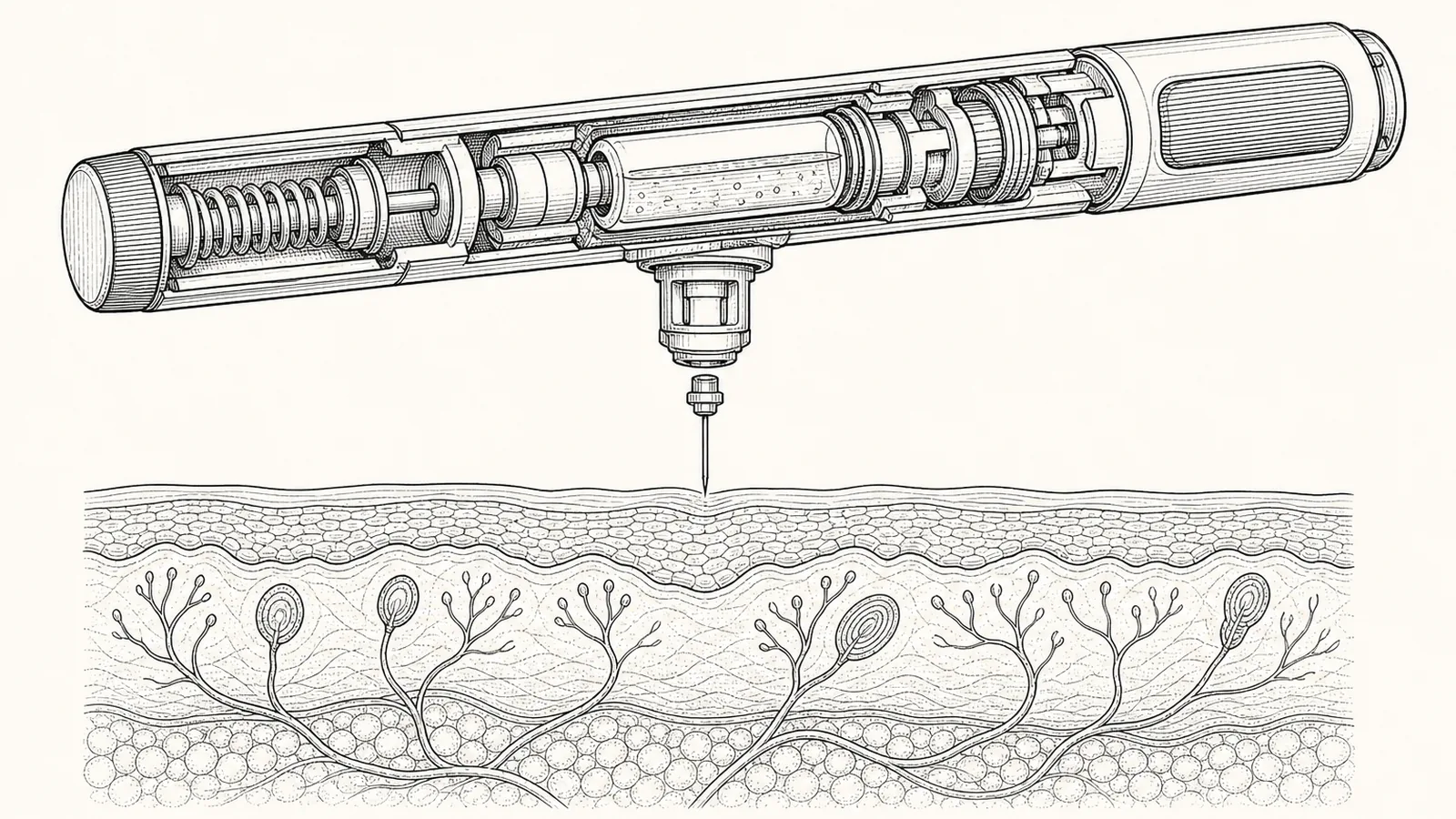
Twenty-eight point three percent body-weight loss in 80 weeks, on the efficacy estimand that assumes patients stayed on the drug (the treatment-regimen figure, counting everyone, is 25 percent). That is the number Eli Lilly walked into the American Diabetes Association meeting in New Orleans with this weekend, courtesy of TRIUMPH-1, the phase 3 trial of its investigational triple-hormone injection retatrutide in adults with obesity and no diabetes. It rivals bariatric surgery. The room cheered. And in the highest-dose arm of a companion trial, TRIUMPH-4, 20.9% of patients reported strange sensations on their skin: tingling that should not be there, patches that did not feel right, burning that nothing was touching. One in five. The drug’s stagiest moment and its weirdest safety signal arrived holding hands, and Lilly’s experts mostly wanted to talk about the first one.
The clinical name is dysesthesia. It means abnormal sensation, and it does not need to mean permanent nerve damage to be the thing on a side-effect form a patient remembers most. The rate climbed with the dose. At the 12 mg arm in TRIUMPH-4 it hit 20.9%; in TRIUMPH-1’s 12 mg arm it was 12.5%. Lilly disclosed it. The conference moved on. That move-on is the part I want to slow down on, because the rest of the data is good enough that the asterisks deserve the same wattage as the headline.
What the third receptor buys you
Semaglutide (Ozempic, Wegovy) is a single-receptor agonist: GLP-1. Tirzepatide (Mounjaro, Zepbound) hits two: GLP-1 and GIP. Retatrutide is a single molecule designed to activate three. The third is glucagon, the hormone your liver leans on to release stored sugar when you have not eaten. Pointing glucagon-receptor activity into a diabetes drug sounds, at first, like the worst idea anyone has had since cigarettes for asthma. The bet is that glucagon-receptor signaling also pushes energy expenditure up a notch in tissues other than the liver, so the body burns a little harder while GLP-1 and GIP take care of appetite and glycemia. The combined effect lands somewhere bariatric surgery used to have to itself.
I came in skeptical that any “third arm” was actually doing the heavy lifting versus already-proven GLP-1/GIP synergy, and what changed my mind is the magnitude itself. Twenty-eight percent over 80 weeks is the kind of number that gets bariatric surgeons drafting career-change emails. Something is adding incremental work, and the third arm is the most plausible candidate.
That same third arm is also the part of this molecule we have the least real-world experience with. Glucagon receptors are not parked solely on hepatocytes. They sit on kidney cells, on pancreatic alpha cells, on neurons. Whether the dysesthesia signal traces to that arm, to the triple-receptor activity as a whole, or to something more mundane is the question nobody on the ADA stage answered. It is the question I would want answered before this drug, if it reaches the market, was prescribed at scale.
The cardiac line item that did not get a press release
TRANSCEND-T2D-1, the phase 3 readout in adults with type 2 diabetes, threw a smaller number into the bundle that has stayed with me. Seven of the 403 participants on retatrutide developed arrhythmias. Three had major cardiovascular complications. The placebo arm: zero on both. Per STAT’s coverage, experts on the panel said the absolute numbers were too small to draw conclusions from. Statistically that framing is fair: a three-versus-zero split in a few hundred patients can absolutely be noise.
It can also be the early shadow of a signal, and the difference between “noise” and “shadow” is exactly what late-stage safety work exists to nail down. When the side effect is your heart, “we will know more later” lands differently than when the side effect is dry mouth. The number is what it is. The framing it received in New Orleans was lighter than the number deserves.
Pfizer brought a monthly drug, and a quieter long tail
Pfizer used the same meeting to roll out berobenatide, an ultra-long-acting GLP-1 engineered for monthly maintenance dosing. The VESPER-3 trial reported a 12.3% placebo-adjusted weight loss at 28 weeks on the 4.8 mg dose in adults with obesity and no diabetes, with the now-routine GLP-1 nausea and vomiting profile. The pitch writes itself: twelve maintenance shots a year instead of fifty-two. (To get there, patients titrate weekly through week 12 first. The full year is not twelve injections; the steady state is.)
Convenience is a real win for adherence, and I will not be the writer who treats easier dosing as a bug. What I will say is that the convenience headline and the pharmacokinetic reality do not match each other point for point. A drug engineered to dose monthly is, by design, sticking around in tissue longer than its weekly cousins. If a patient develops a new neurological symptom in week three of a monthly cycle, you are not stopping the injection on Tuesday and seeing it clear by Friday. With weekly semaglutide the elimination tail is on the order of a week per dose. With an agent built for monthly intervals, the exposure tail is, by intent, longer. That tail is fine when nothing goes wrong. It is the thing you wish someone had thought harder about when something does.
So what do I make of this?
The weight-loss numbers replicate across two TRIUMPH trials and track with what TRANSCEND-T2D-1 already saw in type 2 diabetes. The knee-osteoarthritis pain reductions and the sleep-apnea event-rate improvements Lilly walked through are the kind of comorbidity-collapse readouts you only see when something is hitting metabolic disease at the root. For patients with severe obesity, joint pain that costs them mobility, and obstructive sleep apnea that costs them sleep and cardiovascular margin, a drug like retatrutide, if and when it reaches them, is going to change lives.
Which is precisely why the asterisks cannot be rounded down. We have run this play before. Vioxx posted blockbuster pain numbers and a quietly elevated cardiovascular signal that took years and tens of thousands of excess events to land as a withdrawal. Fen-phen sold easy weight loss while heart-valve damage accumulated in cardiologists’ offices below the marketing line. The lesson in both was not that the efficacy was fake. The lesson was that low-frequency harm in a drug taken by tens of millions of people, for years, costs more in aggregate than the conference applause suggests. The companies sponsoring these trials would prefer the asterisks rounded to zero. The ADA stage is not a neutral venue for that math; it is the same hotel ballroom where the sponsors paid for the coffee.
If a friend told me they had enrolled in a retatrutide trial tomorrow, I would not talk them out of it. I would tell them what dysesthesia actually feels like, ask them to call their study team the first time any of it showed up rather than convince themselves it was nothing, and watch the long-term cardiac data the way you watch a tide line. The triple-hormone bet looks like good biology. It is also a bet whose third chip we have only just put on the table, and the room cheering loudest is the room that placed it.
Sources
- Eli Lilly – TRIUMPH-1 and TRANSCEND-T2D-1 Phase 3 trial results press release (2026)
- STAT News – Lilly shares safety and tolerability data on retatrutide at ADA 2026 (2026)
- STAT News – Triple hormone receptors, a monthly obesity drug, and a bittersweet ending: ADA in 30 (2026)
- Pfizer – Berobenatide VESPER Phase 2b results press release (2026)
- BioSpace – Lilly and Novo face off at ADA 2026 as others seek to compete in obesity (2026)
- American Diabetes Association – Ultra-long-acting injectable GLP-1 RA shows promise for weight management (2026)