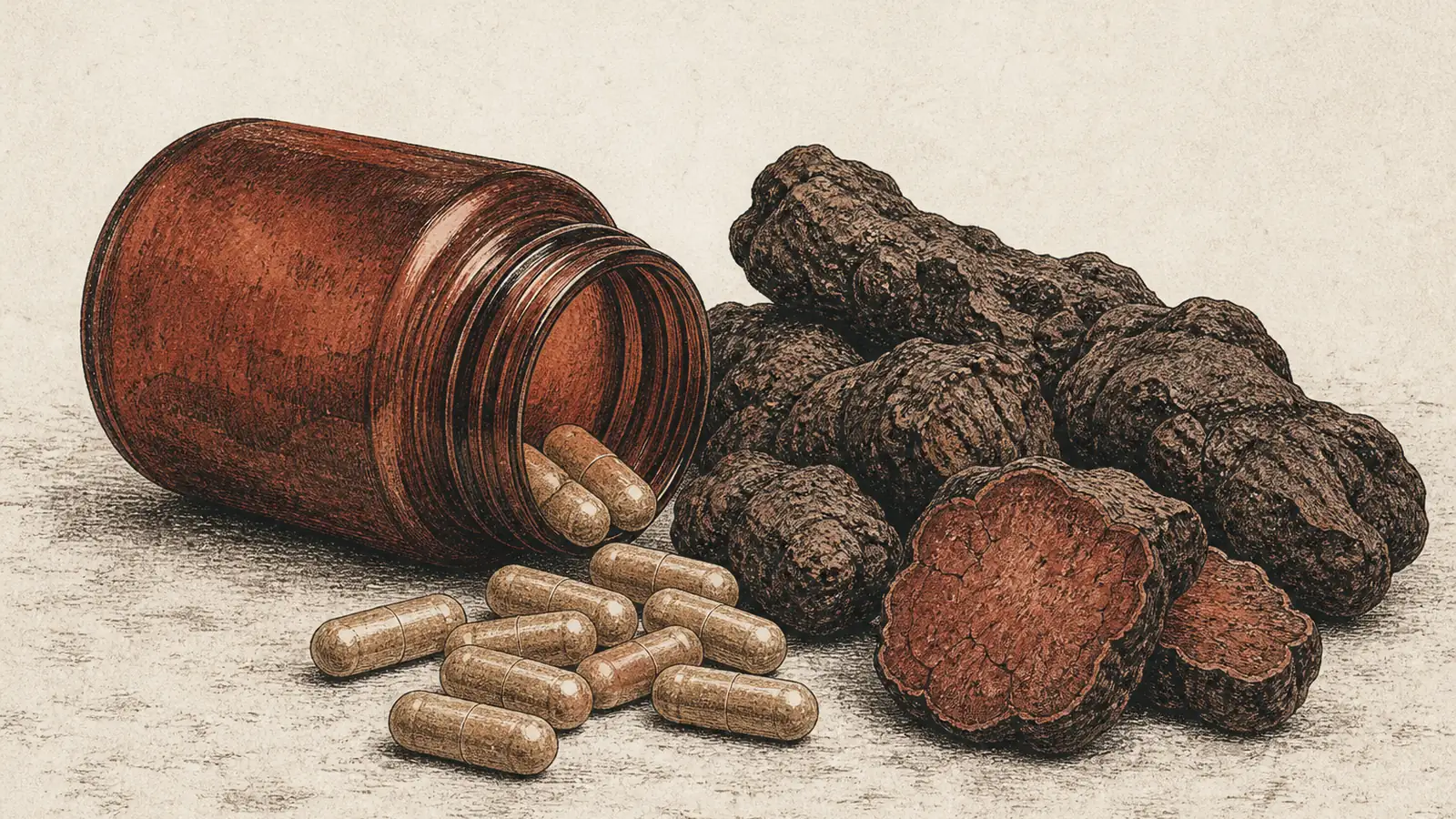
A new pharmacology review pitches Polygonum multiflorum, the climbing root sold as He Shou Wu in Chinese herb shops and as fo-ti in American supplement aisles, as a plausible answer to pattern hair loss. The biology in the paper is more coherent than I expected. The liver-injury file underneath it is worse than the press release admits. And the chemistry doing the interesting work in a follicle dish is plausibly the same chemistry lighting up a stressed hepatocyte in a person who happens to be vulnerable. That is the trade you are being offered, and almost nobody selling the jar tells you it is the trade.
Start with the part that actually surprised me. Han Bixian and colleagues, writing in the Journal of Holistic Integrative Pharmacy out of Guangdong Pharmaceutical University, link the root’s two best-studied chemical components, emodin and tetrahydroxystilbene-glucopyranoside, to mechanisms we already know move androgenetic alopecia: dihydrotestosterone-pathway interference (finasteride’s lane), activation of Wnt and Sonic-hedgehog circuits that wake dormant follicles, keratinocyte rescue from premature apoptosis, and scalp microcirculation, which is part of how minoxidil seems to work in the first place. Nothing in the chain is qi-and-vibes. The pieces are pointed at the right targets. Whether they hit hard enough to grow a measurable hairline in an actual human is a separate, unanswered question.
Then comes the dark side of the file, and it is much fatter than the hair-growth side.
The U.S. National Institutes of Health’s LiverTox monograph catalogues acute liver injury attributed to Polygonum multiflorum on four continents going back to 1996. A 2007–2009 Korean series at a single hospital ran 25 patients with ALT readings between 271 and 1,706 U/L. A separate Chinese referral-center series pushed individual ALT readings as high as 4,095 U/L. A large Chinese drug-induced-liver-injury cohort pinned 145 of 5,703 cases on the root. Reports from Japan, Hong Kong, Australia, Britain, and Italy line up with the same hepatocellular pattern. Onset is sneaky: most cases turn up weeks in, but LiverTox documents windows as short as a few days and as long as six months, with one hospitalized series stretching from 4 to 300 days after first exposure. And in the clinically apparent cases, the ones bad enough to put someone in a hospital bed, a working figure of around 10 percent ended in death or urgent liver transplant. That number does not describe every supplement user. Most people who take this root never come to clinical attention, and nobody can tell you the absolute risk to a casual buyer. What it does tell you is the tail.
Idiosyncratic is the word the toxicology literature uses, and it is the word that should keep you up. Cases turn up at ordinary doses and at doses below the labeled one, no pre-treatment liver panel reliably picks out who will react, and the only consistent risk-amplifiers are cumulative exposure and longer duration. There is no dose anyone can hand you and call safe. The two prime suspect compounds, emodin (an anthraquinone) and tetrahydroxystilbene-glucopyranoside (the stilbene glycoside the Chinese pharmacopeia treats as the active marker), are exactly the molecules the new review credits with hair-growth effects. The chemistry pulling pattern-baldness mechanisms in a dish is the chemistry firing hepatocyte stress responses in a person. Buying a “premium processed” jar is not a guarantee around this either. Some animal work suggests certain preparations carry lower toxicity, but the case reports kept arriving from prepared, marketed product.
To Han Bixian and colleagues’ credit, the review does not oversell itself. They write plainly that “stronger clinical evidence is still needed” and that current support is “primarily laboratory studies and limited clinical observations.” That is honest. The same review also discloses, in the small print of its competing-interests statement, that one coauthor is employed at Hubei Herui Shengye Management Co., Ltd, a herbal-medicine business. Worth flagging, when a Chinese-medicine pharmacology review is making a case for a Chinese medicine.
What is less honest is the press-release ecosystem that took a single narrative review and spun it into a ScienceDaily headline reading like a therapy launch. There is no randomized trial in humans. There is no dose anyone has shown to be both efficacious and safe. There is a mechanistic story and a stack of case reports of liver failure.
Compare that with what does work for androgenetic alopecia, even if you do not love that it is pharma. A 2025 systematic review and meta-analysis in Frontiers in Medicine pooled seven randomized trials of topical minoxidil plus finasteride versus topical minoxidil alone and found the combination did better on hair density, hair diameter, and global photographic assessment. That is pooled RCT data on standardized molecules with known liver and systemic profiles. You can be hard-skeptical of Big Derm and still see the gap between that and what Polygonum can presently offer.
So where does that leave the wellness-curious reader? Not where the press release left them. The interesting thing the Han team did is build a credible bridge between a thousand-year-old prescription and twenty-first-century follicle biology. The plant is doing something. The question is whether the something you want, a thicker hairline, is separable from the something you do not want, an unpredictable hepatocellular event somewhere between week one and month six. On current evidence the answer is no, and the asymmetry is not subtle. Cosmetic upside, hospitalized downside, no rule for which dose is safe, and no pre-test that tells you in advance.
I will watch this space, because if a medicinal-chemistry group can isolate the follicle-active fragments away from the hepatotoxic ones, that is a drug-discovery story worth chasing. Until somebody does that work and runs a randomized trial of a purified, characterized fraction in actual humans, Polygonum multiflorum belongs on the same shelf as kava and comfrey for me: biologically fascinating, historically meaningful, and not something I would put in my own body because a supplement label called it traditional.
Sources
- NIH LiverTox – Polygonum Multiflorum monograph (2020)
- PMC – Polygonum multiflorum-Induced Liver Injury: Clinical Characteristics, Risk Factors, Material Basis, Action Mechanism and Current Challenges (2019)
- ScienceDaily – Ancient Chinese medicine could transform hair loss treatment (2026)
- Frontiers in Medicine – Topical minoxidil plus finasteride vs. minoxidil alone: systematic review and meta-analysis of RCTs (2025)