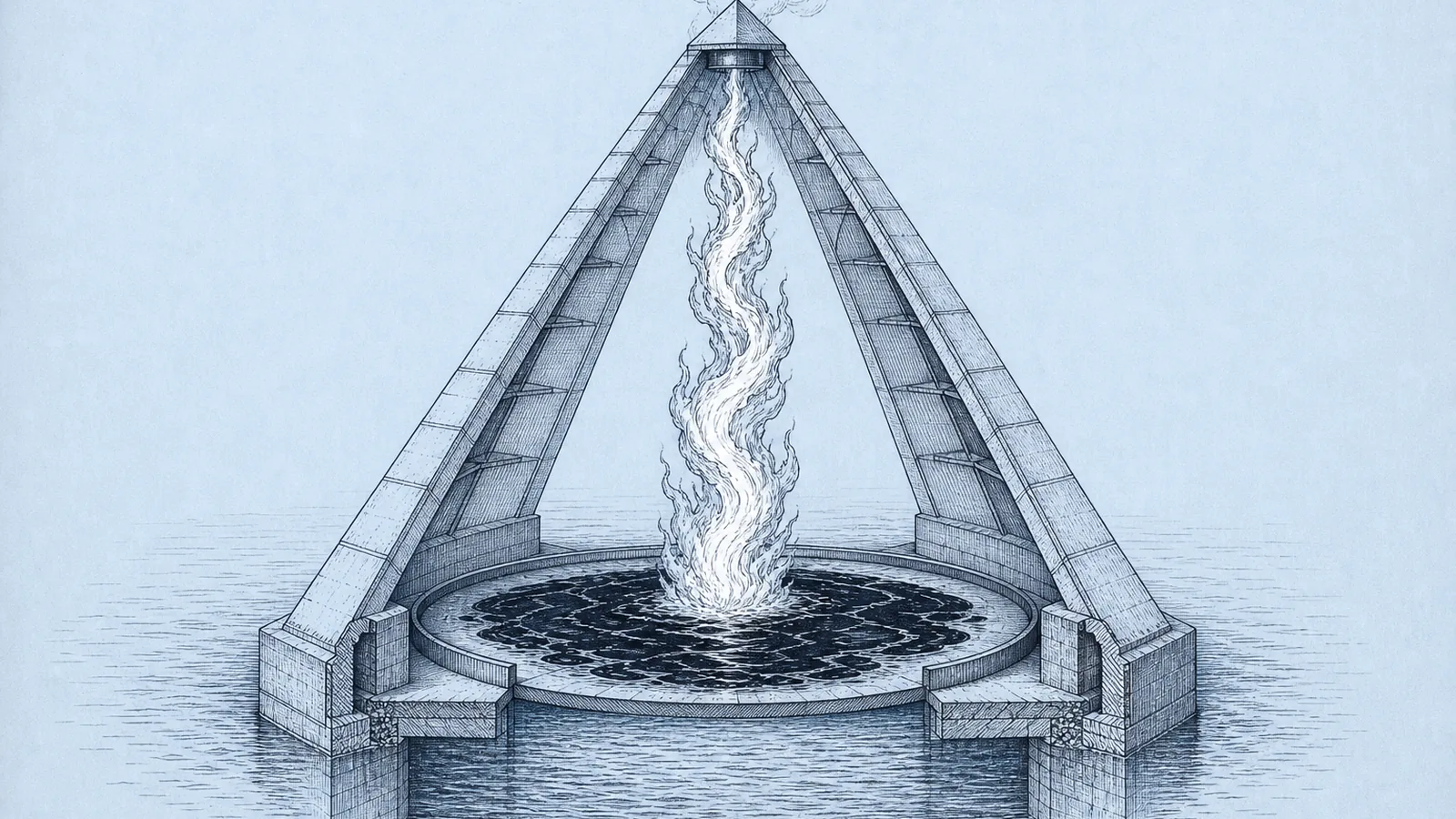
I keep coming back to one image. A team in Texas built a three-walled triangular tower, sixteen feet tall, lit a 1.5-meter pool of crude oil sitting on water, and watched a spinning column of flame climb the whole structure and eat the slick. In their best run, ninety-five percent of the oil burned away. And then the number that pulled me back to reread the paper: forty percent less soot than the standard pool burn, which is the soot that gets breathed by the cleanup crews working downwind.
The post-Deepwater Horizon record on burn smoke is ugly. Modeled air-pollution work from the response found PM2.5 from the burning and flaring operations running well above the federal air-quality standard in the hot zone, with source-worker exposures near the wellhead estimated around 97 micrograms per cubic meter averaged across the two-month flaring period. The follow-up worker study in Environmental Health Perspectives reported lower lung function (reduced FEV1 and FEV1/FVC) in cleanup workers whose modeled PM2.5 exposures were higher, measured one to three years after the spill. The official line for thirty-five years has been that in-situ burning is the least bad option for oil at sea. The science kept telling a more uncomfortable story than the official line allowed.
Then a vortex.
Dr. Elaine Oran at Texas A&M, Dr. Michael Gollner at UC Berkeley, and Dr. Qingsheng Wang ran the trial at the Texas A&M Engineering Extension Service fire training field outside Bryan, Texas, with funding from the Bureau of Safety and Environmental Enforcement, the agency the Interior Department spun up by Secretarial Order after Macondo. The walls were placed with carefully sized gaps so ambient air entered tangentially and forced the rising hot column to spin. Once the whirl forms, the physics changes. A standard pool fire is lazy and sooty, full of cool zones and incomplete combustion. A fire whirl pulls oxygen down into the burn with a fierce centripetal kick, raises flame temperature, and finishes the hydrocarbons more completely. Burning rate climbed about 40 percent, flame heights nearly doubled, and soot dropped 40 percent in the best run. Results were published in Fuel this year (volume 403, article 136093).
Now I have to be honest, because that headline number is from one run. Of the trials the team published, only a single 15-millimeter slick configuration hit 95 percent fuel-consumption efficiency, and other runs extinguished early when ambient gusts disrupted the whirl before it could lock in. The team also has not measured what is happening inside the spinning flame, since Gollner told Eos that probing the flame interior would require a laboratory apparatus that has not yet been built for the question. So we have a beautiful field result and a black box at its heart, which is the kind of evidence pollution-control agencies move slowly on.
Then the ocean. The Texas A&M setup used five-meter walls anchored to a training field. On open water you would need a floating, weather-resilient, three-walled structure that can be towed to a slick, sit on rough seas, and hold its geometry well enough for the whirl to lock in. None of that exists yet. Eos was blunt that walls built too short, or aligned wrong, could actually make air pollution worse than the standard pool fire. The window where the geometry works is narrow, and the ocean is not going to help.
I came in expecting to roll my eyes at another “could revolutionize cleanup” press release. I came out thinking the underlying physics is more interesting, and the public-health case more damning, than either the hype or the skepticism makes room for. The federal cleanup doctrine has been to set the oil on fire and hope the wind blows the smoke offshore, while the burn residue, the heavy tarballs that sink, settles onto whatever seafloor is below. Workers got sick. The agencies wrote it off as the cost of doing business in a deepwater drilling economy. Now a team funded by one of those same agencies has shown, in a field experiment anyone can read in Fuel, that a smarter geometry burns the same crude with 40 percent less soot in its best configuration.
If you want a tell for whether this gets taken seriously, watch BSEE’s grant pipeline, not the next press release. The agency will either fund the open-water engineering program that scales this up, or it will let the result sit in Fuel and move on. The track record on cleanup innovation since 2010 does not earn anyone the benefit of the doubt.
Sources
- Oran et al., Fuel – Large-scale field experiments on enhancing in-situ burning with fire whirls (2025)
- ScienceDaily – Giant fire tornadoes could clean up oil spills faster with less pollution (2026)
- Eos – The Fiery Tornadoes That Could Mop Up Oil Spills (2026)
- Groth et al., PMC/NIEHS – Modeled Air Pollution from In Situ Burning and Flaring Following the Deepwater Horizon Disaster (2022)
- Huynh et al., Environmental Health Perspectives – Fine Particulate Matter and Lung Function among Burning-Exposed Deepwater Horizon Oil Spill Workers (2022)